
July 23, 2026
Hyundai is still barreling towards an EV future, and its Metaplant in Georgia is a testament to that goal.
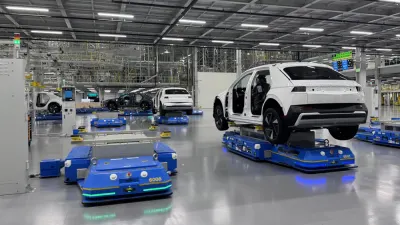
During a recent visit to the Metaplant, I was able to see firsthand how Hyundai is evolving vehicle production, especially EV production. The facility takes cues from the Hyundai Motor Group’s Innovation Center in Singapore (HMGICS), which I visited in 2023. While there are factory lines, vehicles are moved from section to section by robots. Imagine a large Roomba with a vehicle on top, and you get the idea .
The Hyundai Motor Group Metaplant America (HMGMA) in Ellabell, Georgia, has 11 buildings and 7.5 million sq.ft. of space under one roof. For battery supplies, a separate 2.5 million sq. ft. LG facility is currently under construction. In addition to building vehicles and batteries. Hyundai Steel is on site to facilitate the cutting and stamping of the metal needed to build the vehicles.
“In addition to the robotic car sleds that move the vehicles from place to place, the always-sort-of-creepy Hyundai/Boston Dynamics robotic dogs “Spot” were hard at work double-checking the work the humans were doing.”
The facility builds the Ioniq 5 and Ioniq 9, and the Kia Sportage Hybrid has recently started production at the facility as well. Hyundai Motor Group (HMG) says that the facility has the capability of producing up to 10 models, all of them would be electrified in some way.
In addition to the robotic car sleds that move the vehicles from place to place, the always-sort-of-creepy Hyundai/Boston Dynamics robotic dogs “Spot” were hard at work double-checking the work the humans were doing. Hyundai said that it is looking at its Atlas humanoid robots to replace some of the more intense physical tasks that could result in injuries to humans with these robots.
Still, humans are an important part of the mix, with 1,623 people working directly for Hyundai at the time of my visit. When fully staffed, the automaker said it will directly employ closer to 2,600 people and will need more help from suppliers, meaning that around 8,500 total jobs will be needed, according to Hyundai.
Model Review 2025 Hyundai Ioniq 5 Brings All the Right Updates
One item that can’t be performed by robots – yet – is the post-production test drive. Each vehicle produced at the facility is given a quick test by trained drivers, who spot NVH issues and confirm the vehicle’s performance. I was able to drive an Ioniq 9 on the track under the supervision of one of Hyundai’s drivers. We tested the brakes, acceleration, suspension, and the vehicle’s ability to hold itself in place on a steep incline. Any vehicle that doesn’t pass the test is investigated and fixed.
At its peak, Hyundai announced that the Metaplant would eventually produce up to 500,000 vehicles annually. That’s up from an earlier announcement that put the number at 300,000. The automaker wants to do this with 80% of the components sourced from within the U.S. The Metaplant, with its on-campus steel and battery sources, coupled with suppliers popping up locally, can reduce some impacts of the global supply chain.
Hyundai’s electric strategy seems to be paying off with increased sales. As the trend continues, the Metaplant and its employees are ready to build, check and test drive each vehicle using human and robotic dog co-operation.
 Spot robotic dogs double-check the work of humans (Roberto Baldwin) More From SAE Media Group