

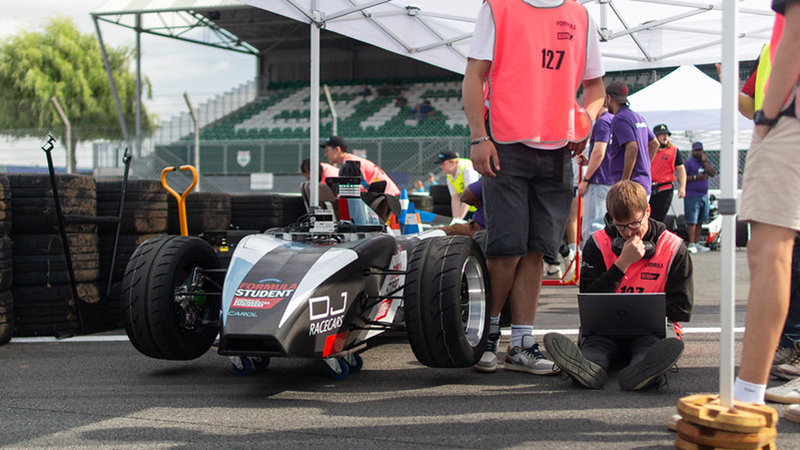
Students work on an FS-AI driverless car at Formula Student
Future leaders of the automotive industry demonstrated their emerging talent with autonomous cars, electric vehicles (EVs) and complex powertrains at last week’s Formula Student competition.
While many teams continued to demonstrate the capabilities of internal combustion powertrains at the IMechE contest, this year’s edition featured more EVs than ever before, occupying roughly two-thirds of the Silverstone paddock. The driverless FS-AI element also grew by 25-30%, according to event chair Andrew Deakin.
A record five teams decided to tackle the complexity of hybrid cars, with one – ECU Racing from Edith Cowan University in Western Australia – crowned overall champions of the event.
Running at the legendary home of the British Grand Prix last week (15-19 July), the competition provided students a first opportunity to flex their engineering skills in a practical setting – and for many, it will offer a springboard to a successful career.
Hybrid approach
The gradual shift from petrol to EV has been one of the dominant trends at the student competition in recent years, bringing new opportunities and challenges.
“The transition of teams from internal combustion to electric has been on such a massive scale,” said Isla Thom, a production engineer at event sponsors Babcock International and a former competitor for the University of Strathclyde. That transition has meant teams have had to develop new skills and utilise advanced techniques, she added.
For teams with hybrid cars, the challenge has been even greater – integrating electric powertrains while also optimising conventional internal combustion. “You increase your complexity by a whole ‘nother powertrain,” said Philip Worung, head of electrical powertrain at winners ECU Racing.
The team, which also clinched first place in 2024, first planned to just make minor changes to a previous car, but as the project developed they decided to make much bigger conceptual changes. Principal amongst these was the introduction of a hybrid system, with two in-hub motors at the front complementing the unsprung solid axle engine in the rear.
Using both approaches introduced twice the potential number of challenges to solve – but, Worung said confidently on Thursday before any track events, “this is one of the fastest cars the team’s ever built.”
Runners up MoRe Modena Racing from the University of Modena and Reggio Emilia in Italy also took on the hybrid challenge. “Every power source – or every component, in general, that you add in a car – is a potential source of problems, and in this case, an internal combustion engine is already complex, per se. So adding another system, which is on the front axle, is maybe adding a degree of complexity,” said Filippo Nuccioni, powertrain division leader.
“But I guess it would be more complex to have the hybrid system on the internal combustion engine, because of the thermal management, because of the coupling between them, vibration and so on and so forth.
“So for sure, it is maybe a very complex architecture, but I guess it’s more reliable with respect to a full electric car, because in case you have any problem with the hybrid system, there is always the internal combustion engine running.”
‘The full experience’
The competition is an “absolutely brilliant” experience for students, said event chair Deakin to Professional Engineering. “Here, you do the drawings and the calculations, and you make it and you test it in real life. And if it breaks, then you learn why it breaks, and go revisit those calculations. What did you get wrong?”
The contest does not just involve classical engineering – successful teams also need excellent project management, including budgeting, organisation and securing sponsors.
“I firmly believe that certainly the team leaders from these teams will have more experience than you’re likely to to get in the first 10 years of an engineering job, where you’re just working on one little bit of a project, designing stuff. You get the full experience… there’s a lot of employers that look on that as a real plus point,” Deakin said.
All of the ECU team wants to work in motorsport, Worung said. “Where we are in Perth, there’s not a very big motorsport scene at all. So to come to the home of motorsport and compete here, that matters a lot.”
Babcock International’s Thom said she “couldn’t imagine” her university experience without Formula Student, or what sort of engineer she would have been if she had not competed. “There were so many skills that I pulled from that, whether it be technical skills, whether it be softer skills, even management skills,” she said. “That meant that I was able to transition and take on work within the different roles that I have been in over the past few years at Babcock.”
She added: “It feels like quite often there’s a bit of a divide between university and industry… being able to have those conversations, whether it be through former students or other outreach, we see the benefit it has.”
Thom’s colleague Daniel Lazarus, a strategic systems engineer, added: “When I left university and went into industry, I felt that Formula Student had given me so many different skills and so much experience… I wanted to still come back and support the event, knowing that the next generation of engineers – but also even marketing and commercial individuals – would have this platform to use as a stepping stone into industry.”
Driverless journey
Formed in 2019, Oxford Brookes Racing Autonomous was overall winner in this year’s FS-AI element. After previously using one of IMechE’s shared FS-AI cars, onto which teams add their own software controls, the team developed and entered its own vehicle.
That choice introduced some new freedom and some challenges, according to autonomous controls lead Timofey Fominov. “It’s a slightly different dimension car – it’s got different steering rates, it’s got different restrictions on it. So when we build internal systems within our software to, for example, have motion prediction to compensate for any delay we might have, we have to have a completely new set of parameters for this new vehicle,” he said. “Otherwise, if we use the data from the standardised vehicle, we would just get incorrect path-following behaviour.”
The car uses a similar perception stack to commercial projects such as Waymo, with visual cameras and Lidar. The data is used in a different way, however. “We use more literature-based control system designs that we validate,” Fominov said.
“Companies like Waymo… have the ability to run thousands upon thousands upon thousands of hours of simulation and real-world testing. So they have more machine learning-based control systems.”
Wider uptake of the competition’s driverless element is a “particularly positive move”, said Lazarus from Babcock, which sponsors FS-AI. “To have the young engineers experiencing… modern technology and innovating with that technology before they even reach industry, means that as the generations move forward, that technology can then be introduced on a wider scale.”
Want the best engineering stories delivered straight to your inbox? The Professional Engineering newsletter gives you vital updates on the most cutting-edge engineering and exciting new job opportunities. To sign up, click here.
Content published by Professional Engineering does not necessarily represent the views of the Institution of Mechanical Engineers.