

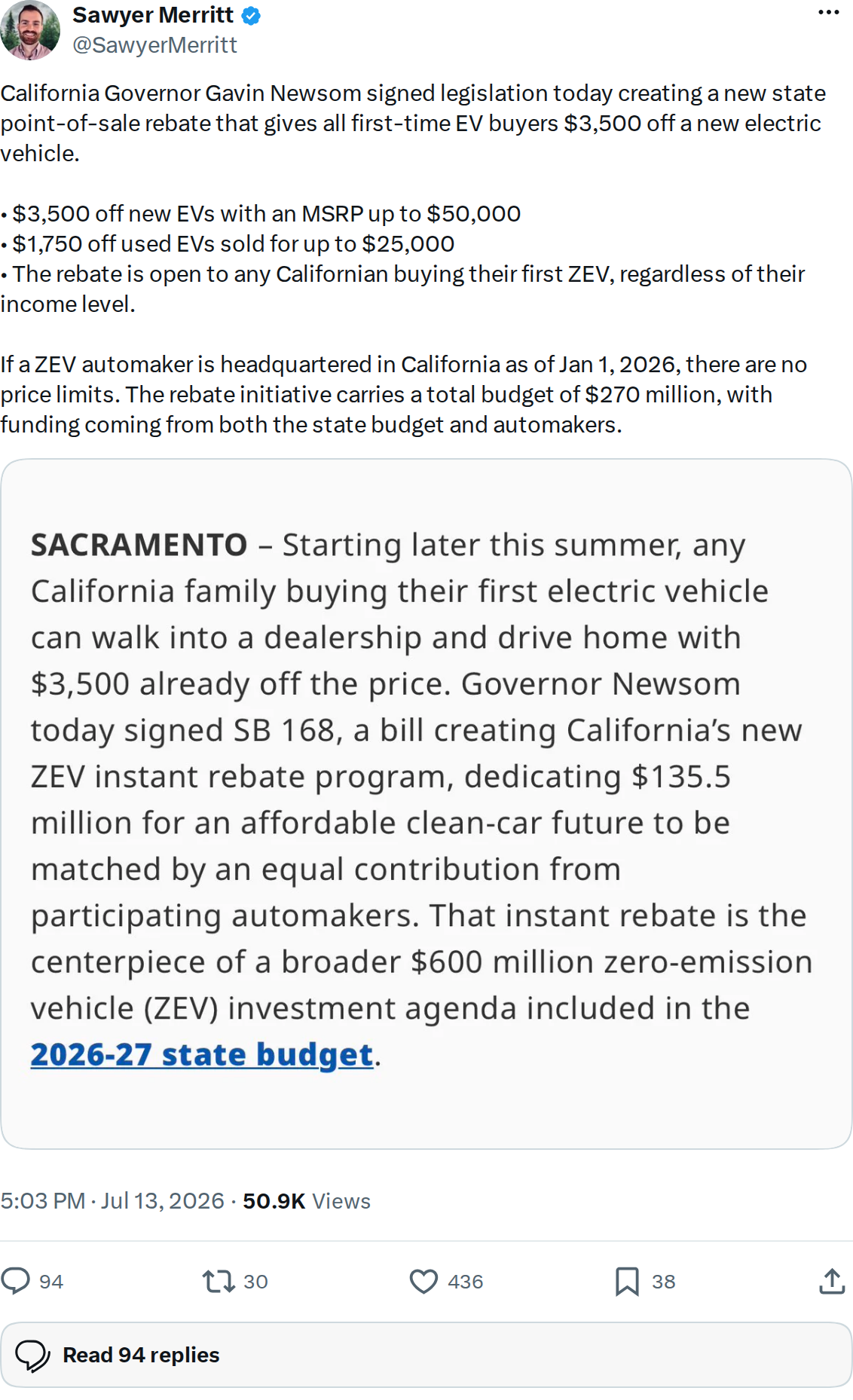
California Governor Gavin Newsom signed Senate Bill 168 on July 13, creating a new point-of-sale EV rebate program that puts up to $3,500 in first-time buyers’ pockets at the dealership. The program sounds straightforward — until you read the fine print. A carve-out for California-headquartered EV makers means Rivian and Lucid vehicles qualify regardless of price, while Tesla, which manufactures hundreds of thousands of vehicles in the state, is subject to a hard $50,000 MSRP ceiling.
 Source: @SawyerMerritt — July 13, 2026
How the Rebate Works
The program, sometimes referred to as “MyFirstEV,” is funded by a $135.5 million state commitment matched dollar-for-dollar by participating automakers, bringing the total budget to $270 million, according to background research from multiple outlets including Forbes and the LA Times. Rebates will be applied instantly at the point of sale — no waiting for a tax credit at filing time — and are expected to become available later this summer as the California Air Resources Board finalizes agreements with dealerships.
The core terms are clean: $3,500 off a new EV with an MSRP at or below $50,000, or $1,750 off a used EV priced at $25,000 or less. Eligibility is limited to California residents buying their first electric vehicle.
Rebate Type
Amount
Price Cap
New EV (first-time buyer)
$3,500
$50,000 MSRP*
Used EV (first-time buyer)
$1,750
$25,000 sale price
*Cap does not apply to California-headquartered automakers that exclusively manufacture zero-emission vehicles.
The Exemption That’s Raising Eyebrows
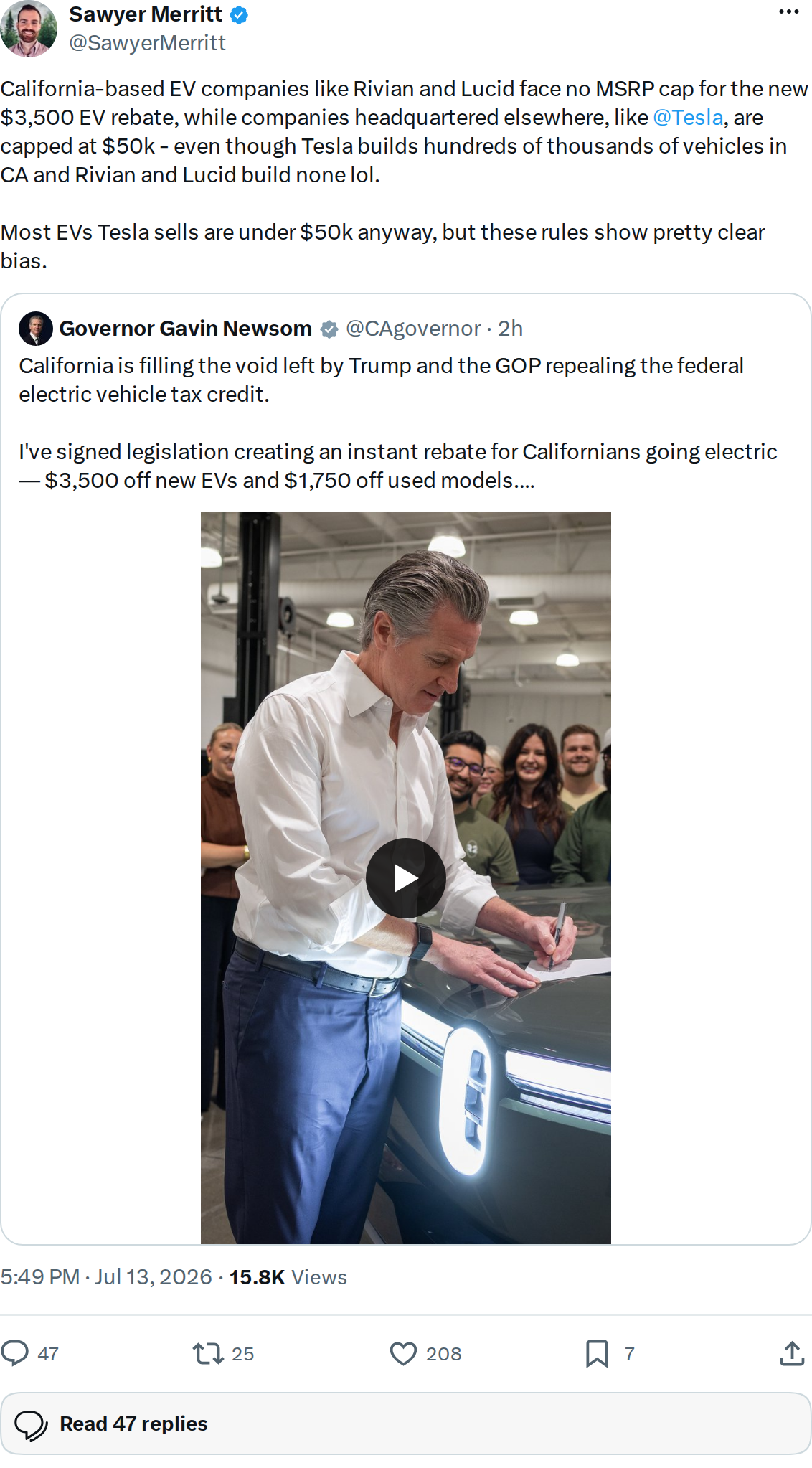
The legislation includes a carve-out for automakers that are both headquartered in California and exclusively manufacture zero-emission vehicles. That language covers Rivian (headquartered in Irvine) and Lucid (based in the San Francisco Bay Area), meaning their vehicles — including models priced well above $50,000 — qualify for the full rebate with no ceiling.
 Source: @SawyerMerritt — July 13, 2026
Tesla does not qualify for the exemption. The company relocated its corporate headquarters from Palo Alto to Austin, Texas in 2021, and that move is now costing its California customers. The irony, as Sawyer Merritt noted on X, is pointed: Tesla operates a massive manufacturing facility in Fremont, California, producing hundreds of thousands of vehicles per year in the state. Rivian and Lucid, by contrast, build none of their vehicles in California — Rivian assembles in Normal, Illinois, and Lucid in Casa Grande, Arizona.
What It Means for Tesla Buyers
The practical impact depends on which Tesla you’re shopping for. Entry-level versions of the Model 3 and Model Y that fall under the $50,000 MSRP threshold are still eligible for the $3,500 rebate — so a significant portion of Tesla’s volume in California is unaffected. Higher-trim variants and vehicles like the Model S, Model X, and Cybertruck, which exceed the cap, receive nothing under this program.
For buyers on the fence between a base Model 3 or Model Y and a higher-spec trim, the rebate structure creates a meaningful pricing cliff. A configuration that crosses $50,000 loses $3,500 in state support overnight — a factor worth weighing carefully when configuring.
Editor’s View
The headquarters-based exemption is a peculiar policy design. Using corporate domicile rather than where vehicles are actually manufactured as the qualifying criterion produces outcomes that are hard to defend on economic or environmental grounds. A Rivian R1S starting above $70,000 can qualify for California’s rebate without restriction, while a Tesla Model Y Long Range built in Fremont hits a wall. Whether the legislature revisits this language — or whether Tesla’s 2021 HQ move proves to have longer policy consequences than anyone anticipated — is a question California’s EV market will be living with for some time.

David Hartley
Contributing Writer — Industry & Markets
David covers the EV industry, regulatory developments, and accessory ecosystem. 15+ years writing about consumer tech. Based in London.
Sources verified at publish time. Spotted an inaccuracy? Email editorial@basenor.com.