

 Tesla sales Tesla delivered over 480,000 vehicles globally in the second quarter, blowing away expectations. What happened?
Tesla’s car business had a rough 2025. Then Q2 happened.
Last quarter, Tesla delivered some 480,000 vehicles worldwide, a 25% jump year-over-year.
Growth in Europe and resilience in China helped the carmaker offset losses in the troubled U.S. market.
After a rocky couple of years, Tesla’s car sales are actually looking… kind of good? Earlier this month, the EV maker said it had delivered just over 480,000 cars worldwide in the second quarter, a 25% year-over-year pop that blew away Wall Street analyst expectations of around 406,000 units. Clearly, I wasn’t the only one who didn’t have this on my bingo card.
It’s the rosiest that Tesla’s car business has looked in recent memory. After moving a record 1.8 million units in 2023, sales dropped for two years straight and saw an especially brutal 2025. Elon Musk’s support of right-wing causes gave the brand a stink. The Cybertruck, its first new model in years, has been a flop. Things were looking bleak. Now Tesla just notched its best second quarter of deliveries in its history. Has it turned the page? It depends where you look.
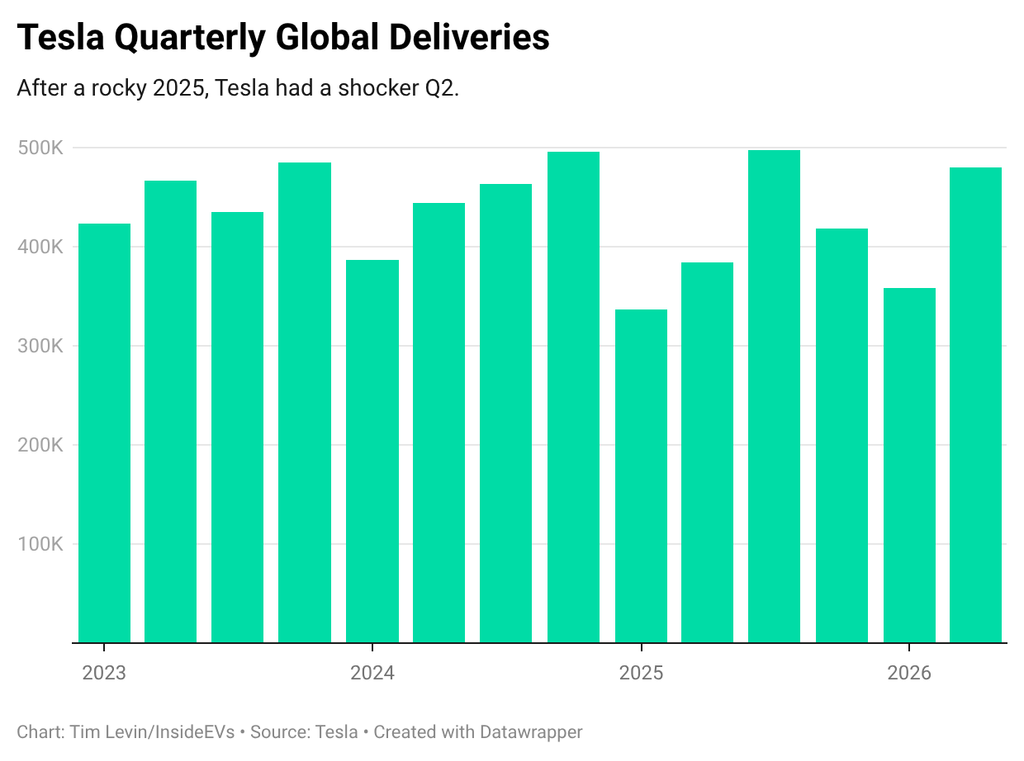 A chart displays Tesla’s quarterly global deliveries from 2023 through Q2 2026
Photo by: InsideEVs
Europe played a big role, with data from the European Automobile Manufacturers’ Association showing that the brand’s sales shot up by 77% from January through May compared to the same period in 2025. (Tesla itself doesn’t break out its delivery numbers by region.)
It may be that the Musk Effect is finally wearing off. Or that cheap lease and financing deals are doing their job. It may also be a matter of a rising tide lifting all boats; plug-in car sales are booming in Europe. So far this year, 2.5 million electric and plug-in hybrid vehicles have been sold on the continent, according to Benchmark Mineral Intelligence, a 27% surge over the first half of 2025. The firm chalks that up to government subsidies and high fuel prices. Gas prices are already higher in Europe than they are in the U.S., and a reliance on imports made the Iran oil crisis hit harder there.
2026 Tesla Model S and Model X
There are a couple of ways to look at this. Sustained, long-term growth in Europe’s EV sector would be a boon for Tesla. But we may be looking at more of a sugar high created by temporarily high gas prices. Analysts aren’t sure if the gains will last for the rest of the year.
“A primary negative interpretation here for us,” analysts at BNP Paribas wrote in a note to clients, “centers on the price of crude oil, which is now back to ~$70/barrel and likely incites ratcheted-down EU-led growth through the 2H.” Then again, with tensions flaring again, it’s not exactly clear how long the conflict will last.
Story Continues
In China, meanwhile, Tesla sales fell by about 2% in the second quarter, marking its fifth straight quarter of declines in the country. Still, the automaker has been performing relatively well in a market with both intense competition and a broader slowdown in car sales, said Phate Zhang, founder of the Chinese EV website CnEVPost.
Model Y L Interior
“Conventional wisdom might suggest that price cuts and new models by domestic competitors could impact Tesla, but experience over the past several years shows that this is not the case,” he said in an email. Homegrown giant BYD posted a 22% drop in domestic sales for June, suggesting that Tesla is managing a fierce sales environment better than some Chinese giants.
Despite the constant march of new and refreshed EV models, he said, the Model Y is still one of the top-selling SUVs in the country regardless of powertrain. (Tesla moved nearly 39,000 units in June alone.) It and the long-wheelbase Model Y L are still usually the first options people consider when they look to buy an electric car, he said.
“That said, Tesla has yet to introduce any new models, and FSD has not yet been fully rolled out in China, making it difficult for the company to achieve significantly higher sales in the country,” he added.
Tesla Model Y L
If a rising tide lifted all boats in Europe, then the opposite is true in the U.S., where things are still not pretty for Tesla or EVs in general. The frenzy to buy EVs before the tax credit ended propelled U.S. EV sales to a record high in Q3 and helped Tesla notch its best quarter ever. Things went downhill from there.
Tesla sold 124,800 cars in the U.S. last quarter, according estimates from Cox Automotive, marking a 13% year-over-year drop. Tesla’s bread-and-butter Model Y held relatively steady, with only a 1.5% drop to 84,863 units. But the Model 3 and Cybertruck, plus the discontinued Model S and Model X, saw larger slides on a percentage basis.
Not great. But Tesla still outperformed the industry, which saw EV sales plunge 20% during Q2 thanks to the tax-credit rug-pull and the demise of other clean-car regulations. The lack of brand-new models—well, ones that people actually want to buy—has spelled trouble for Tesla for a couple of years now. But the company may have its best fix yet.
Read this far? You’ll love Critical Materials
Our weekly newsletter breaks down the biggest EV news every Friday Sign up today!
Tesla just launched the Model Y L to the U.S. market, after debuting it in China last year. The stretched-out Model Y, with a slightly different look and a more usable third row, could get more people in the door, said Ivan Drury, director of insights at Edmunds. Tesla sells a seven-seat version of the regular Model Y, but the way-back is cramped and hard to get to. The L is larger and has second-row captains chairs that should make ingress and egress easier.
“It’s a move in the right direction of trying to give people something new, and a little bit different sheet metal,” he said. In focus groups with car buyers, a couple of things are consistently at the top of the list, he added: If a crossover has two rows, they want three. And if it has three rows, they want more space back there.
Whether that’s enough to reignite Tesla’s growth is another question. The company certainly looks healthier right now than many expected. Yet its comeback still hinges on a narrow lineup, uneven performance across markets, and the hope that a refreshed Model Y can carry the brand until robots and self-driving taxis become a serious part of the business.
After years of bad news, Tesla finally has a credible case that its car business is stabilizing. Now it’s up to the automaker to prove that this wasn’t just a blip, but the beginning of something more.
Contact the author: Tim.Levin@InsideEVs.com
More EV News