

Hindsight is 20/20. It’s tempting to call out Detroit’s automakers for missing the mark by focusing on EV development while ignoring hybrids, even though Toyota had demonstrated for years that US consumers were buying them in big numbers. It might not be fair to single out General Motors, Ford, and to a lesser extent, Stellantis for putting their eggs in the EV basket when Volkswagen and other automakers were heading in a similar direction. Product-development dollars only go so far; trying to spend equal amounts to support all propulsion methods is simply impractical.

2026 Ford F-150 Lariat SuperCrew PowerBoost Hybrid Front 3/4 ViewFord
When Toyota was aggressively pivoting toward EVs several years ago, the automaker was roundly criticized for slow-rolling battery-electric developments. That turned out to be a smart strategy, as other automakers have burned tens of billions of dollars in their EV investments.
But as CarBuzz learned this week, Toyota is now facing unique challenges of its own, including perhaps too many models and too much complexity and build variation. Cox Automotive Executive Analyst Erin Keating responded to our questions with some interesting insights at an automotive trends briefing this week in Dearborn, Michigan.
For Toyota, Too Much Choice Is A Problem

2026 Toyota Highlander driving front 3/4 angle in whiteToyota
Toyota has more than doubled its US product lineup (to 21 nameplates, over the past 30 years), “and so they are struggling with nameplate confusion and crossover between segments,” Keating says, referring to the 2026 RAV4 XSE Hybrid costing $2,200 more than a larger base Highlander.
“They have ridiculous amounts of variance… They’re having to figure out, ‘How do I reduce complexity amongst my trims and my variants?’”
–Cox Automotive Executive Analyst Erin Keating
In some cases, Keating says Toyota has six or nine trims or variants of a single model and needs to get that down to three, “because that will bite them if they aren’t quick enough to solve some of that complexity from a pricing perspective.”
Hybrids Are Finally Primetime Winners
Q2 2026 automotive sales trends as tracked by Cox AutomotiveCox Automotive
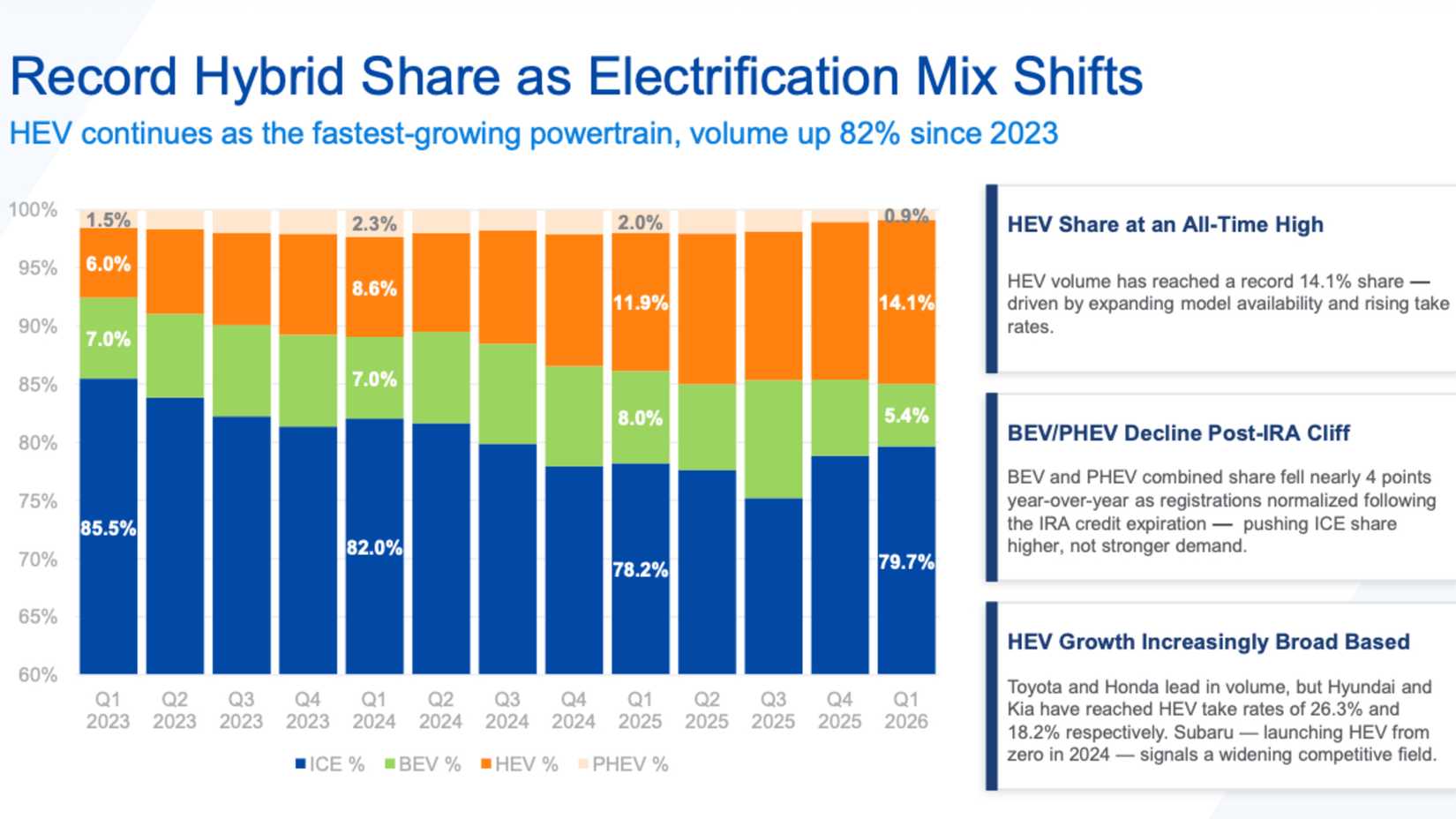
But on the sales front, based on the first half of 2026 as it ends next week, Toyota is surely benefiting as hybrids reach an all-time high for the US with 14.1% market share. Honda, Hyundai, Kia, and Subaru are also cashing in on higher EV sales. Hybrids have become the most important growth story in the market today, and they no longer represent a bridge technology, says Stephanie Valdez Streaty, director of Industry Insights for Cox Automotive.
“There are now 49 HEV models available, up seven since 2023, offered across 12 makes, and eight models are sold exclusively as hybrids,” she says. “Automakers are building real scale into this segment.”

Related
Why Hybrid Skeptics Are Now Quietly Admitting That Toyota Was Right
Hybrids may not have been the temporary middle ground as some analysts predicted. Hybrid skeptics seem to be drawing that same conclusion.
Consumers remain engaged with hybrids, particularly as the war with Iran has spiked fuel prices. In a May survey by Cox, 56% of in-market shoppers said rising gas prices make them more likely to consider a hybrid or plug-in hybrid, which has resulted in “very strong take rates across models like the Toyota Highlander, Honda CR-V, Ford Maverick, Hyundai Santa Fe, and Kia Sportage,” Valdez Streaty says.

Official Giveaway
🔥 Limited Time
Enter The Weekly Giveaway
Win Car Guy Gear
Sign up to our newsletter to enter. Follow on socials for more entries.
New giveaways every 2 weeks
No purchase necessary. Open to US residents 18+. Full giveaway details on the page.
Hybrids Skyrocketing As PHEVs And EVs Slide

Hybrid and EV sales trends for Q2 2026 from Cox AutomotiveCox Automotive
Sales volume for hybrids has skyrocketed 82% since 2023, while BEV and PHEV share declined year over year following the loss of federal tax credits. “The future is still electric, but the path there is more gradual and more segmented than many expected, with hybrids and used EVs playing a critical role in expanding adoption along the way,” Valdez Streaty says. “Success going forward depends on having the right mix.”
CarBuzz Insight – Why This Matters:
Did Detroit miscalculate badly by ignoring hybrids for so long? Wall Street wanted every automaker to be like Tesla, so you can’t blame companies for trying to serve their shareholders. At Ford and GM, the strategic decisions were made by committees after tons of research in a planning cycle that Cox Chief Economist Jeremy Robb says takes at least five years. How long does it take to turn around a freighter in the harbor?

Related
Honda Element Is Coming Back As A Rugged Hybrid Crossover: Report
Honda’s box of awesome could be back by end of decade.
Sure, Toyota is in a different boat, with too many hybrids, rather than not enough. Consumers like choice, but they also don’t like to be confused by too many options, too many trim decisions, or too many comparisons with rival vehicles. While Toyota keeps growing its portfolio, let’s not forget that the Japanese automaker has three new or refreshed EVs also in showrooms – the bZ, bZ Woodland, and C-HR. Having multiple powertrain options forces shoppers to do their homework.
Source: Cox Automotive