
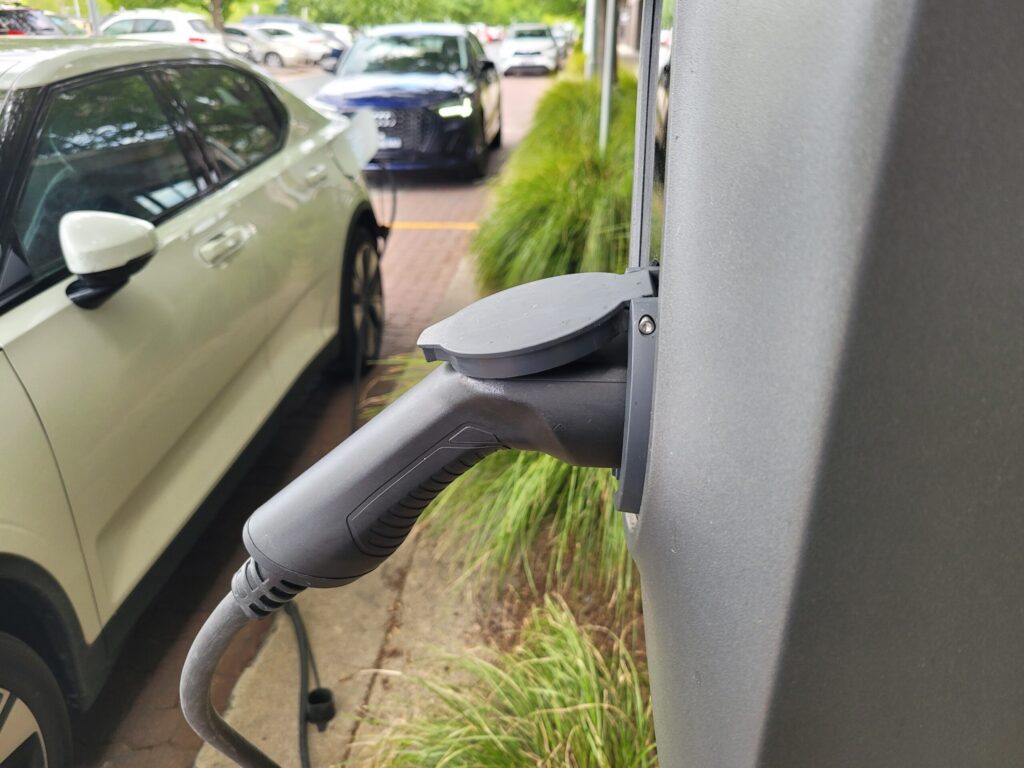
The Australian Energy Market Operator’s (AEMO’s) 2026 Integrated System Plan (ISP) has recognised electric vehicles (EVs) and charging infrastructure as consumer energy resources (CER), alongside rooftop solar and home batteries.
Confirming their role as central to Australia’s future distributed energy system, the ISP forecasts that by 2050 around 80% of vehicles on Australian roads will be electric, and identifies workplace, kerbside, commuter carpark and on-road charging as important components of Australia’s future charging network.
Accelerating toward that estimate, the Electric Vehicle Council (EVC) recently announced the 30,618-battery electric and plug-in hybrid EVs sold in May 2026 represented 29.6% of all new vehicles sold in Australia for that month.
The ISP also forecast road transport electricity demand – primarily through the increase in electric vehicles and trucks on Australian roads will grow from approximately 1 TWh in 2026, or one trillion watt-hours, to 61 TWh, the equivalent electricity to power approximately 90% of Australia’s current households for a year.
Bi-directional charging
It also said more than 10% of household EVs could participate in vehicle-to-grid (V2G) programs by 2050, providing approximately 4.3 GW of flexible capacity and almost 49 GWh of storage to support the electricity system.
EVC Head of Energy, Infrastructure and Commercial Dr Alina Dini said AEMO’s modelling confirms the enormous potential of bidirectional charging.
“Even under more conservative participation assumptions than those considered in the Draft ISP, EVs are still forecast to provide one of Australia’s largest distributed storage resources,” Dini said.
Freight electricity demand
Forecasting approximately half of road transport electricity demand growth to 2050 to come from commercial and freight vehicles, EVC Chief Executive Officer Julie Delvecchio responded by saying one of the most significant findings in the ISP is the scale of future freight electrification.
“Around half of future transport electricity demand is expected to come from commercial and freight vehicles, yet many of the questions around truck charging, depot charging and freight charging corridors remain unresolved,” Delvecchio said.
“As Australia moves toward a more electrified transport future, ensuring we have the right charging infrastructure in the right locations will be just as important as forecasting the electricity demand itself.”
Dini said the next challenge is understanding what charging infrastructure Australia needs to support future demand.
“While the ISP confirms charging infrastructure will be critical, it leaves open the question of how much charging infrastructure Australia will need, where it should be built, how freight charging networks should develop, or how deployment should be prioritised. That’s exactly why Australia needs a coordinated national outlook for charging,” Dini said.