
Main reason for an enthusiast’s publication like Autoweek’s coverage of auto industry sales numbers and statistics is to give you, dear reader, a better idea of whether we are in a buyer’s or seller’s market and to help identify the segments and models where you are most likely to find a good deal. How does it look this year for buying a new car or truck?
Uh, it’s complicated.
We can say for certain that the “K-shaped economy” persists. That means you’re more likely to be in good financial shape for buying a new vehicle in 2026 if you belong to the upper-middle class or richer.
If you are middle- or working class? Not so much. You’re much more likely to be struggling with the burst of inflation triggered by the US-Israeli war on Iran and subsequent Strait of Hormuz blockade.
The national average for a gallon of unleaded regular cost $4.564 Memorial Day weekend (with diesel averaging $5.656), according to AAA, up from $2.98 per gallon February 28, the day the US and Israel began launching missiles on Tehran. Since late May, fuel prices have come down, with unleaded regular at $3.928 on Wednesday.
 Brandon Bell//Getty Images
Fuel prices at an Austin, Texas, gas station this month.
The spike in gas prices appears to have helped the electric vehicle market, according to Cox Automotive, which presented its first-half 2026 review and outlook Wednesday.
Total US auto sales will be 4.16 million for this second quarter, down 0.8% compared with Q2 of 2025, but up 13.9% over Q1 of 2026, Cox Auto says (its projections were made with about a week left in the quarter). That brings first half 2026 sales to 7.82 million, off 3.6% compared to the first half of 2025. Cox Auto is sticking with its initial forecast that the US will buy 15.8 million new vehicles by the end of the year, down 2.9% from 2025.
Fastest growing segment in year-to-date sales is the midsize sport/utility, up nearly 6% year-over-year, according to Cox Auto’s Kelly Blue Book. Midsize trucks and midsize cars also are up, though under 1% each, while full-size trucks are down more than 4%. Slipping further this year are luxury midsize SUVs and full-size SUVs. As if to prove that the middle- and working classes are avoiding the new-vehicle market, compact cars and compact SUVs both are down nearly 8% this year.
Cox Auto forecasts the US will have purchased 244,000 EVs by the end of the quarter, June 30, “down 22% year-over-year but recovering,” according to industry insights director Stephanie Valdez Streaty. New EV sales peaked at 311,022 in the third quarter of 2025 as buyers rushed to take advantage of a $7500-max tax credit before it was eliminated by President Trump’s One Big Beautiful (budget) Bill after September 30. That’s just under 6% EV market share for Q2 of this year compared with nearly 11% market share for Q3 of 2025.
What’s Selling in 2026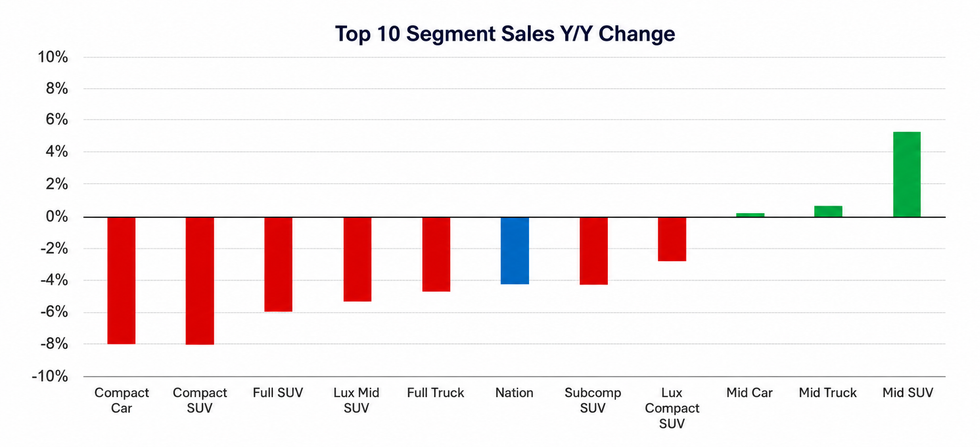 Cox Automotive
Affordable and expensive segments are both down.
The bigger success is in used EVs, with a projected 128,000 sold, highest in the history of electric vehicles and up 28% year-over-year.
Cox Auto (and others) predicted the used EV boom, because the latest brand-new EV boom came as the world was emerging from its COVID pandemic some three years ago. Now a flood of those battery electrics are coming off lease. Used EV values dropped after their Biden-era tax credit disappeared in Q4 of 2025, further pushing their sales.
The average price of a used EV is hardly bargain-lot material, at $37,083, versus $34,856 for the average ICE+ (internal combustion, plus hybrid and plug-in hybrid) in April, and up 3% year over year, according to the first-half report.
The average transaction price (ATP) for a new EV in April was $54,532 in the first half of ’26, versus ATP for ICE+ of $49,015, for a record-low EV premium of just $5517, says Cox Auto.
The combo of ICE+ and EV ATP in May was $49,220, having leveled off from the all-time record of $49,814 last November.
For what it’s worth, new vehicle ATPs have managed to avoid breaching the $50k ceiling so far.
New car and truck prices rose from the low-$40s before the pandemic up into the high $40s as automakers gave premium models priority for computer chips in short supply. The biggest full-line automakers generally managed to maintain net profits even as they moved far fewer units, a paradigm that fits well into the K-shaped economy.
Vehicle Affordability Index Cox Automotive
Weeks of median household income needed to buy a new vehicle (May 2026).
It takes 34.9 weeks of average income to pay off a new 2026 model, compared with 33.7 weeks in 2016, according to Cox Auto. Monthly payments are up from an average of $471 at 6.35% interest rate to $753 per month at 9.53%.
So, what to buy with all that money?
In the last couple of years, General Motors was one of the biggest sales stars, reaching market share not seen in years, but Cox Auto reports its sales will be down 7.2% for the first half of the year, with market share down 0.8% to 16.8%.
Toyota, which passed Ford Motor Company to become the second biggest automaker (including Lexus) a couple of years back looks ready to knock on GM’s door, with H1 sales up 0.7% and market share up 0.6% to 15.8%.
Ford remains third, but sales plunged 10.3% in the first half and market share was down 1% to 12.6%.
Sales for fourth-place Hyundai (with Kia) was up 3.1%, with market share up 0.7% to 11.7%. Honda remains fifth, with sales up 2.4% and market share up 0.5% to 9.6%.
After a couple of miserable years, Fiat Chrysler-owner Stellantis was up 4.8% in first-half sales year-over-year, with market share up 0.6% to 7.9%.
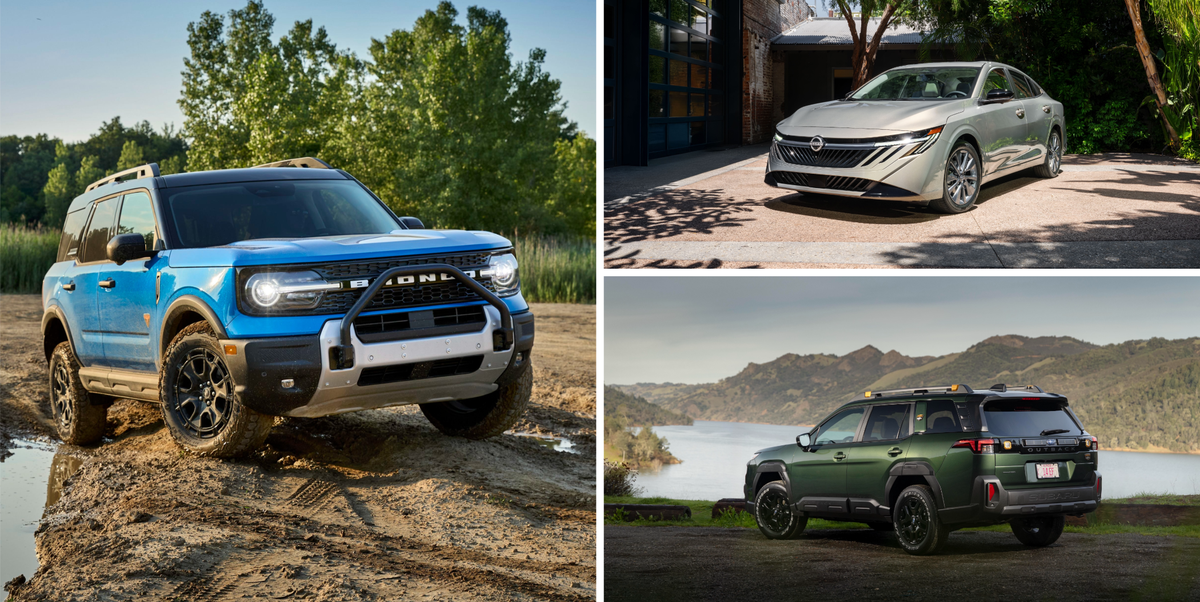
So, look to GM and Ford for bargains (also Nissan, -1.9% sales, and Subaru, -5.5% sales for the first half). You’re more likely to pay something much closer to MSRP for a new Toyota, Hyundai, Honda, Fiat, or Chrysler/Dodge/Jeep/Ram, so start shopping Nissan Sentras, Ford Bronco Sports, and the like.