
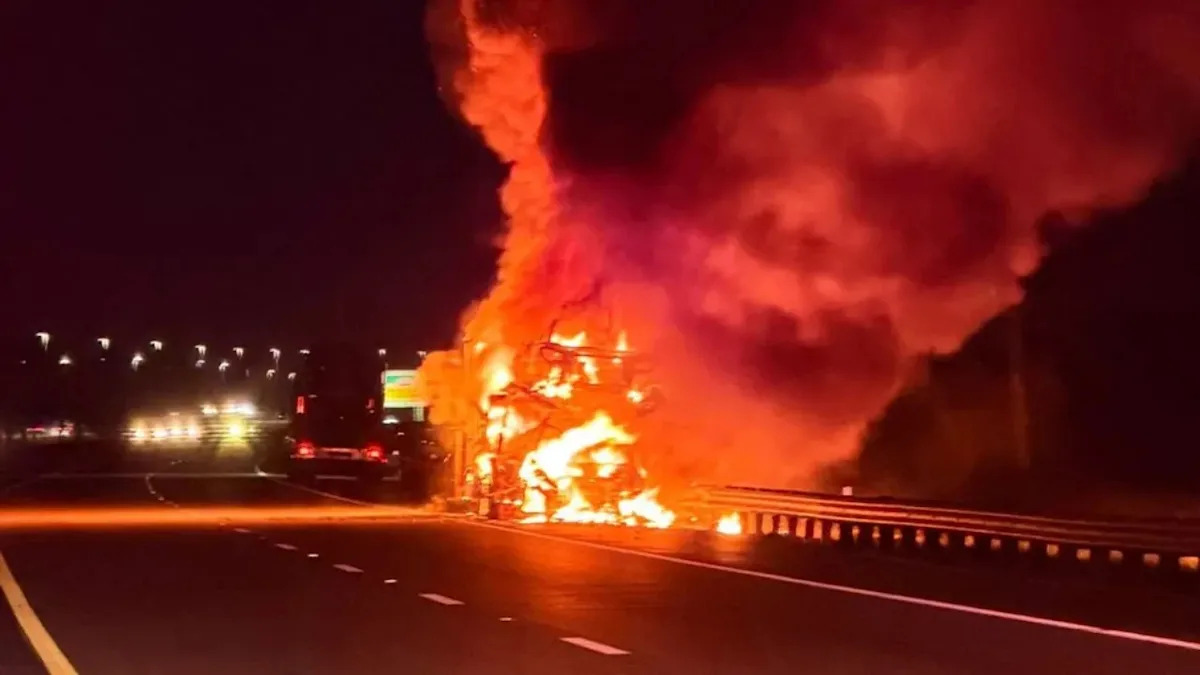
A car hauler loaded with Teslas doesn’t need to be involved in a crash to make headlines. Sometimes, it just needs to catch fire in the middle of the night on one of the busiest stretches of interstate in the southeastern United States. That’s exactly what happened in Hobe Sound, Florida, late Friday when a semi-truck transporting six Tesla vehicles ignited near Mile Marker 120 on Florida’s Turnpike, triggering a multi-agency emergency response that effectively shut down two major corridors at once.
Martin County Fire Rescue crews arrived just before 11 p.m. and immediately faced a complication that made the situation significantly harder to manage: shifting winds. As conditions changed, smoke and fire spread in ways that ruled out keeping even a single lane open, prompting the full closure of both northbound and southbound lanes of Interstate 95 in addition to all lanes of the Turnpike in the area. That’s a serious footprint for a single vehicle fire, and it speaks to how quickly a situation like this can escalate when the cargo involved isn’t a pallet of lumber.
No injuries were reported, which is the best possible outcome in a scenario like this. Still, the incident carries weight beyond the immediate road closure. The cause of the fire has not been released, and it was not immediately clear how many of the six Teslas were lost in the blaze. As of Saturday morning, the roadways had reopened, but the questions this kind of event raises tend to linger a bit longer than the smoke.
For anyone who follows the EV space, a burning Tesla on a car hauler isn’t an entirely unfamiliar image. The combination of high-voltage lithium-ion battery packs, the confined geometry of a multi-car transport rig, and a single ignition source creates a scenario that firefighters have been working to better understand for years.
This particular fire adds another data point to an ongoing conversation about how the industry transports, stores, and responds to fires involving electric vehicles at scale.
Two Interstates, One Fire
The scale of the road closures here is worth pausing on. Florida’s Turnpike and Interstate 95 run parallel through this part of Martin County, which means that when emergency crews closed both simultaneously, drivers in the area had few good alternatives.
The Martin County Sheriff’s Office confirmed both corridors were back open by Saturday morning, but for anyone traveling that stretch of South Florida overnight, it was a significant detour at an inconvenient hour.
Why EV Transport Fires Are Complicated
Lithium-ion battery fires behave differently than conventional vehicle fires. They can reignite hours or even days after they appear to be extinguished, require far greater volumes of water to suppress, and the thermal runaway process that drives them is difficult to interrupt once it begins.
For fire departments responding to a multi-car hauler full of EVs, those factors don’t make the job straightforward. It’s worth noting that authorities have not confirmed the fire originated with the vehicles themselves rather than the truck, and the cause remains under investigation.
A Familiar Scene, an Unanswered Question
This incident will likely draw comparisons to previous Tesla transport fires, which have occurred often enough that some fire departments have begun developing specific response protocols for EVs. The question that always follows these events is whether the origin was a battery, a mechanical failure on the truck itself, or some other factor entirely. Until investigators release their findings, the answer remains open.
What is clear is that six Teslas on a car hauler in Florida produced enough of a fire to close two interstates, and that’s a fact worth filing away regardless of cause.
Lessons Learned
Events like this tend to move fast in the news cycle, but they carry longer-term value for anyone in the transportation or fire response industries. Better protocols for transporting EVs, clearer communication about fire suppression strategies, and infrastructure planning that accounts for major arterial closures are all areas where this kind of incident can inform real decisions.
The good news is that no one was hurt. The better news would be a thorough, public investigation into what started the fire in the first place.
If you want more stories like this, follow Guessing Headlights on Yahoo so you don’t miss what’s coming next.