
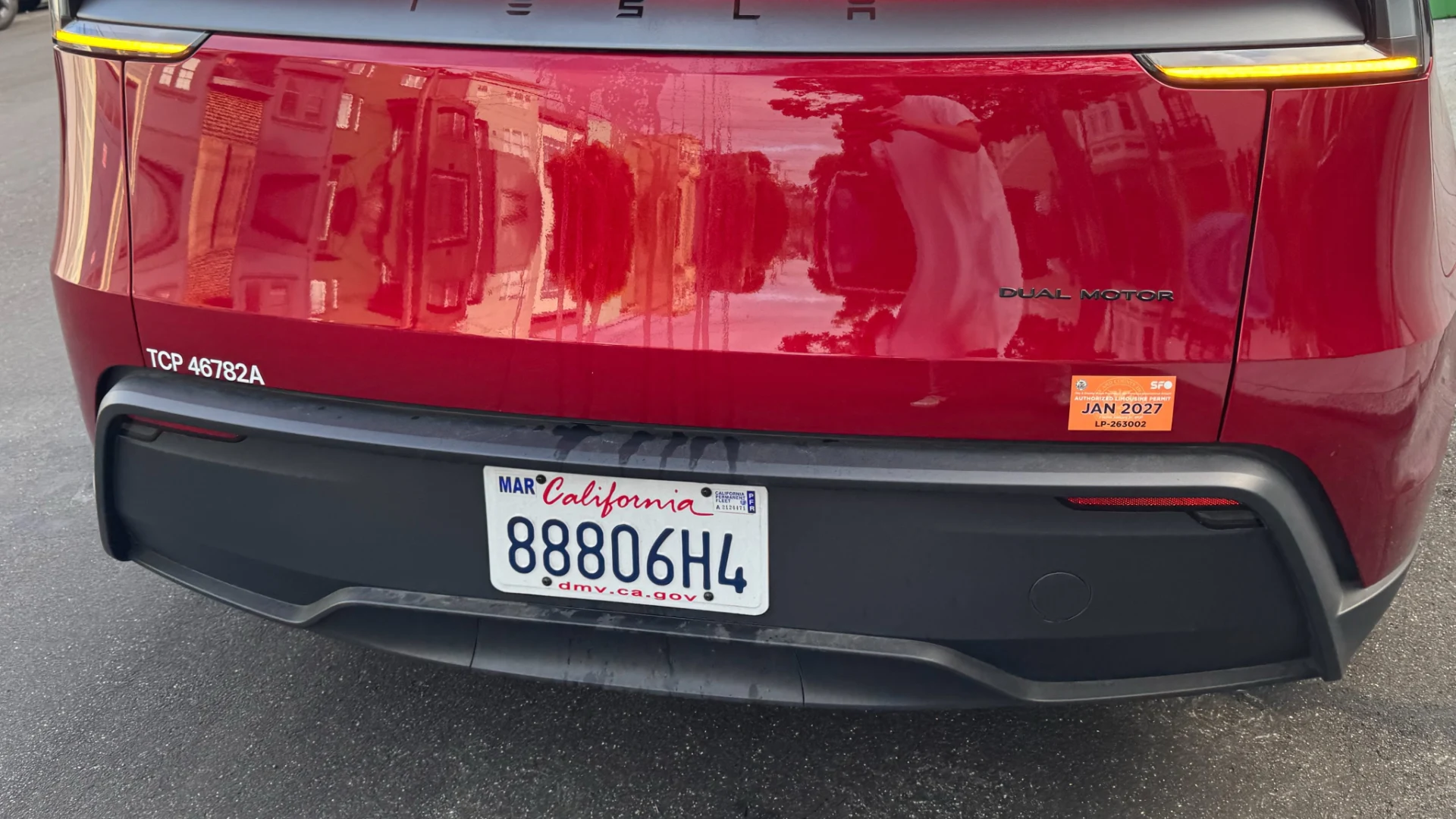
A Model Y used in Tesla’s Bay Area ride-hailing service was spotted on Thursday with a permit sticker allowing it to operate at the San Francisco International Airport.
The “Authorized Limousine Permit” sticker — numbered LP-263002 and valid through January 31, 2027 — is issued by the City & County of San Francisco for limousine operations in the San Francisco International Airport.
It marks the first confirmed evidence that SFO has granted Tesla commercial ground transportation access at the airport — roughly nine months after the company first approached the facility about securing one.
The sticker signals that the vehicle can conduct paid passenger pickups and dropoffs at SFO’s designated commercial ground transportation zones.
As of Thursday, no public announcement had been made by Tesla or SFO regarding the approval date.
Tesla’s First SFO Approach
Tesla initiated formal engagement with SFO and two other Bay Area airports — San Jose Mineta International and Oakland International — in September 2025.
The company’s legal team notified the California Public Utilities Commission (CPUC) at the time that the company was “initiating engagement with the following airports to secure the necessary approvals,” according to reporting by Politico.
SFO spokesperson Doug Yakel confirmed to the media outlet that the airport had received Tesla‘s request and was scheduling discussions.
San Jose airport representatives revealed Tesla had inquired about permits but had not yet filed an application, while Oakland officials confirmed initial contact but no detailed plans.
All three airports reported no approvals at the time.
The outreach came shortly after Tesla launched its ride-hailing service in the Bay Area, nearly a month after the debut of the Robotaxi service in Austin a year ago.
The Bay Area service is provided with safety drivers behind the wheel.
The service has since expanded to cover large portions of San Francisco, the Peninsula, and the South Bay.
The fleet grew to more than 600 vehicles since launch, according to Robotaxitracker — though all rides have required a human driver due to California’s regulatory framework.
Tesla reported nearly 700,000 cumulative paid rides across Austin and the Bay Area combined as of the fourth quarter of 2025.
A Limousine Permit
The SFO permit falls under the airport’s standard limousine service category.
It sits on top of the California Transportation Charter-Party (TCP) permit that Tesla obtained in March 2025 — the same type of statewide authorization that any limousine or black-car company holds to transport paying passengers.
Pat Tsen, the CPUC’s deputy executive director for consumer policy, transportation, and enforcement, made the regulatory classification explicit during an interview on the Driverless Digest podcast in March 2026.
“What they have from us is essentially a charter party carrier permit,” Tsen stated, adding that “it is the same type of permit that a limousine company would get from the CPUC to provide a limousine service.”
The deputy director also stated that the person seated in the driver’s seat of Tesla‘s ride-hailing vehicles is legally classified as a driver — not a safety driver — regardless of whether FSD (Supervised) software is active.
“Tesla is not operating an autonomous vehicle service,” she stated.
California defines autonomous vehicles as SAE Level 3 or higher.
Tesla‘s Full Self-Driving system remains classified as Level 2, which legally requires a human driver to remain attentive and ready to intervene at all times.
The SFO limousine permit therefore authorizes Tesla‘s vehicles to operate at the airport under supervised, human-driven conditions — the same operational model already in use across the company’s broader Bay Area fleet.
Fully Autonomous Service
Last July, Alphabet’s Waymo became the first authorized fully autonomous ride-hailing service to operate commercially at the San Jose Mineta International Airport.
The company has been offering fully autonomous rides to and from SFO since late January, following a three-phase pilot programme.
Waymo‘s SFO operation uses its Level 4 autonomous vehicles — fully driverless, with no safety monitor or human operator in the vehicle.
The company now delivers more than 500,000 paid rides per week across 11 US cities and operates approximately 3,000 vehicles nationwide.
Tesla‘s SFO permit, by contrast, authorizes only supervised, human-driven commercial rides under the limousine category.
Fully unsupervised autonomous rides at SFO would require additional AV-specific regulatory approvals that Tesla does not hold.
The regulatory divide between Tesla and Waymo has extended into a broader industry debate.
Waymo co-CEO Tekedra Mawakana called on federal regulators to establish a national standard recently requiring autonomous vehicle developers to demonstrate their safety, arguing that shared roads demand shared accountability.
“I think the regulators should issue a national standard, so everyone is demonstrating their safety,” she told The New York Times in March.
Waymo executives have criticized Tesla’s vision-only approach to autonomy several times, reaffirming their bet on LiDAR sensors for more safety.
Tesla AI engineer Jimmy Tsai recently pushed back on X, arguing that Waymo‘s LiDAR-based approach is not inherently safer and pointing to NHTSA’s probe into Waymo vehicles’ interactions with school buses.
“It has nothing to do with LiDAR. It has to do with the brain,” Tsai wrote.
Texas’ Unsupervised Service
Tesla‘s unsupervised ride-hailing programme — where vehicles carry no human driver or safety monitor — operates exclusively in Texas.
The company launched fully unsupervised rides in Dallas and Houston on April 18, expanding beyond Austin, where unsupervised operations began in a limited capacity in January 2026.
As of Thursday, the combined unsupervised fleet across all three Texas cities stood at 31 vehicles, with 21 in Austin, five in Dallas and six in Houston.
The company committed to launching the Robotaxi service in seven additional cities — Dallas, Houston, Phoenix, Miami, Orlando, Tampa, and Las Vegas — within the first half of 2026, as outlined in its Q4 2025 shareholder update.
With fewer than two weeks remaining in the period, only Dallas and Houston have launched.
Tesla filed an application for an Autonomous Vehicle Network Company permit in Nevada earlier this month, covering Clark County and Harry Reid International Airport with a proposed fleet ceiling of 5,000 vehicles.
Widespread by Year-End
Last month, CEO Elon Musk said at the Smart Mobility Summit 2026 in Tel Aviv that Tesla already has vehicles operating “with no people inside and no safety monitors” in three Texas cities, predicting that the service will be “widespread in the US by the end of this year.”
Musk acknowledged during the first-quarter earnings call that Robotaxi revenue would not be meaningful this year.
“I don’t think probably unsupervised FSD or Robotaxi revenue will be super material this year,” he stated, adding, “but I do think it will be material in a significant way next year.”