

In 2024, we labeled the Toyota Camry the most important vehicle in the world; if a nameplate like the Camry could pivot to become hybrid-only, it was a sign that hybrid was officially mainstream. This year it’s Lexus’ turn to have a Camry moment, and with the reveal of the 2026 Lexus ES, it’s done just that. In case you missed it, the ES is no longer the visual automotive equivalent of a muffin top – the old one always looked awkwardly pudgy – it’s now a real looker, at least to my eye.
More importantly, the ES is available as a hybrid in base form with two battery-electric variants. This marks the first time Lexus has made one of its core models an EV, and it will be a big turning point for the brand. But it’s also the perfect model to take this leap, and stands to become the Prius of the Lexus lineup – a forward-thinking technological showcase for the rest of the Lexus lineup to follow.
The views represented in this article do not reflect those of CarBuzz and are those of the author.
What’s In A Name? A Lot, Actually

2026 Lexus ESLexus
“What’s in a name? That which we call a rose by any other name would smell as sweet.”
– William Shakespeare, Romeo & Juliet
We’ve all heard the quote above, used whenever someone wants to justify that the name we call something doesn’t change what it is. That’s true, to an extent, but in the automotive world, a name is a matter of brand equity, a sign of what to expect from a brand or model. It carries the weight of heritage, or new beginnings, and it can turn buyers off of a particular model, or drive interest in it.
Mercedes-Benz has learned this the hard way, launching the Mercedes-EQ sub-brand for all its EVs to give them different names and styles in a bid to differentiate them from the core combustion models. But before we’d even seen a second generation of EQ models, Mercedes announced it would backtrack and name and style its electric cars after the core vehicles. It was an egg-on-the-face moment for the German brand, as it had to effectively admit BMW was right to launch the i4, i5, and i7 as nothing more than 4-, 5-, and 7 Series models with electric powertrains.

Related
2025 Toyota Camry Crowned First-Ever CarBuzz Car Of The Year
The humble Camry has signaled the dawn of a new era, not just for Toyota but for the automotive world as a whole.
As it turns out, launching an egg-shaped EV called the EQS and trying to convince everyone this was “the S-Class of EVs” didn’t really work. If it were the S-Class of EVs, why not call it an S-Class? The S-Class name has a certain weight to it, a power behind the badge that tells the ordinary person the vehicle they’re looking at, driving, or being driven in is the pinnacle of luxury and technology, at the bleeding edge of what can be done in a production vehicle.

2025 Mercedes-Benz EQS 450+ Black Front Angled ViewMercedes-Benz
If Mercedes-Benz didn’t believe an electric luxury sedan was worthy of the S-Class nameplate, how was the rest of the world supposed to buy into the EQS as being the next step in luxury mobility? If Mercedes was really certain the EQS was the next step forward, it wouldn’t have been ashamed to call it an S-Class. The fact that it was too scared to do so was something the automotive world picked up on, even if only subliminally.
The ES Is The Perfect Lexus To Take On The Electric Torch

2026 Rolls-Royce Spectre Black BadgeRolls-Royce
With that in mind, the Lexus ES is the perfect nameplate to adopt electrification for the Japanese luxury brand. Why not the LS, you might ask? The LS was and is, after all, the Lexus equivalent to the S-Class. It was the billion-dollar car that launched the Lexus brand and proved Toyota could go toe-to-toe with Mercedes at its peak, and win, so why not take the LS electric? Because the LS is still mainstream. As much as I’m a dyed-in-the-wool fan of combustion, I believe certain vehicle segments can and should be electric. In the realm of ultra-luxury cars, where silence and effortless power are huge selling points, an electric powertrain is perfect.

2026 Rolls-Royce Spectre Black BadgeRolls-Royce
That’s why a brand like Rolls-Royce should and will embrace electrification and be better off for it. But the LS, and even the S-Class, is still a mainstream type of luxury car, and in the mainstream, where an LS may be used to cover vast distances, combustion is still king. Why else would we still have V12s in the Maybach S-Class? Or hulking twin-turbo V8s in the AMG S63?
But the ES is an oddball. It was never a core model for Lexus in the same way the IS, GS, and LS were. The former two were the sports sedans; rivals to the 3 Series and 5 Series with F versions to take on the finest M had to offer. The LS was the perfect alternative to an S-Class at a fraction of the price. But the ES? Who knew what that was? It was front-wheel drive, for starters, which always seemed odd. And under the skin, it was nothing more than a Toyota Avalon in fancy dress. So when the Avalon kicked the bucket, replaced by the oddball Toyota Crown lifted sedan, we all thought the ES would go the way of the dodo.

2026 Lexus ES rear three-quarters angle in silver while parked in a studioLexus
But the ES did something other Lexus models didn’t; it was an unashamed display of comfort. I’ve been fortunate to drive thousands of vehicles, but the Lexus ES was arguably the most comfortable. Forget the S-Class, forget the Bentley Continental GT, the ES was the car that delivered pure, plush comfort in a way no other could. The back seat of the last ES was the equivalent of a leather sofa on wheels, paired with soft suspension that made no promises of rapid lap times. It was the embodiment of comfort and quiet, perfect for the buyer who could care less about performance or handling. Plain and simple, if you wanted the most comfortable car to commute in, you could not go wrong with the Lexus ES.

2026 Lexus ES interior view of both rows of seats from the sideLexus
And because of that, it’s outlasted the Lexus GS, and it’s created a niche for itself as a car that does things differently from its peers. And it’s for that reason that it’s the perfect model in the Lexus lineup to adopt a mix of hybrid and BEV powertrains. The ES leans into comfort and quiet in much the same way a Rolls-Royce does. And the name has no sporting pretense to have its reputation ruined by an electric powertrain.

2026 Lexus ES interior view of the front cabin areaLexus
Can you imagine if the Lexus IS 500 F Sport Performance went from the sonorous naturally aspirated masterpiece of a V8 to a silent EV? Lexus fans would riot in the streets. Politely, of course, because Lexus buyers aren’t hooligans, but they’d riot nonetheless. I’d be right there with them, for the record, because that Yamaha-tuned 5.0-liter V8 is a masterpiece that deserves to be preserved, no matter the cost.

Related
The Cheapest V8-Powered Performance Sedan On Sale In 2025
This is not only the most affordable V8-powered performance sedan on the market today, but it may also be the only affordable V8 sports sedan left.
The Lexus ES is the Prius of the Lexus lineup, a model that exists outside the status quo and can experiment with styling and technology in a way the others can’t, but which still has the cachet of an established nameplate to draw in potential buyers. And just like the Prius, it now looks spectacular, with Lexus drawing influence from concept cars to turn it into a design that says “futuristic” without screaming “alien.”
The ES Is A Litmus Test For EV Adoption In The Luxury Scene

2026 Lexus ES350e studio photos.Lexus
Whether the Lexus ES can succeed as an EV is the big question at hand, though. If we learned anything from 2024, it was that the world wasn’t yet ready to adopt the EV wholesale. What automakers thought would be the year of the EV quickly became the year of the hybrid, and resulted in dozens of automakers scrambling to revise their entire product pipeline for the next decade. Early adopters aside, the mass market no longer wanted to buy EVs en masse; they wanted hybrids instead.
And the masses spoke, not with their words, but with their wallets. Demand for EVs in 2024 fell off a cliff compared to automakers’ predictions, and while the year-end sales releases proclaimed huge growth in EV sales, the sweeping changes to electrification deadlines and massive drive towards hybrids over EVs were far more telling.
2026 Lexus ES Specifications
Model
ES 350h
ES 350e
ES 500e
Platform
TNGA-K
Engine
2.5-liter hybrid inline-4
Single electric motor
Dual electric motors
Transmission
e-CVT
Single-speed eAxle
Drivetrain
FWD/AWD
FWD
AWD
NOTE: Preliminary specifications are subject to change prior to market launch
But with the ES now offering both hybrid and electric powertrains, it will be a true A-B test scenario for the luxury segment. When given the choice, without the weight of expectation and peer pressure that accompanies a badge renowned for sportiness, what will luxury buyers choose? That’s why the ES nameplate is so vital here. It has no sporting pretense. It’s an out-there model exempt from the pressures of the luxury sports sedan market. It takes social pressure out of the equation entirely.
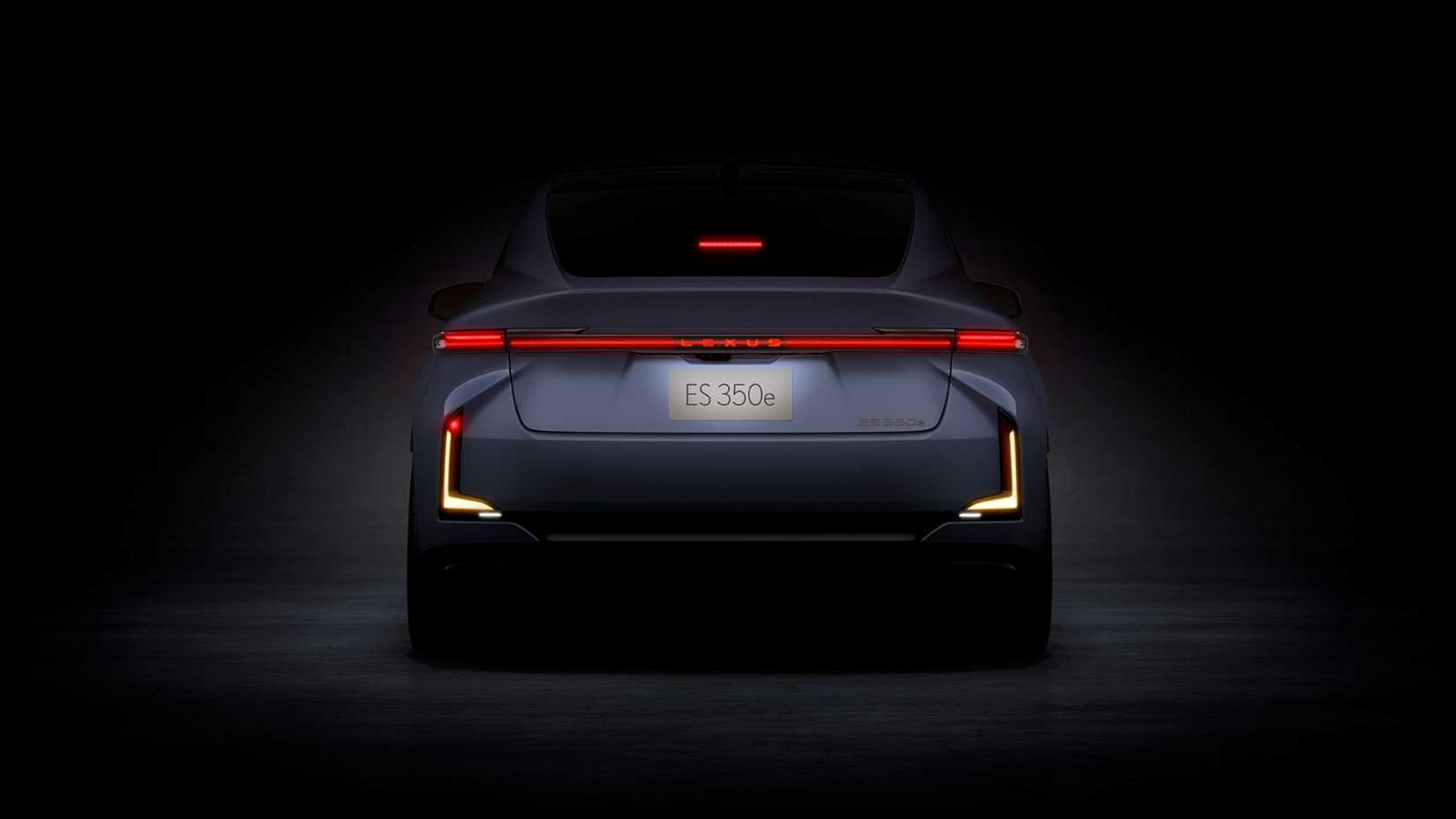
2026 Lexus ES 350e rear angle with brake lights on while parked in a studioLexus
If ever there was a model that could predict the future of EV demand in the premium segment, the 2026 Lexus ES is it. And if buyers demand more hybrids, Lexus can just shift production in favor of that powertrain, wait for the swing to EVs, and shift production again. The 2026 Lexus ES is proof that, yet again, Toyota’s seemingly slow approach to the EV game was a complete masterstroke.