
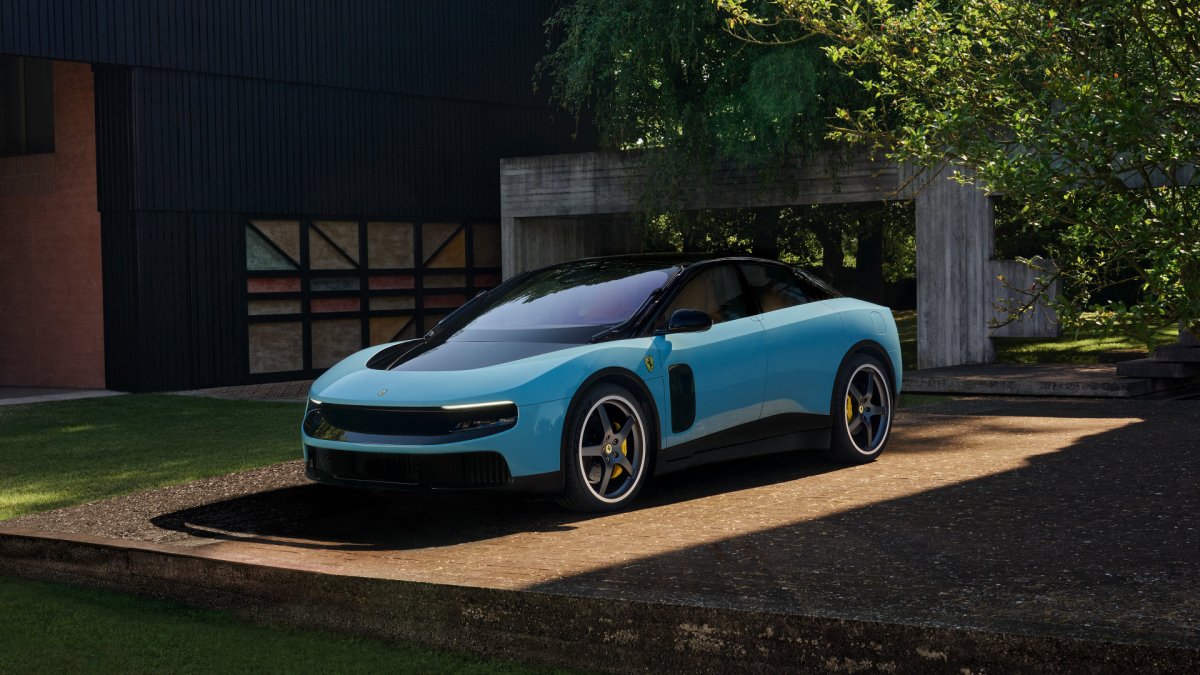
The Prancing Horse recently launched its first full EV to little fanfare. The Ferrari Luce was shown off in full for the first time, and the reactions we saw and had ourselves were very mixed. This was the iconic supercar brand’s first foray into a true EV, and for enthusiasts, it proved disappointing.
But that isn’t to say that everything about the Luce is bad. There are numerous unique features in the Luce inspired by Tesla’s late Model S Plaid. In fact, Ferrari had a Plaid Model S at its internal test track at its headquarters several years ago and likely took it apart to learn from the best.
Let’s take a look at the Ferrari Luce and the Model S Plaid and see how they stack up.
Drivetrain & Specs
The mechanical core of the Model S Plaid relies on Tesla’s mature tri-motor architecture, which features carbon-sleeved rotors that maintain a peak 1,020 horsepower all the way up to its 200 mph top speed (with Track Pack). This configuration allows a four-door family sedan to achieve a blistering 1.99-second 0-60 mph launch time with exceptional thermal repeatability in Track Mode.
In contrast, the Ferrari Luce’s brand-new electric drivetrain reveals the engineering friction of a company that built a compliance EV. While Maranello’s engineers have tuned power delivery to mimic the range of a high-revving gas engine, the raw performance metrics struggle to justify the badge of a supercar when lined up against the Model S Plaid.
Specification
Tesla Model S Plaid
Ferrari Luce
Powertrain
Tri-Motor AWD (Carbon-Sleeved)
Quad-Motor AWD
Horsepower
1,020 hp
~1036 to 1050 hp
0-60 mph Time
1.99 seconds
~ 2.4 to 2.5 seconds
Top Speed
200 mph
Track-Limited V-Max
The Luce struggles to achieve the same results as the Plaid, which is surprising, considering that Ferrari’s engineers have had their hands on the Model S for several years, including having the ability to fully tear it down and see what makes it tick.
Range, Battery, & Efficiency
The battery packaging also reveals two very different design philosophies. Tesla utilizes its signature skateboard pack, which defined the EV industry at large, integrated into the chassis. That design helps maximize space efficiency and delivers an EPA-estimated range of 359 miles.
Ferrari rejected that uniform skateboard layout to preserve the traditionally low supercar seating position and weight distribution. The Luce splits its battery architecture into separate, irregular compartments carved out behind the cabin and along the central body tunnel.

Not a Tesla App
This intricate layout sacrifices volumetric density to ensure that the Luce handles as close as possible to a gas-powered sports car, but results in a significantly compromised range profile.
Battery Metric
Tesla Model S Plaid
Ferrari Luce
Pack Architecture
Structural Skateboard
Segmented Central & Rear Tunnels
Battery kWh
95kWh pack
122 kWh pack
Estimated Range
Up to 359 miles
Up to 280 miles
Peak Charging
250 kW DC
11.5 kW AC
350 kW DC
22k kW AC
Exterior Design
Aerodynamic priorities heavily dictate supercar design, and that’s true for both vehicles. The Model S Plaid hides its high-performance capabilities under a conservative, low-drag fastback sedan design. That results in a drag coefficient of just 0.208, and the smooth lines and flush door handles are designed to slice through the air as efficiently as possible.
Ferrari, on the other hand, turned the visual volume to the absolute maximum, with sharp active front flaps, a front air loop, and prominent side air scoops. These are design features to maximize downforce and grip on the track. However, the disadvantage is reduced efficiency due to turbulent wakes created by the design.
While the 4-door Luce stays tight to the ground on the track thanks to downforce, Tesla manages the same with the S Plaid by simply shifting the weight to the bottom of the vehicle. This difference in design philosophy is what has resulted in such different vehicles.
The Luce is designed around a philosophy of keeping as close to a classic Ferrari as possible, while the S Plaid is designed to be fantastic at everything it does.
Interior Design
The vehicles’ interior layouts are two starkly different extremes. The Model S Plaid features a minimalistic cabin with a massive touchscreen, yoke, and driver’s display, neatly bringing the tech to the front.
The Luce was designed as part of a creative collaborative effort with LoveFrom, a company spearheaded by former Apple design chief Sir Jony Ive, who collaborated closely with Ferrari’s own chief design officer, Flavio Manzoni.
The interior design is wrapped in luxurious hand-stitched leather, but the instrumentation’s integration clutters the environment. There are digital state-of-charge metrics and thermal information crammed into a claustrophobic binnacle on a large display, which wastes space.
A series of physical buttons on the steering wheel and the poorly placed signal indicators make it feel like the vehicle’s interior was built by a committee, with a vote on the random placement of physical knobs and digital displays.
When paired with a physical key fob that must be placed in the center console, the Luce’s interior feels like a vehicle trapped somewhere between modernity and antiquity. It still manages to fit a three-across bench seat, which is just spacious enough for an average adult to sit in comfortably.
Pricing
The final divider between the vehicles is the huge gap in pricing. The Model S Plaid, while now retired from Tesla’s lineup, remains a benchmark on price-to-performance ratios. It offers hypercar-level acceleration in a practical, mass-production package for a low six-figure sum of approximately $109,990, or $129,990 with Track Pack.
On the other hand, the Ferrari Luce commands an astronomical premium deep in traditional supercar territory. For the price of a Luce, you could buy a Model S Plaid to take to the track, a Cyberbeast to tow it, a Model 3 Performance to commute with, and a Model Y Performance to put on display, and still have leftover money.
The Luce begins at a staggering $640,000, which means that at the end of the day, you aren’t paying a premium for performance anymore. Instead, you are paying for the privilege of the prancing horse badge and a vehicle that was shaped by the legendary Jony Ive.