
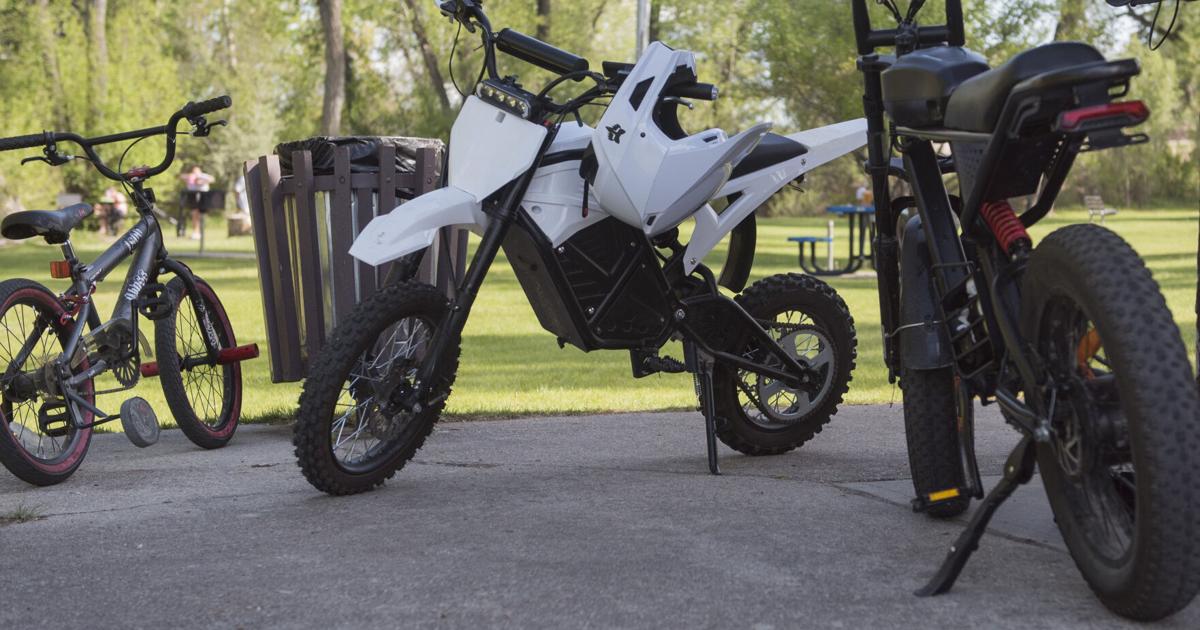
As summer heats up, e-bike concerns are growing again in the community.
Buffalo Police Chief Sean Bissett made a public service announcement at the May 19 City Council meeting that while the department has received several complaints related to e-bike users speeding and disobeying traffic laws in town, the department has little ability to enforce traffic laws on e-bike riders. Bissett said he is hopeful state statute can catch up to current technology. Until then, he said, it’s “a parental issue.”
“That starts at home when you buy that e-bike and send those kids out on the street, because I do not want to see a tragedy happen,” Bissett said.
Despite challenges with enforcement, some laws specifically related to e-bikes reside in state statute. State law classifies e-bikes into three categories. A Class 1 electric bicycle is an e-bike equipped with a motor that assists riders while they are pedaling and stops assisting them when they reach 20 mph. A Class 2 electric bicycle has a motor that may be used to propel the bicycle without pedaling and stops when the bicycle reaches 20 mph. A Class 3 electric bicycle is equipped with a motor that provides assistance when the rider is pedaling and stops assisting when the bicycle reaches a speed of 28 miles per hour.
Based on statute, it is illegal for anyone under the age of 16 to ride a Class 3 e-bike, and while a minor, they must wear a helmet. Like bicycles, e-bike riders have many of the same rights and responsibilities of vehicles on the road. Bissett said the issue is how the department can enforce these laws.
“A 12-year-old riding a class 3 e-bike, doing 28 miles an hour, running a stop sign in a crosswalk, the police have no teeth to make a stop and to issue a citation right now,” Bissett said. “To issue a traffic citation, you need to be a licensed driver in a motor vehicle. An e-bike does not fall under motor vehicle law.”
City ordinance doesn’t mention e-bikes specifically, but it prohibits cyclists from riding on sidewalks, riding more than two abreast and riding outside of a “reasonable” and “proper” speed. Bissett said that changes to city ordinances could aid enforcement as well.
The department also hears complaints about e-bike riders on the Clear Creek Trail System, although they are prohibited from using the trails. Bissett said it is currently impossible for the department to enforce e-bike riding on the trails.
“We don’t have the manpower, nor do we have the teeth to do that,” Bissett said. “… This starts at home when you buy that e-bike for your child, and it’s not just children, right? We know there’s kids over 18 doing the same thing.”
The department has been involved in an educational initiative, also supported by Johnson County Public Health, where officers rewarded e-bike, scooter, skateboard and bicycle riders for wearing helmets and obeying traffic laws. It has also engaged in other educational efforts to encourage safe practices.
Bissett said that officers also still make contact with e-bikers when they see them speeding or riding recklessly and warn them of the dangers of riding e-bikes. E-bike-related injuries and fatalities grow every year, along with their popularity, he said. Still, the department can’t single out people on e-bikes as that could fall under profiling, which is against the law, he said.
“Know that we are out there. We don’t just allow them to drive crazy. We make the stop, we educate them, we talk to them, but they then drive away with no consequence. That’s tough for us, but the best we can do,” Bissett said. “And do I want to sit there and write 12-year-old kids traffic tickets and send them to court? No. But what do we do as a community to try to help? So, I’m just asking everyone to help me out some, if they can, and that includes the parents and the kids that are riding these things.”