

It’s fair to say the reveal of the Ferrari Luce (pronounced loo-chay and meaning “light”, as in illumination) has sparked fierce debate online. A more millennial way of putting it would be that the car blew up the internet.
The Italian brand’s first electric car was always going to be controversial, but it’s likely Ferrari wasn’t fully prepared for the animus directed its way, largely aimed at the car’s styling.
The most stinging attack must have come from the former chairman Luca di Montezemolo, 78, who said that it’s a car so unappealing even the Chinese wouldn’t copy it. Most of those commenting online felt the same way, and the market reacted accordingly, with Ferrari’s market value dipping by up to £4 billion the day after its unveiling.
A few notable voices had the courage to take a different view. James May, for example, said he liked the design, calling it “very contemporary, very modern”. He reminded people that those characteristics have always defined Ferrari’s styling.
Neither di Montezemolo nor May were at the car’s launch, though — The Times was. I spent three days embedded with Ferrari in Rome, sitting through the glitzy unveiling as well as a round-table interview session with LoveFrom, the creative agency brought in by Ferrari to influence the Luce’s exterior and interior design, and attending seven in-depth workshops on key features of the car.
Here is an explainer that hopefully addresses some of the key questions and criticisms following the Luce’s launch. It’s not designed to change your opinion, but hopefully it will be illuminating.
Did Jony Ive design the Ferrari Luce?
Not on his own, no. Ive, who was Apple’s senior vice-president of industrial design and chief design officer, is the man behind incredibly influential tech products such as the iPod and iPhone. Ferrari turned to LoveFrom, the “creative collective” that Ive formed with another acclaimed industrial designer, Marc Newson, for a “fresh perspective” on the design of its first electric car.
Both Ive and Newson have automotive design experience, with the latter working on the Ford 021C concept, and Newson said that all those involved on the Luce project are “petrolheads”, having owned Ferraris themselves. Newson has even taken part in the Mille Miglia classic car rally 14 times, he said.
 Jony Ive with the Apple CEO, Tim Cook, in 2018, when it released three new versions of the iPhone and an updated Apple WatchGetty Images
 A young Marc Newson (right) pictured with J Mays, the Ford design vice-president, at the unveiling of its 021C concept vehicle in 1999Reuters
It wasn’t a two-man project, of course. A number of LoveFrom designers contributed to the Luce’s final look and feel. They included Chris Wilson, who worked on the human machine interface (HMI) — the screens and associated controls — and Jeremy Bataillou, who was in charge of the interior details. Both men were at the launch in Rome alongside Newson. Sadly, Ive could not be there as he was recovering from an operation, though his son Charlie was in attendance in Rome as a guest.
But don’t think Ferrari wasn’t involved in the design; far from it. Newson told us that while LoveFrom was given complete creative freedom, his team had worked “hand-in-glove” with the Ferrari Design Studio, which is headed by Flavio Manzoni, for about seven years.
“Safe to say that we’ve been completely embedded in the Ferrari organisation,” Newson told us. “We’ve had people practically living at Ferrari during that time. But we’ve also been doing work in the studio in San Francisco, the studio in London.”
Ultimately nothing was signed off without Ferrari’s approval.
So why does the Luce look so different from other Ferraris?
You will have an opinion about the look of the Luce’s exterior, and we won’t try to change your mind. Having seen the car up close and from every angle, some of the criticism is perhaps a little harsh, but arguably some of it is fair. Side-by-side comparisons of the blue-painted Luce with a new Nissan Leaf in a very similar colour are hard to dismiss, as superficially the cars look very similar — something Nissan was all too keen to highlight.
But look closer and they’re very different machines. One key thing to note is that the Luce’s painted bodywork is almost like a shell placed on top of the core part of the design, which is a teardrop-like passenger cell. Newson called this the “glasshouse” and it’s much more apparent up close than in pictures, particularly as you can see the uninterrupted line from the lower edge of the glasshouse right over the roof and to the back of the car.
This clean flow was a key feature that LoveFrom pushed for, and the vertical alignment of the windscreen wipers — flush against the A-pillars at rest — is an example of how Ferrari and LoveFrom worked together to find solutions that, in their words, “retained the purity of the design concept.”
“[The] passenger cell … sits within, in a way, the body of the car,” Newson told us. “There are lots of ways that that’s expressed, obviously in colour, but in a physical sense of separation with this gap that runs around the entire perimeter of the beltline of the car. That was a device I think that we hit upon very, very early in the design process. We liked the idea that you could treat these two things almost as separate design elements that work very much together, in unison.”
Formed by the wind
Why do it? In a word: aerodynamics, because that teardrop passenger cell is incredibly slippery through the air. The result is that the Luce has the lowest drag coefficient of any Ferrari to date — which is quite an achievement given that it’s taller than most of its stablemates.
 Under the outer shell of the Luce is a passenger cell called the ‘glasshouse’. Its teardrop shape is extremely aerodynamicFerrari
At our aerodynamics workshop, Ferrari’s engineers said that hundreds of computer simulations had been run just to configure those upright wipers, looking at minimising not only drag but also wind noise.
The painted “body” includes that front wing and rear wing, both of which do provide downforce but not huge amounts; the focus with Luce was always on maximum aerodynamic efficiency, rather than pushing the car down onto the road surface at speed.
Other design elements play into that philosophy, such as the radiators being positioned at the front of the car behind active louvres that close when not needed, to avoid creating unnecessary drag when cooling isn’t required. Ferrari’s aero engineers said the downforce target was similar to its grand tourers, like the Amalfi, adding that at speed the nose drops 10mm to improve efficiency.
The rear of the car is to some eyes the least successful part of the Luce — it’s quite soft, in design terms — and here LoveFrom’s influence is clearly felt. Newson told us they wanted to create surfaces for the front and rear lights that didn’t make them invisible when not in use, but “seamless” and “not obvious”.
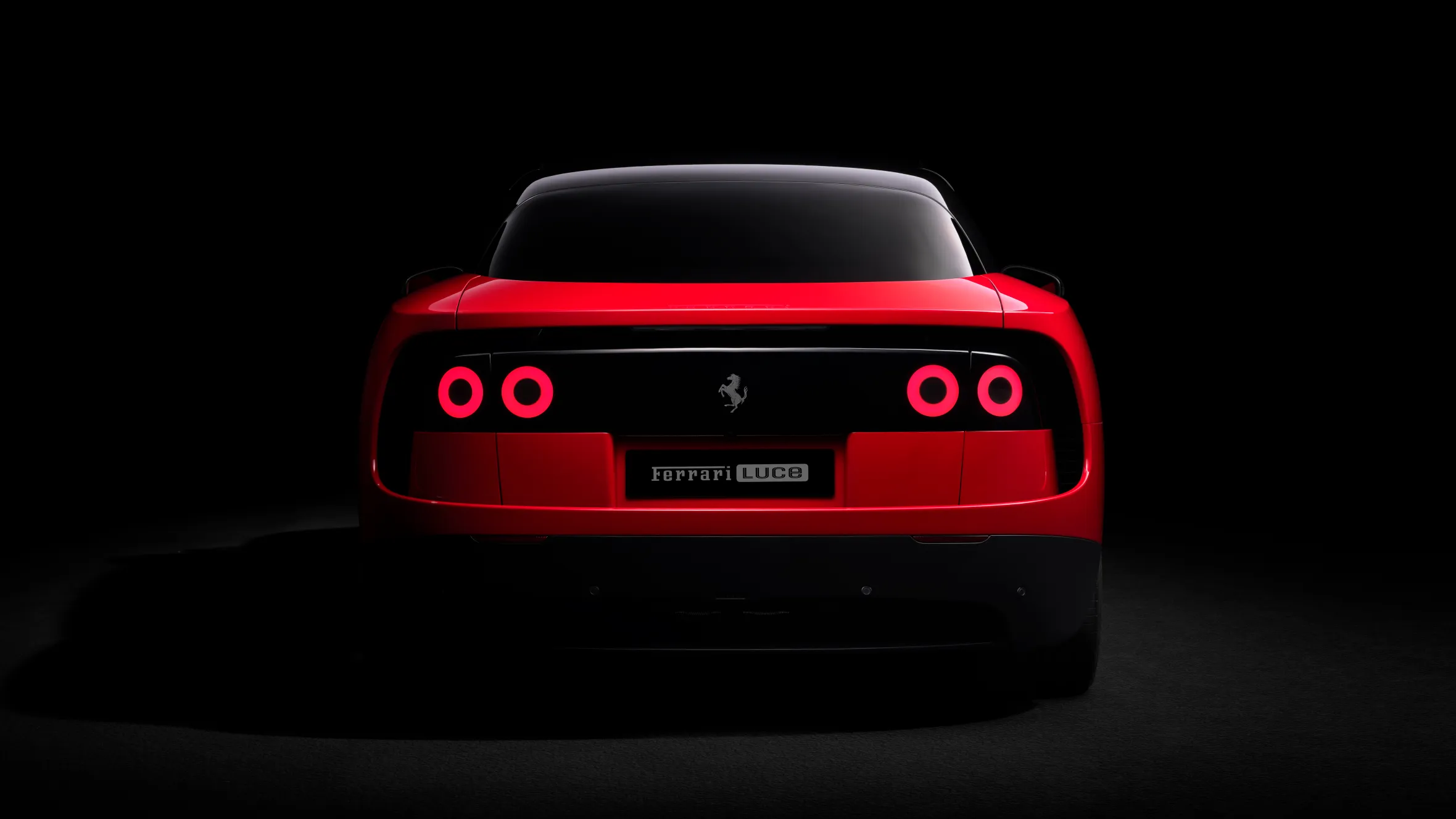 The rear lights are behind a flat panel and are designed to be less obvious when not in useFerrari
It was cited by him as an area that required a little persuasion on their part for buy-in by Ferrari, but we shouldn’t forget that this was a collaboration, with sign-off in Maranello, rather than an imposition by Californian tech designers. That really would be a shocking idea.
The brief was not to design an EV
Interestingly, Newson said that early discussions with Ferrari were not about creating an electric car at all. “The project brief, it wasn’t really a brief … to a certain degree it evolved mutually,” he told us. “We didn’t start with an EV. We didn’t say, ‘OK, we’ve got an EV platform and now let’s kind of populate this platform; let’s exploit everything that an EV can do.’ Rather we had a list of objectives. Ferrari had a list of objectives — very, very clear objectives.”
Those objectives included having four doors and five seats, which was a completely new direction for the company, Newson noted. “When we started this project the Purosangue hadn’t come out so there was no four-door Ferrari in existence,” he told us at our UK-exclusive media interview.
 Will Dron sitting in the Ferrari Luce at the launch in Rome. Newson said the original brief was to create a four-door five-seater, and the electric platform came from that starting pointFerrari
 The Ferrari Luce’s rear doors are hinged at the back, like those of the V12-powered PurosangueFerrari
At some point the designers decided that the only way they could reach those goals was to do it with an EV platform, with a “skateboard layout”, and the design evolved from there. Ferrari has kept a fairly “cab forward” layout, with the driver near the front, aping a mid-engined supercar, and that in turn means that the rear passengers are afforded lots of legroom. A roomy second row in itself is something Ferrari traditionalists are finding tricky to accept.
It’s different and bold, but Manzoni and Ferrari are clearly confident that the design will stand the test of time. They will certainly be hoping that the initial shock will make way for approval and appreciation over time.
Is an electric Ferrari an abomination?
That’s a viewpoint taken by many, but times are changing. The electric era is here, and Ferrari felt it needed to be part of it. Moreover, Ferrari said it has developed electric motors, batteries, inverters and control systems in F1 and its hybrid supercars to a point where they’re now appropriate for creating a pure EV that still has the emotion of a true Ferrari.
It’s important to remember that Ferrari is not giving up on combustion power — it fits naturally aspirated, non-turbocharged V12 engines to the Purosangue and 12Cilindri, for example, and other cars in the current model range come with turbocharged V6 and V8 engines, with hybrid and plug-in hybrid configurations. The Luce’s pure-electric powertrain simply adds to the line-up. It offers a different option for customers, and with five seats opens up the brand to an all-new type of customer.
A key message came from John Elkann, Ferrari’s chairman, during his opening speech at the unveiling: “Ferrari has never been defined by what powers it; it has always been defined by what it makes you feel.” Clearly Ferrari feels that the Luce still feels like a Ferrari when you sit in it, and when you drive it, despite not using combustion power.
Really? The Luce still has the emotion of a petrol Ferrari?
We don’t know this for sure yet because media drives won’t take place until the end of the year, but Ferrari seems to think so. The engineering details are exciting too.
The chassis is completely new, designed and built in-house, including the battery pack, which is a structural part of the vehicle. The battery doesn’t sit under the floor — it is the floor. The result is a chassis with 35 per cent more torsional rigidity than the Purosangue.
The “skateboard” layout is nothing new, in design terms — Tesla was doing this in 2009, when the original Model S was first shown. But for Ferrari it is a first, and it meant its engineers had a blank sheet to tune the car to their whims, including choosing the exact weight distribution and driving position.
Focus on driver engagement
Dynamically the Luce is infinitely customisable. With four electric motors, the torque and electrical regeneration at each corner can be controlled completely independently, while four-wheel steering (the rear wheels can be turned independently up to 2.15 degrees), independent active suspension and an all-new ultra-fast electronic control unit mean handling in all modes can be fine-tuned by the company’s test drivers. The cornering potential is extreme.
 The Luce has one motor per wheel, four-wheel steering and independent active suspension at each cornerFerrari
And Ferrari’s engineers created something unique to keep drivers entertained behind the wheel: a system called “torque shift engagement”. This uses the steering wheel paddles in Tour and Performance modes to limit torque in five increasing steps.
It doesn’t work quite like fake gears, as found on Hyundai’s Ioniq 5 N and 6 N sports cars, because with the Hyundai systems a fake rev limiter means that you have to change up to keep accelerating, or you bounce off the simulated redline. With the Ferrari Luce you could in theory reach the car’s top speed even in the first setting — “It would just take a long time,” according to the test driver who explained it to us. Drivers will instead find the car has a torque curve that tails off as speed increases, and to get the maximum acceleration you have to use the right paddle as you hit the peaks.
It increases engagement, yes, but also deals with the problem common to other performance EVs, of having a solid wave of power on the exit of a corner. To many drivers that feels artificial and overwhelming. “It’s about dealing with a powertrain that might be sometimes too quick to react,” we were told.
As you do this along a straight, there’s no regenerative braking at all, but as drivers approach a corner they will be able to use the left paddle to increase regen, which (as in other EVs) feels like engine braking. According to Ferrari, the effect can be as much as 0.33g, which is “more or less the same deceleration as second gear in a V12”.
 Paddles behind the wheel control torque and regenerative braking, with two Manettino dials for changing the driving modesFerrari
There’s also an advanced version of side slip control on the Luce, which suggests that powerslides will be possible. With 831bhp of the 1,035bhp total coming from the rear motors, we can only imagine it’ll be fairly easy to “play” with the rear end. It should also feel blindingly quick — 0-62mph takes 2.5 seconds.
But the goal was not to have the most powerful or fastest electric car, Ferrari’s engineers insisted — it was to have the most engaging EV, with the best feeling through the wheel.
Sound will be important
Ferrari chose to house the rear motors within a subframe, mounted to the main chassis with rubber bushes that remove noise and vibration without compromising handling. A rear subframe is a first for Ferrari.
While unwanted noise will be reduced, Ferrari is fully aware that the noise produced by its cars is a key part of a Ferrari and so it has created a system that it says is not simulated but based on actual motor output. We’re sceptical, though.
Watch Will Dron guide you round Ferrari’s first electric car
Ferrari uses a sensor to pick up on vibrations through the rear e-motors and then amplify them both inside and outside the cabin, but the brief sound demonstration we got when watching the Scuderia Ferrari F1 drivers Lewis Hamilton and Charles Leclerc testing the car on track suggest the Luce still sounds quite artificial. Whether or not it is a satisfying soundscape remains to be seen (or heard).
Is the Luce’s interior as good as people claim?
Absolutely — it’s terrific. In fact several journalists from other outlets went as far as to proclaim that it was, in their opinion, the best car interior of all time. I refuse to be quite as hyperbolic, but my view after sitting in the car, flicking the switches, pressing the buttons and turning the dials, is that it is indeed incredibly impressive; seemingly a perfect mix of the physical and digital. I particularly liked the aircraft influences, and everything you touch feels of supreme quality, right down to the spring load of the aluminium grab handles and the milled Gorilla Glass drive selector.
 The Luce’s interior is a perfect mix of physical and digital, says Dron, with sublime quality throughoutFerrari
I also played with the touchscreen, which responds quickly and is the most intuitively designed interface I’ve yet tried. I was also able to confirm that Android Auto and Apple CarPlay can be run within the lower part of the display, and the physical buttons underneath mean native menus can be accessed super-quickly. Climate control is always adjustable immediately via physical switches. Even the back of the screen is attractively designed.
“It was clear to us that capacitive buttons and multitouch are completely inappropriate for car interiors,” Bataillou said. “It’s more or less dangerous, because when you’re driving, especially in a sports car, especially a Ferrari, you need to be focused on the road. And with those type of controls there’s no feedback, so you have to look at what you’re doing.
“We really wanted to design tactile, physical controls. But we also got the opportunity to merge them with a digital interface.”
 The launch control lever in the roof is ‘pure theatre’Ferrari
 The clock has real needles but a digital background, with buttons on the screen’s bevel to switch to a stopwatch or compassFerrari
That’s evident in one of my favourite features — the clock, which has metal needles but a digital background, and can switch to a compass or stopwatch via a pair of buttons on the edge of the bevel. Another standout feature is the launch control handle that pulls down from the roof and glows yellow in its outer ring when activated — pure theatre.
Whatever you think of the exterior of the Ferrari Luce, the interior design sets a new standard and could be a reason for the super-rich to buy this car in itself.
Ferrari Luce: specifications
Price From £440,000
Powertrain Four electric motors
Power 1,035bhp (281bhp at front axle, 831bhp at the rear)
Torque 730 lb ft
Kerb weight 2,260kg
Weight distribution 47% front / 53% rear
Acceleration 0-62mph: 2.5sec / 0-124mph: 6.8sec
Top speed 193mph
Battery capacity 122kWh (gross)
Range 329 miles (to be homologated)
Recharge speed 350kW (70kWh in 20min)
Seats Five
Doors Four
Boot space 597 litres