

 VW’s plug-in hybrid family SUV tested
Likes
Genuinely fun to driveInterior fit and finish EV power improves low-speed driveability
Dislikes
Brake and steering feel can be inconsitentSome plastics in the cabinPricing steep against Chinese rivals
One of Volkswagen’s most important vehicles has welcomed what will almost certainly be its most important powertrain, with a plug-in hybrid variant here to capture all those people tired of having to black-market an organ every time they need to fill up.
And it turns out that there are a lot of those people. Plug-in hybrid sales are up 119 per cent so far this year – and more than 500 per cent in April alone – and it’s into this PHEV feeding frenzy that Volkswagen launches its plug-in Tiguan, which is available in Elegance guise, or as a sportier and more powerful R-Line.
In Elegance guise, the sticker price is $64,590 before on-road costs, while the R-Line ups the cost to $74,550. Both have sharp drive-away price deals at the moment that will see you on the road for less than the RRP.
Read more
There’s a solid inclusion list too, mirroring the non-hybrid range, as well as some driving kit, like adaptive damping, and a clever e-diff that smooths out understeer and dials up grip.
Well, VW calls it an eHybrid, which is company parlance, but the end result is the same, with its powertrain combining a 1.5-litre turbocharged petrol engine with a front-mounted electric motor and a 19.7kWh battery.
Electric driving range is around 115km (WLTP), and both grades are set up for 40kW DC charging, or 11kW charging at home – the latter meaning you can essentially use a regular power point, or a much faster wallbox-style charger.
Opt for the Elegance, and the total system power is 150kW and 350Nm, while the R-Line is tuned to deliver 200kW and 400Nm. Both feed their power through a six-speed dual-clutch automatic gearbox, and are front-drive only, with the electric motor positioned on the front axle.
 View +5 Photos
Power is only ever a small part of a new-car story. Producing grunt is often the easy part. Delivering it in a car that feels properly ready to receive it is seemingly much harder.
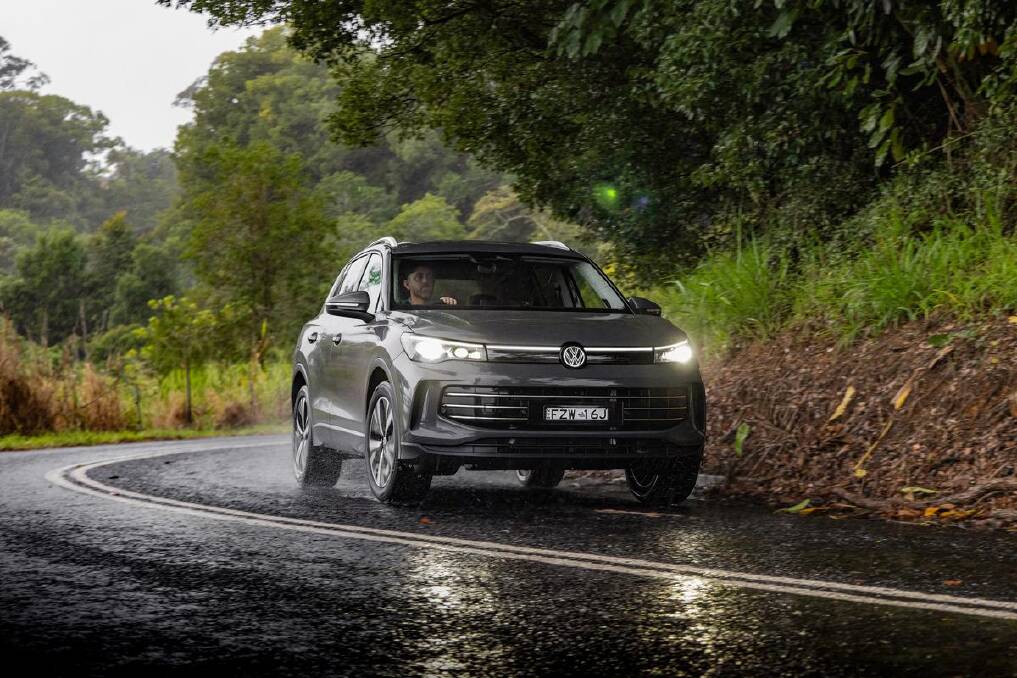
Happily, the Tiguan is a definite bright spot on the soft and spongy horizon of new-car sales in Australia. It feels properly engineered from behind the wheel, with a ride that delivers true connection with the road surface below, even if it does definitely stray into too-hard (and even a bit jittery) territory over corrugated road surfaces. There’s not a huge amount of body roll when cornering, and it feels sorted from behind the wheel.
The way the electric power is delivered in this car is also a bonus. It is very noticeable that it is using exclusively electric power from low speeds. The torque is instantaneous and it propels you forward before the engine kicks in at about 20 kilometers an hour or so. The result is an SUV that feels more like a nippy little EV at city speeds, before turning into plug-in family transport elsewhere.
 View +5 Photos
There are only two quirks that irk me a little. One is the consistency of the brake pedal feel, which sometimes feels like there is plenty of pedal travel, and other times feels like there isn’t much at all, which makes how much pressure to apply a little unpredictable at times. The other is the weight of the steering, which can go from very light as you brake into a corner, before quickly weighting up as you accelerate out. Neither are major problems, but can take a little getting used to.
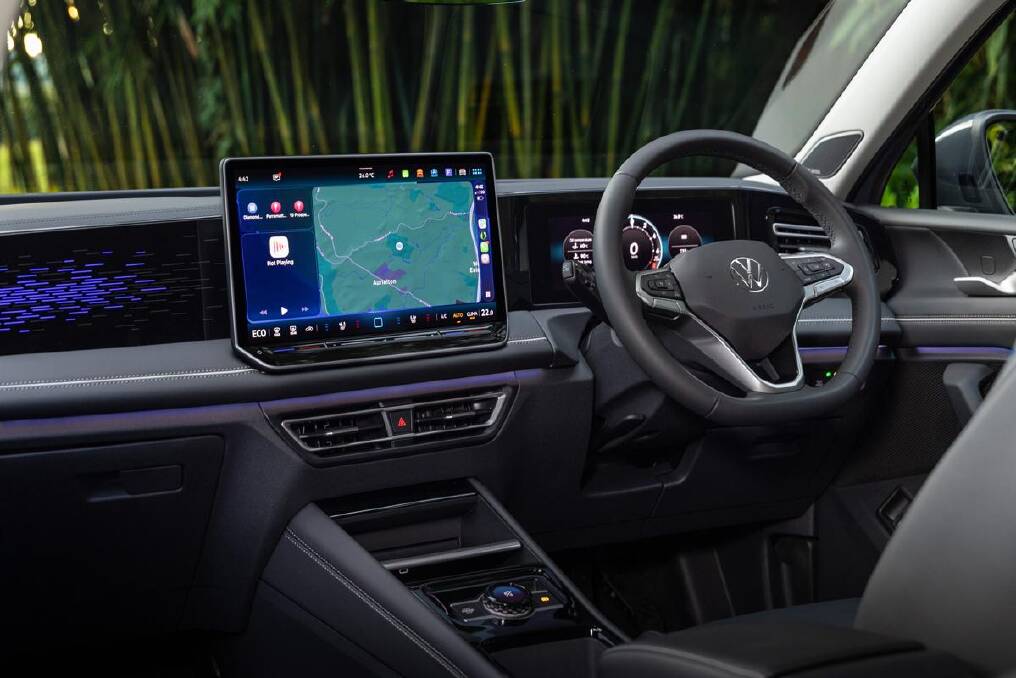
Inside, the interior lighting is customisable and has a nice, sporty touch in the R-Line, while the twin screen setup – including the gigantic centre screen – is premium in look and feel, too.
Be warned though, the driver-distraction monitor doesn’t just sound an alarm, but locks you out of the screen until it decides that you’re paying attention again, so if you’re doing something on the screen, it then freezes.
 View +7 Photos
But kudos to Volkswagen for concocting an iPhone wireless charging solution that actually holds your phone in place, with a little lift flap in the centre console that keeps things secure while charging, whether that’s via the twin USB-C ports or via the twin wireless charging pads.
Elsewhere, and apart from the plastic-feeling centre console edging, everything in the cabin is nicely wrapped, and it does give the sense of a car that just feels well sorted, both on the road and from the driver’s seat.
Space in the backseat is ample for my 175cm frame, and boot space is pretty family friendly – despite a slight space penalty to pay compared to non-hybrid models -with 490 litres with the rear seats in place, and 1486 litres with the second row stowed.
 View +1 Photos
Verdict
The Volkswagen Tigaun eHybrid is a family friendly SUV that’s nice to look at and fun to drive, and one in which electric power only improves the drive experience.
Note: CarsGuide attended this event as a guest of the manufacturer, with travel, accommodation and meals provided.
Note: The author, Andrew Chesterton, is a co-owner of Smart As Media, a content agency and media distribution service with a number of automotive brands among its clients. When producing content for CarsGuide, he does so in accordance with the CarsGuide Editorial Guidelines and Code of Ethics, and the views and opinions expressed in this article are solely those of the author.