
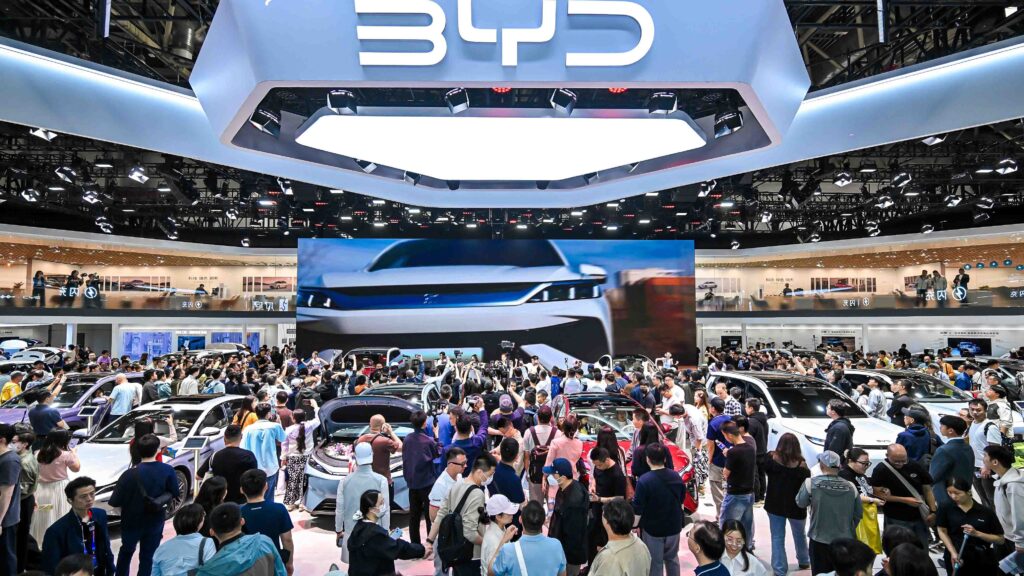
Chinese automaker BYD has guided to full-year sales of 5.0 to 5.5 million new energy vehicles in 2026 — implying year-over-year growth of 10% to 20% — while reiterating an overseas sales target of 1.5 million units.
The guidance was shared during a post-holiday investor call attended by more than 100 participants, where BYD management discussed new model performance and overseas ambitions following the Beijing Auto Show.
JP Morgan analysts first highlighted the targets in a new research note, in which they described three “incremental positive surprises” from the call.
Management guided to domestic sales volume of 3.5 million to 4.0 million units this year, representing growth of 0% to 14% depending on competitive dynamics in the Chinese market.
JP Morgan’s own estimate sits at 3.5 million units — flat year over year — while consensus expectations pointed to flat or a moderate annual decline.
The analysts said the wide range “demonstrates management’s growing confidence in solid order flow for newly launched models installed with BYD‘s ultra-fast charging solution” unveiled at the Beijing Auto Show.
BYD‘s second-generation Flash Charging technology — capable of refilling a battery from 10% to 97% in nine minutes — has drawn both strong consumer interest and public scrutiny from rivals including BMW, Lucid, and Nio.
On overseas markets, BYD reiterated its 1.5 million-unit sales target for 2026, a 50% increase from the approximately 1.05 million vehicles the company exported in 2025.
The figure marks an increase from the 1.3 million overseas target it initially set in January.
Management indicated potential upside risk to the overseas figure due to robust demand, particularly following the recent oil price hike, the note said.
The company further emphasized that its fleet of eight car-carrying vessels — with a combined annual capacity of more than one million vehicles — will be ready to support the push.
Competitive Pressure
The third takeaway from the call concerned domestic profitability.
JP Morgan flagged improving margins from new models equipped with Flash Charging as an underappreciated factor.
The bank estimated that more than 30% of domestic sales volume by the fourth quarter of 2026 will come from new models priced mostly above 200,000 yuan ($29,400).
The figures contrast with 2025, when roughly 70% of BYD‘s domestic volume sat below the 150,000-yuan price point.
The resulting average selling price improvement could exceed 5,000 yuan per unit, per JP Morgan’s estimates — what the bank called “an effective measure to mitigate cost inflation and price competition.”
BYD‘s new Datang — the Dynasty Network’s first D-segment flagship SUV — surpassed 100,000 pre-orders after opening pre-sales at the Beijing Auto Show, with pricing between 250,000 and 320,000 yuan.
The company reported a 55% year-over-year decline in net profit in the first quarter of 2026 — the lowest in more than three years — with earnings falling to 4.08 billion yuan ($561 million).
Operating cash flow collapsed by 67%.
BYD had already posted its first annual profit decline in four years for 2025, when net profit fell 19% despite a record 4.6 million units sold.
Chairman Wang Chuanfu warned in March that competition in China’s EV market had reached “fever pitch,” describing the sector as undergoing a “knockout stage.”
Domestic Sales
The optimistic guidance arrives amid continued pressure on BYD‘s domestic business.
The automaker sold 314,100 new energy vehicles in April, marking the eighth consecutive month of annual decline.
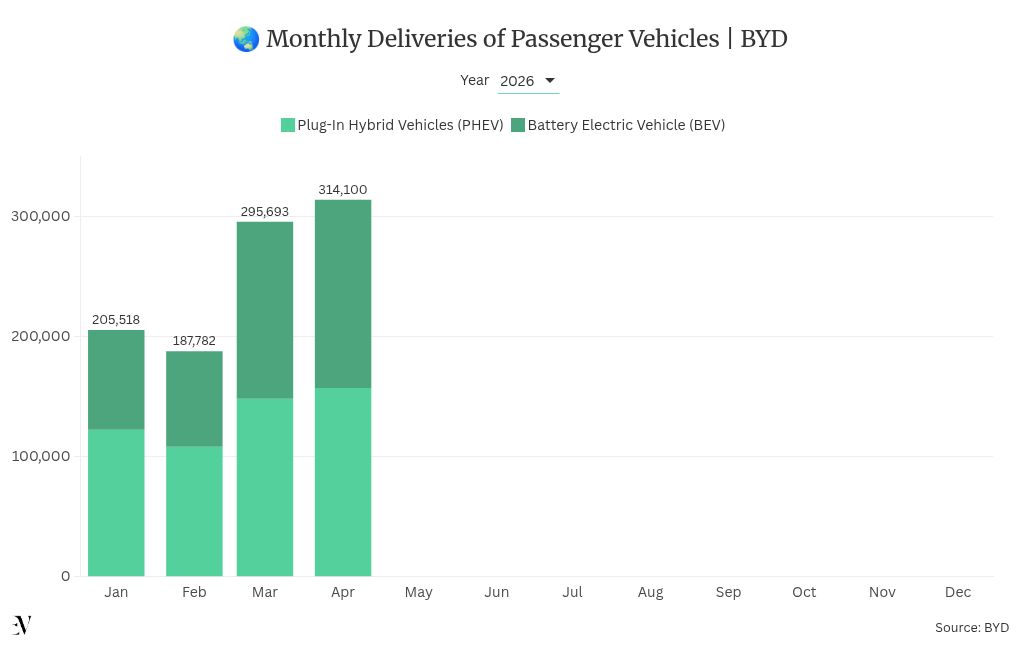
Cumulative sales through the first four months of 2026 stood at approximately 1.02 million units, down around 26% year over year.
BYD‘s core Dynasty and Ocean lineup contributed 273,448 units in April, down 21% from a year earlier.
The full-year guidance of 5.0 to 5.5 million vehicles implies BYD needs to sell between 3.98 and 4.48 million units over the remaining eight months of 2026 — an average monthly pace of roughly 498,000 to 560,000 vehicles.
That would represent a substantial step-up from the approximately 255,000 monthly average registered through the first four months.
Overseas Deliveries
Despite the domestic weakness, BYD‘s overseas business hit a record high in April.
The company sold 134,542 passenger vehicles and pickups outside China, a 70.9% year-over-year increase.
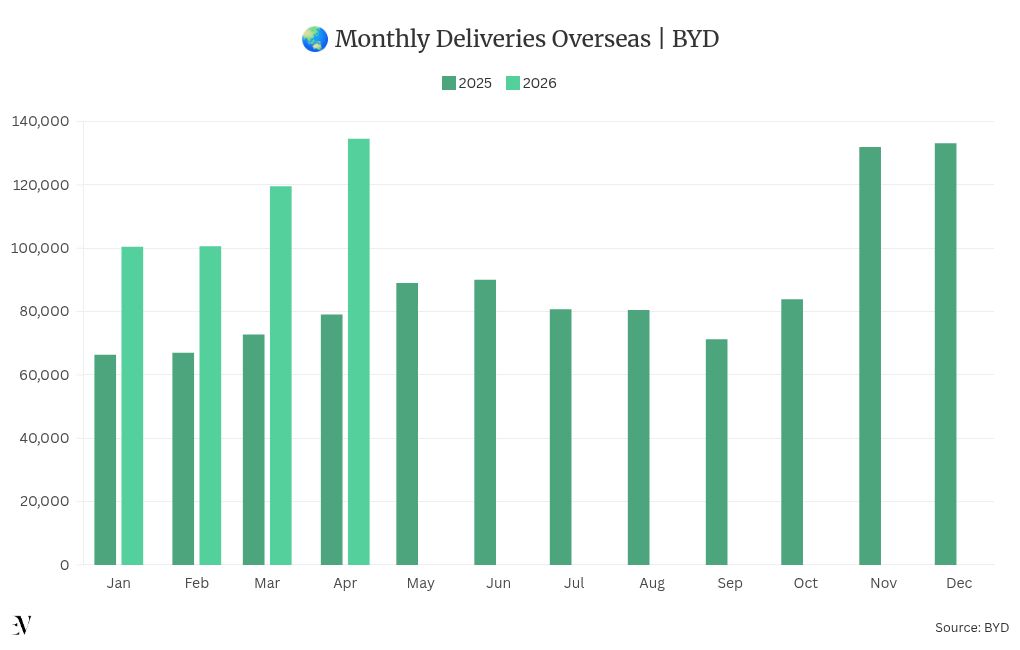
Overseas sales accounted for approximately 42.8% of total April volume.
Through the first four months of the year, BYD sold roughly 456,000 vehicles outside China, up nearly 60% year over year.
Europe has been central to the acceleration.
The company nearly tripled its European sales in March, registering 37,580 vehicles across the continent, according to data from the European Automobile Manufacturers’ Association.
First-quarter EU registrations reached 50,646 units, a 170% year-over-year increase that lifted BYD‘s market share to 1.8% from 0.7% a year earlier.
In Germany, the company set a new monthly record in April with 4,705 registrations — more than tripling year over year.
Year-to-date registrations through four months surged nearly 400% to 13,825 units.
BYD‘s German subsidiary has targeted 50,000 vehicle sales in the country for 2026.
In Spain, the Chinese automaker surpassed 40,000 cumulative registrations three years after entering the market.
The company began trial production at its first European passenger vehicle factory in Szeged, Hungary, in January — with series production expected in the second quarter of 2026.
The company operates additional plants in Thailand, Brazil, Indonesia, and Uzbekistan.
BYD leadership has previously outlined a long-term target of 10 million annual vehicle sales, with roughly half coming from outside China.