
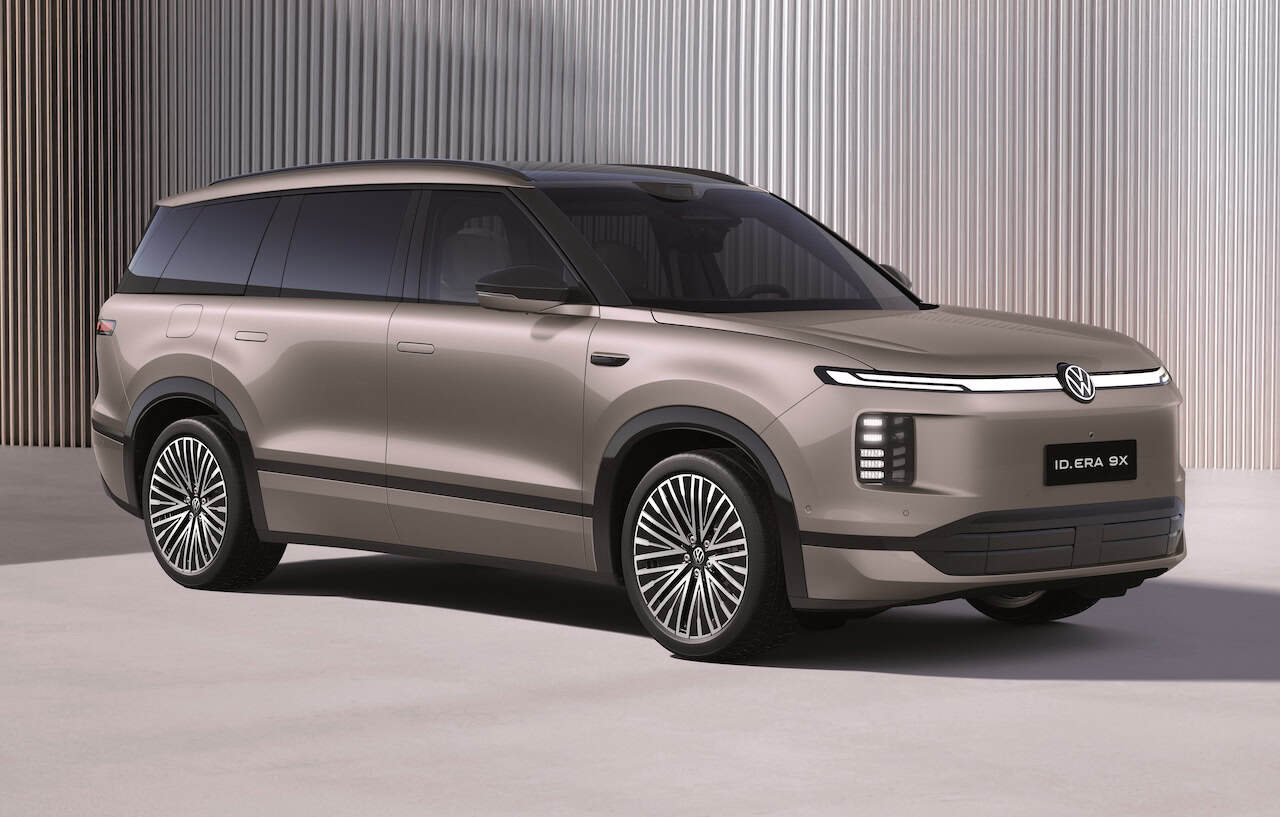
VW has unwrapped its biggest and most advanced plug-in hybrid yet with the launch of the Volkswagen ID. Era 9X.
Measuring an imposing 5.2 metres long, the new seven-seat ID. Era 9X might sound more suited to US buyers than the Chinese buyers it is initially targeted at, but the growing popularity of large SUVs in China proves there’s a market for them.
Developed in partnership with Chinese state-owned SAIC, the new ID. Era 9X is an expression of the German brand’s latest design language, which blends an ultra-slim light bar with split headlamps and an added wide lower intake that features active shutters.
READ MORE: Re-hatched: Why the overhauled Volkswagen ID.3 Neo might finally have everything it needs to do well in Australia and beat the Tesla Model 3 and MG4
READ MORE: Volkswagen ID. Cross electric SUV breaks cover: Critical affordable EV just months from launch
READ MORE: Groundbreaking Electric Volkswagen Golf Mk9 teased for the first time! Is this the super-hatch that finally beats China for tech?
Pop-out door handles, smooth surfaces, a full-width tail-light, floating-effect roof and a prominent LiDAR binnacle are all present.
Sharing the same footprint as the combustion-powered Mercedes-Benz GLS, the new ID. Era 9X is 5207mm long, 1997mm wide and 1810mm tall, with a 3070mm wheelbase.
Remarkably, despite its dimensions, the new battery-powered large SUV has a low drag coefficient of just 0.253Cd for better range and efficiency on the move.
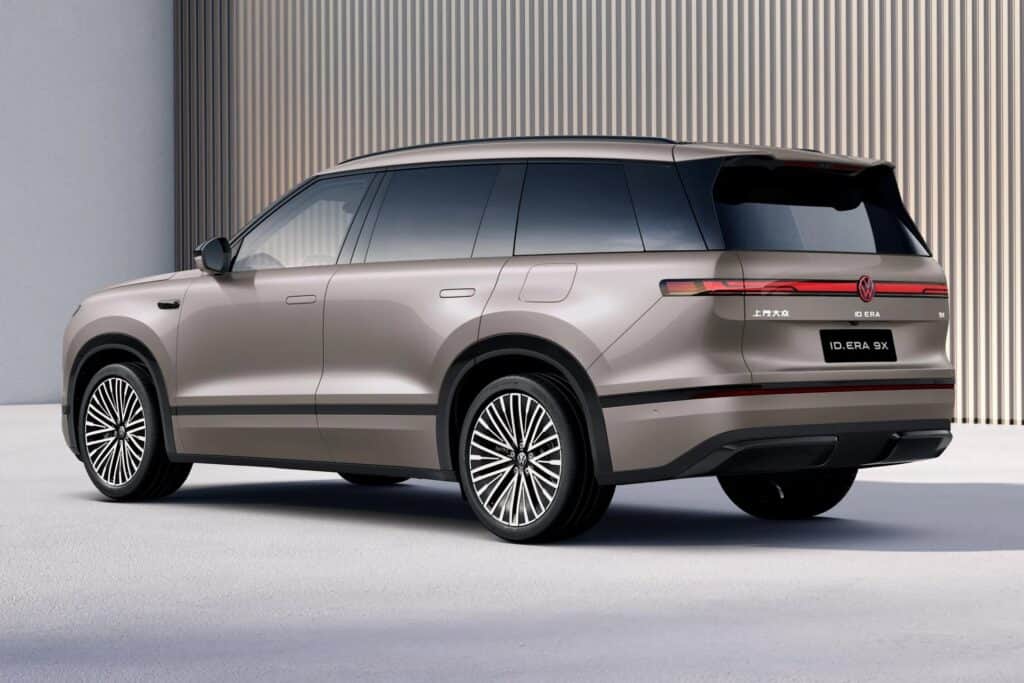 2026 Volkswagen ID. Era 9X.
Inside, the ID. Era 9X offers a 2+2+2 seating arrangement, while ahead of the driver are dual 15.6-inch screens combined with a small 8.9-inch digital instrument cluster and a large head-up display.
In the second row, as well as a pair of 6.0-inch screens in the rear doors, there’s a 21.4-inch screen mounted in the ceiling.
Fresh tech alien to current VW EVs includes four-zone voice and gesture control, a sound system that integrates speakers within the headrests, microphone-free karaoke, zero-gravity heated and cooled massage seats, and configurable 256-colour ambient lighting.
Other handy additions include an onboard fridge with a heating function and navigation-led adaptive cruise control that also takes care of parking when you arrive.
Boot space is limited to just 210 litres with the third row of seats in place, but that figure expands to 1014 litres with the rear seats folded.
Under the bonnet you’ll find Volkswagen’s 1.5-litre turbocharged four-cylinder, but unlike other hybrids from the brand, the combustion engine works only as a generator, or range extender.
While the standard version comes with 370kW dual motors and a 51.1kWh battery for a 347km EV range, the flagship gets 380kW and a larger 65.2kWh battery pack that allows it to travel as far as 406km in zero-emission mode.
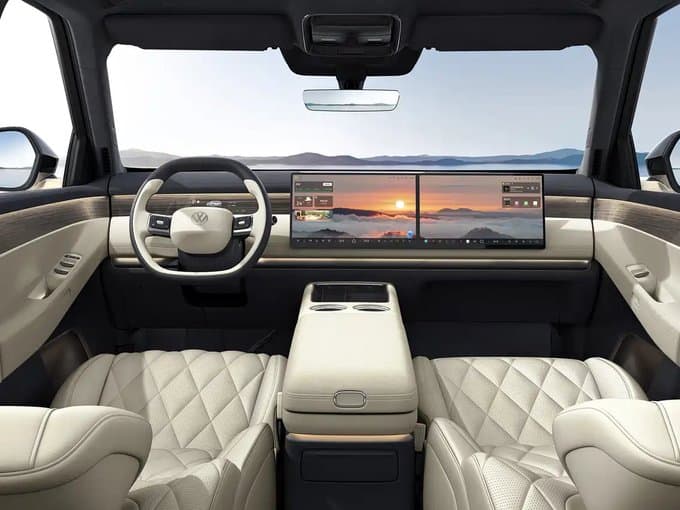 2026 Volkswagen ID. Era 9X.
Off the line, the punchier of the two accelerates from 0-100km/h in just 5.6 seconds.
Total range for both vehicles, once the petrol engine has kicked in, is between 1611km and 1651km, with fuel consumption stated at 6.27L/100km with a depleted battery.
Plug in the ID. Era 9X and, thanks to powerful 800-volt electrics, a 10-80 per cent top-up takes 16.5 minutes.
Helping it deliver what’s claimed to be class-leading comfort is a new dual-chamber air suspension system that works with sensors scanning the road, pre-arming the air springs and dampers for what lies ahead.
In urban environments, new rear-wheel steering earns its keep by slashing the turning circle to just 4.85 metres.
In China, the new ID. Era 9X large SUV has been priced from 309,800 yuan (A$64,000).
There’s no word yet on whether the flagship range-extender hybrid Volkswagen has been engineered for right-hand-drive markets so, for now at least, the ID. Era 9X remains off-limits for Australians.