
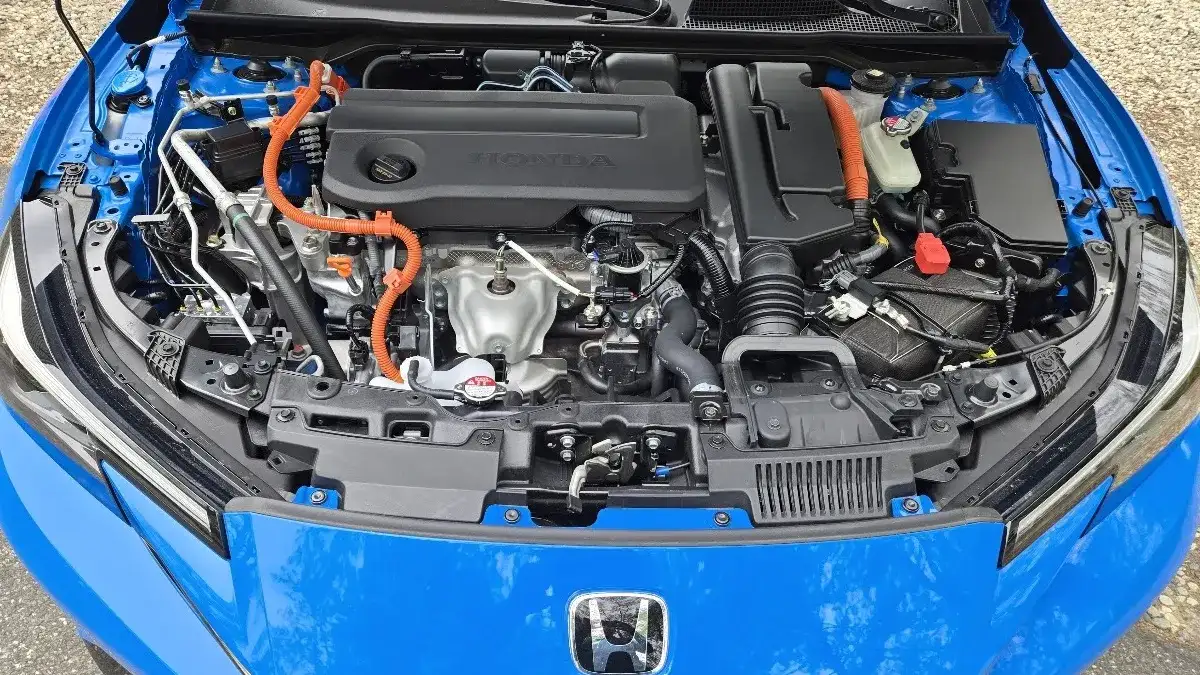
Battery-electric vehicles, a.k.a. “battery-only vehicles,” have many pluses. For many years, one of the biggest of these advantages was the “electric driving experience.” Reviewers, including me, often describe the abundant torque from a stop, the smooth way EVs accelerate, and the quiet, pleasant driving experience of EVs. It’s a definite plus for the powertrain type. But what if you could get that experience, but without the downsides EVs come with? Honda just answered that question.
Honda’s current line of hybrids offers this experience. When you drive a Civic Hybrid, Accord Hybrid, CR-V Hybrid, or Prelude (100% hybrid), you are actually driving electric. In nearly every situation, you are being moved around solely by electric motors. When you start off, the engine isn’t pushing or pulling the car along. When you are accelerating in town, same. Instead, Honda has moved past the way that most hybrids operate, Toyota most notably, and its current technology is basically an EV that can charge its own battery using a notoriously reliable and efficient liquid-fueled engine.
The upshot of this is that you get that satisfying high-torque pull or push. You start off in silence. For nearly all of your drive, the powertrain barely makes a peep. You won’t hear unless you pin the throttle.
This method of converting energy and supplying it to the wheels is not really new. GM’s Volt was hugely popular among owners, and it had this type of powertrain almost twenty years ago. The Volt had a plug as well, but Honda is skipping that. You never need to plug in a Honda hybrid.
Advertising
On the highway, there is a way for the Honda hybrid system to directly power the wheels and help the vehicle move along. There is no transmission involved. Just a clutch. No complex, heavy set of gears. The system is simple and has proven very reliable for Honda.
Instead of plugging in a Honda hybrid, you add liquid fuel (gas paired with ethanol in almost every part of America today). The hybrid system is powered in part by its small engine and in part by regenerative braking, as we explained in our story, “Busting a Myth – Hybrid-Electric Vehicles Don’t “Just Run on Fossil Fuels”. Hybrids use the same trick that EVs do to recapture energy wasted by ICE vehicles. This prolongs brake life, and puts money back in your wallet every time you coast or brake. The CR-V hybrid is about 25% to 33% more fuel-efficient than the conventionally-powered CR-V. That saves a lot of fuel and a lot of carbon emissions.
It takes about 90 seconds to add about 500 miles of range to a CR-V Hybrid. To add that amount of range to a Honda EV, like the Prologue, would take two stops, and roughly an hour on a public DC charger, or about half a day of total charging using a level 2 home EV charger.
Advertising
Contrary to popular belief, hybrids are simpler than conventional powertrains, not more complex. We dove deeply into this in our story Study Finds Hybrids and Gas Cars More Reliable Than Electric Vehicles.
Honda’s hybrid technology is slowly taking root across the brand’s top sellers. The CR-V, Civic, and Accord are the brand’s top sellers and are all offered as hybrids. More than half of the CR-Vs and Accords Honda delivers are now hybrids, and about a third of the Civics are. All of its Prelude sport coupes are hybrids. Honda is now delivering about 100,000 of its hybrids each quarter and may well reach a half-million-per-year pace in 2026.
It’s not just one type of vehicle that benefits from hybridization. Honda’s hybrid tech is applicable to everyday sedans like the Civic and Accord, off-pavement SUVs like the CR-V TrailSport, and sportscar coupes like Honda’s fun-to-drive Prelude.
With tariffs being a concern for many automakers (Chevy uses a Chinese battery in its 2026 Bolt EV), Honda was wise enough to tariff-proof its hybrid system. Honda’s hybrid-electric power unit is built by the Honda Transmission Plant in Ohio. The 2.0-liter Atkinson-cycle four-cylinder engine is made at the Anna Engine plant in Ohio. By on-shoring its hybrid powertrain, Honda sidesteps import duties.
With energy experiencing a price spike in Q1, Honda’s hybrids had their best month of sales in company history. Contrast that with its all-electric models dropping by 42% in that same period. Clearly, Americans are starting to lean towards hybrids as time passes. This is true of all brands. In Q1, EVs had their worst market share since 2020, and Hybrids added market share. Hybrids now outsell EVs by three to one in America, and the gap is widening.
For the EV-only crowd, this should be a wake-up call. The argument that battery-electric vehicles offer a uniquely superior driving experience no longer holds water. Honda has delivered the silent starts, the instant torque, the smooth and quiet acceleration, and the regenerative braking, all without the range anxiety, the charging headaches, the hours spent tethered to a plug, or the premium price tag. You get the best parts of driving electric with none of the compromises, and you fuel up in 90 seconds at any corner in America. As Honda’s hybrid sales climb toward record territory and EV sales slide, the market is sending a clear message: drivers want the electric experience, not necessarily the electric-only lifestyle. Honda figured that out, and the rest of the industry, along with the true believers who insist batteries are the only path forward, should be paying very close attention.
John Goreham is a 14-year veteran of Torque News. An accomplished writer and a long-time expert in vehicle testing, Goreham also serves as the Vice President of the New England Motor Press Association and has a growing social media presence. He’s also a 10-year staff writer and community moderator for Car Talk. Goreham holds a B.S. in Mechanical Engineering and an undergraduate Certificate in Marketing. In addition to vehicle and tire content, he offers deep dives into market trends and opinion pieces. You can follow John Goreham on X and TikTok, and connect with him on LinkedIn.
Follow us today…


