
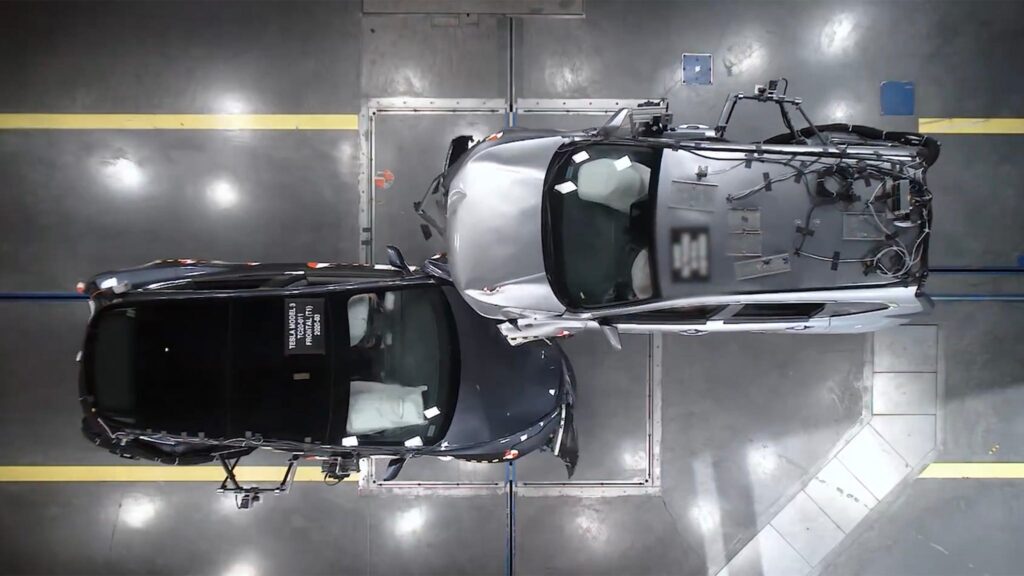
In the event of a car crash, every millisecond counts. Simply put, the more time you have to react, the better your chances are of reducing the risk of serious injury. Now, through an update to Tesla Vision, the automaker’s suite of exterior cameras, Tesla is aiming to have its cars do exactly that: respond to a crash even earlier by deploying its airbags and other safety measures just prior to the moment of impact.
The new capability added to Tesla Vision will reportedly allow it to “watch” for a crash. Tesla says the system will be able to identify when the car will make contact as well as the potential severity of the crash, and then it will pass that information along to the airbag controller so it can start deploying the airbags and pre-tensioning the seatbelts. The entire process apparently takes as little as 70 milliseconds.
ADVERTISEMENT – CONTINUE READING BELOW
To be clear, Tesla Vision isn’t designed to replace the traditional impact sensors. “We’re still using impact sensors to detect crashes,” Jarad Hutchinson, a crash analysis engineer at Tesla, said in a video uploaded to X on May 8. “We’re just supplementing our decisions by using information from the Vision system.” In response to an X user’s question about a potential false deployment, Tesla pointed to a September 2025 post that said the cars’ airbags “do not deploy based on Tesla Vision alone.”
The update occurred as part of a May 9 software update.
ADVERTISEMENT – CONTINUE READING BELOW
It’s an interesting use of a vision-based sensor system. Traditional safety sensors, while usually located in bumpers or other crumple zones, have to detect impact first before deploying airbags and seatbelt tensioners. Of course, by that point, the impact is also already at work on the occupants in the car. Earlier deployment of safety equipment would only help matters.
If Tesla Vision can indeed deploy safety equipment a fraction of a second faster than a traditional setup in the event of an unavoidable crash, we’re all for it, but of course, we’re interested to see how quickly it works under independent safety testing.