
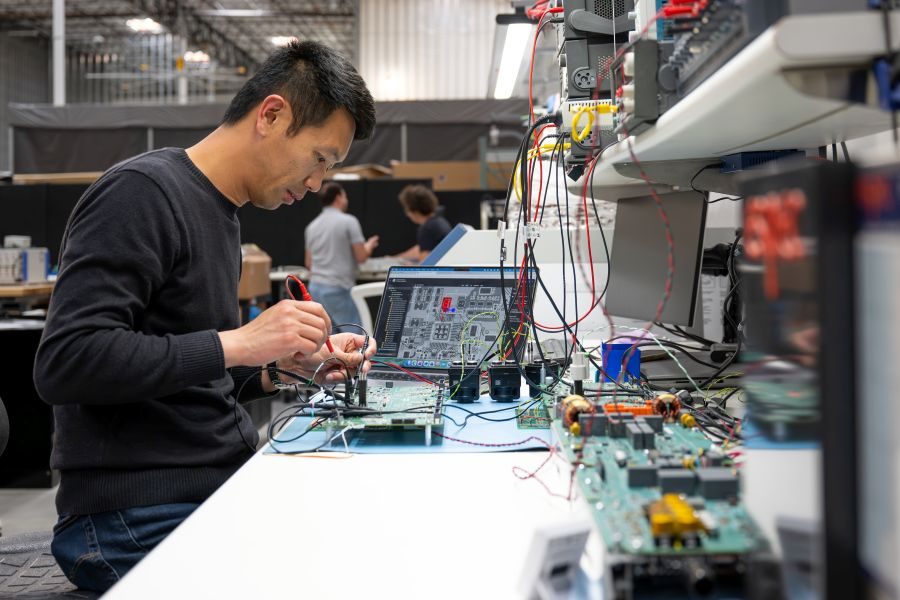
LONG BEACH, CA—Ford Motor Co. is rethinking how it designs and builds electric vehicles at a state-of-the-art facility here. A team of engineers based there is in the process of developing an affordable mid-size pickup truck. Their mantra is “testing early, fail fast.”
More than 350 people are currently working on the project at the automaker’s Electric Vehicle Development Center (EVDC). Everyone is focused on Ford’s Universal EV Platform, which will use gigacastings and a streamlined production process to mass-produce the next-generation vehicle at the retooled Louisville Assembly Plant.
The EVDC features a campus layout that enables employees to develop new ideas in a nontraditional environment. Innovations can quickly evolve from raw materials to physical prototypes. Engineers can move ideas from concept to testing in a matter of hours or days instead of weeks or months.
The facility includes a meeting room equipped with a floor-to-ceiling LED wall to display life-sized vehicles. In addition, a 22,000-square-foot design studio that’s centrally located on the campus features seven milling towers for modeling at scale, plus 3D printers, a trim shop and a 360-degree turntable.
Every team member has access to a fabrication shop for turnarounds on full-size prototypes that can take as little as 30 minutes to produce. Whether an engineer needs to craft from metal, foam, clay or composites, they can do so with onsite resources. A five-axis gantry machine with a large robotic arm can carve full-size vehicle models in just a few days. Tools equipped with water-cutting jets can also cut metal.
For smaller components, such as seating and other interior elements, the trim shop features banks of sewing and cutting machines for crafting prototypes. No matter the part, the EVDC shop can sculpt and shape it for a hands-on representation, reducing a typical three-month turnaround to as little as two weeks.
Labs can test prototypes in almost any simulated weather or load condition. In the battery lab, for instance,a thermal shock chamber tests battery packs, while ultra-high precision coulometer technology simulates years of wear in weeks.
Looking for quick answers on assembly and manufacturing topics?
Try Ask ASM, our new smart AI search tool.
Ask ASM →
Nearby, a thermal lab that can accommodate full-size vehicles can mimic environmental extremes to see how batteries and other parts hold up. A climatic chassis dyno lab simulates grade, humidity, speed and wind resistance using 48-inch rollers.
This isn’t the first time that has Ford operated a facility in Long Beach. Indeed, between 1930 and 1958, the automaker owned an assembly plant adjacent to the city’s harbor that once mass-produced everything from Model A’s to Fairlane sedans.