
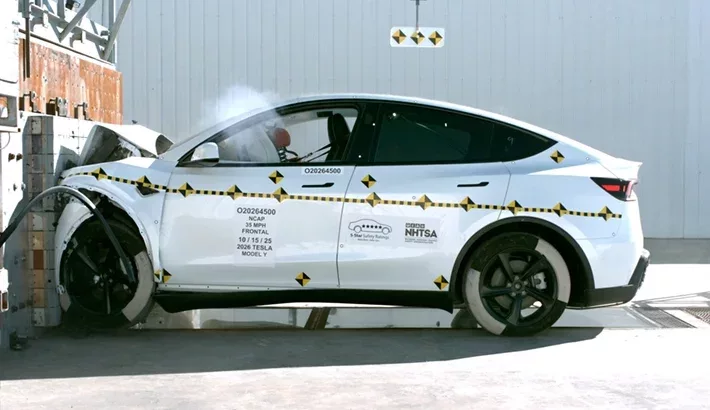
The Tesla Model Y 2026 model year has been officially recognized as the safest vehicle under the updated evaluation criteria for new cars in the United States. The National Highway Traffic Safety Administration (NHTSA) confirmed that the crossover became the first vehicle to successfully pass all sections of the modernized NCAP program. This result demonstrates that Tesla’s active safety technologies can prevent accidents more effectively than competing solutions.
Overview of the new NHTSA 2026 safety requirements
The updated NHTSA testing program is a response to changing road conditions and the rapid technological development of the automotive industry. The tests have become significantly more demanding: regulators have shifted the focus from passive crash protection to active accident prevention systems. The Tesla Model Y, produced after November 12, 2025, demonstrated the ability of its automation to react instantly in situations where human drivers may become inattentive. Experts note that Tesla’s success sets the direction for the entire EV market for years to come.
ADAS features and system overview
To pass the NCAP program, a vehicle must demonstrate the effectiveness of eight Advanced Driver Assistance Systems (ADAS). This list includes both standard features and new algorithms that had not previously been subjected to such strict evaluation. The Tesla Model Y performed flawlessly in the following scenarios:
Automatic emergency braking for pedestrian detection (a completely new test module);
Lane Keeping Assist (LKA);
Blind-spot obstacle detection warnings;
Active collision avoidance during lane changes;
Emergency braking for stationary objects on the road.
Regulators specifically highlighted the performance of the sensors, which are now required not only to recognize objects but also to intervene in real time to protect pedestrians and road users.
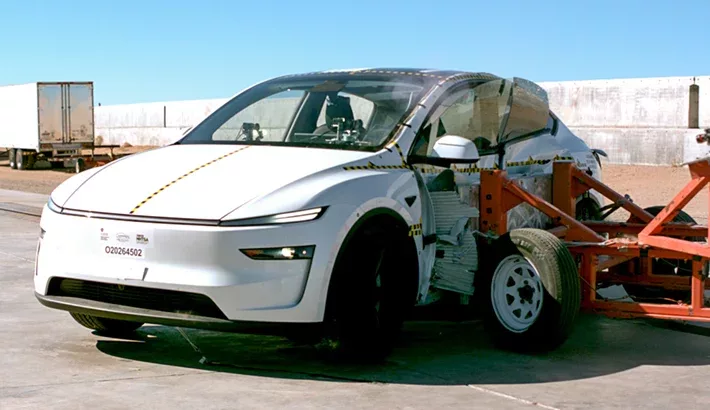
Testing differences and certification importance
The main difference in the 2026 program is that simply having a feature listed in the equipment package no longer guarantees passing the test. Jonathan Morrison from NHTSA emphasized that the agency now objectively measures software performance in real-world conditions. Tesla’s ability to adapt both software and hardware faster than competitors further confirms its technological lead. While companies such as Toyota and Hyroad focus on alternative technologies like hydrogen-powered trucks, Tesla prioritizes protecting everyday consumers in urban environments.
Tesla Vision system features
Although discussions around Full Self-Driving (FSD) and robotaxi ambitions continue, the NHTSA certification confirms the baseline reliability of Tesla’s standard safety systems. Elon Musk’s approach relies on cameras and neural networks, which managed to meet regulatory requirements without the use of expensive LiDAR systems. The Model Y’s road monitoring system has learned to anticipate pedestrian behavior, which became a key factor in its success in the updated NCAP program.
Safety first
For buyers whose primary concern is family protection and accident prevention caused by human error, the Tesla Model Y 2026 is currently the only option officially certified to meet the latest standards. Today, this electric vehicle offers one of the most advanced systems for preventing frontal and side collisions. As new regulations come into force in 2026, the Model Y is expected to remain a benchmark of reliability and innovation in the active safety segment.
Don’t miss interesting news
Subscribe to our channels and read announcements of high-tech news, tes