
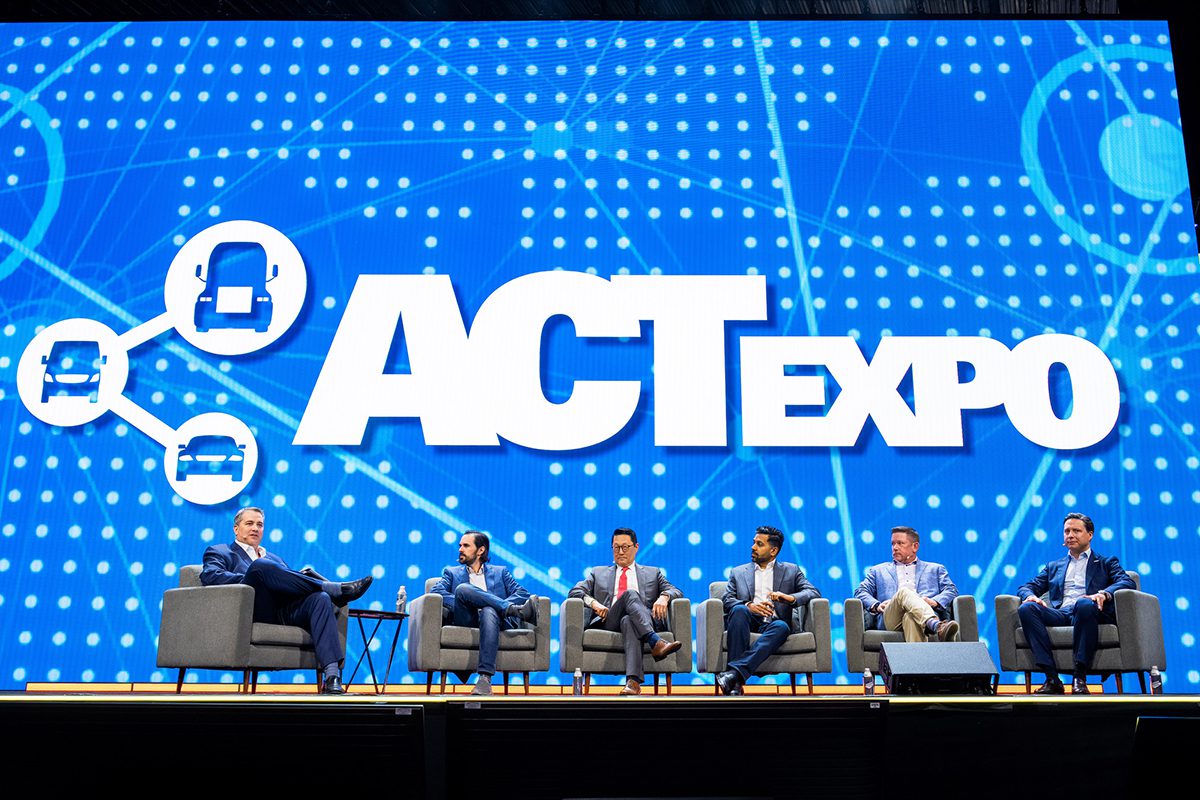
The commercial EV market has entered a more pragmatic phase.
That was the central theme of the ACT Expo panel “Commercial EV Reality Check: The Road Ahead for Fleets,” moderated by Erik Neandross, president of TRC Companies’ Clean Transportation Solutions team, with panelists John Harris, co-founder and CEO of Harbinger; Bob Lee, president of North America at LG Energy Solution; Mustafa Samiwala, principal of fleet development at Amazon; Steve Hanson, senior director of fleet operations, engineering and sustainability at PepsiCo; and Brandt Hastings, president of North America at ABB E-mobility.
Neandross opened the discussion by acknowledging a turbulent year for the EV market and asking the panelists for a direct assessment.
The answer from the panel was broadly optimistic, but with important caveats. The commercial EV market is not collapsing, panelists said, but it is changing. Early adoption driven by sustainability goals, incentives and regulation is giving way to a tougher, more operationally grounded phase focused on costs, energy, infrastructure and utilization.
“I think we had maybe a rough 2025, where people waited to see what was really going to happen,” Harris said. “But I think we’re going to sell more EVs under this administration than the last one.”
Harris pointed to fuel prices as one of the strongest arguments for electrification.
“There’s no better sales tool for EVs than fuel at $8 a gallon,” he said.
Hastings said the charging infrastructure conversation has changed significantly over the past year. The first phase of EV infrastructure deployment was focused on scale and charger nameplate power. The next phase, he said, is about economics.
“The conversation is completely shifting,” Hastings said. “The sort of first phase was all about rollout, sort of, how can I scale my network as quickly as I can?”
Now, he said, fleets and charging providers are asking a different question: “How do I deliver charging and energy most efficiently, especially to my fleets that we’re serving?”
Lee said the battery sector has also had to adjust to a slower-than-expected EV ramp. LG Energy Solution has eight plants in North America, seven of them in the U.S., with half already in production and the rest expected to enter production this year. But the company has had to redirect parts of its strategy toward energy storage, grid stability and data centers as the EV market recalibrates.
“The expectation was so high five years ago,” said Lee. “The market really never caught up to that expectation. But it is growing. It is a compelling product.”
LG Energy Solution is now focused on helping customers lower costs through chemistries such as LFP and lower-nickel formulations.
“We need to just figure out what are the markets where we have total cost of ownership and really focus on that,” he added.
For fleets, that total cost of ownership conversation is now central. Neandross asked Amazon and PepsiCo how they are thinking about EVs amid elevated and volatile diesel and gasoline prices, and whether electrification is becoming a hedge against energy risk.
According to Hanson, PepsiCo has not necessarily framed EVs primarily as a forward-looking fuel price hedge, but he said a balanced fleet portfolio helps manage risk.
“From a risk mitigation standpoint, I think the more balanced portfolio you have, the better you are,” he said, adding that PepsiCo has spent more time working on resiliency for EVs, including how to keep operations running through natural disasters and other disruptions.
“This current phenomenon of high gas and diesel prices, we’ll see how it endures,” said Hanson. “It certainly makes us look a little bit smarter at the moment.”
Harris believes the commercial EV market is entering what he described as a third era of adoption. The first phase was driven by sustainability and regulation. The second was driven by cost. Now, he said, energy security and resiliency are becoming more important.
“I think we’re really rapidly transitioning to what you might think of as the Third Age of why people are buying EVs,” said Harris, adding that the earlier policy-driven framework relied too heavily on regulatory pressure. “That was almost entirely stick and very little carrot, and was not a particularly effective framework.”
Samiwala pointed to Amazon’s disciplined approach to commercial EV deployment, with the company seeing the business case hold up in real-world operations.
“I can confirm what we see is the TCO does work,” said Samiwala. “The fuel advantage is there over ICE vehicles and the maintenance aspects that we anticipated.”
One area that has exceeded expectations, he said, is uptime tied to software-defined vehicles.
“The one that’s surprising us — and pleasantly — is the uptime benefit from the software defined vehicle,” Samiwala said.
Amazon operates more than 30,000 electric delivery vehicles and has installed more than 50,000 chargers for last-mile delivery operations. According to Samiwala, the data coming from vehicles, chargers and the grid is helping Amazon improve utilization, match vehicles to routes and move beyond a break-even TCO model.
“We’re getting this benefit of a ton of data coming off the vehicles and off the chargers, off the grid,” Samiwala said, adding that the goal is to make those vehicles more productive. “Those two things allow us to go from this break-even TCO that everybody was targeting to a TCO that’s actually better.”
PepsiCo has learned that EV economics depend heavily on fit, route and charging strategy. In the earliest deployments, the focus was to get EVs into operation without disrupting the business, according to Hanson. Since then, the company has moved through phases of optimization around charging, energy management and rate mitigation.
“We’ve seen and gained a lot of intelligence in the fit and route and what we can do,” he said, but two financial questions remain unresolved —how EVs will age over a full life cycle and what the secondary market will look like.
Residual value remains a major issue for TCO models, particularly because commercial fleets are used to having established secondary markets for conventional vehicles.
“What’s that secondary market look like?” Hanson added. “We need to get those answers to really unlock some of the financial elements that we’ve become accustomed to in the conventional vehicle space.”
Infrastructure is another factor that can make or break the economics. Hanson said early EV deployments often burden each project with both vehicle costs and the cost of installing new charging infrastructure. That creates a different financial picture than buying diesel vehicles into a mature fueling ecosystem.
“We don’t burden the diesel purchase with building the truck stop on the interstate,” Hanson said. “We’ve had that infrastructure for generations.”
The charging infrastructure, according to Hastings, needs to be evaluated through a broader lens than upfront capital expense. ABB E-mobility is seeing fleets look more closely at operating costs, energy efficiency, reliability and the ability to scale infrastructure over time.
“The most successful partners are taking many other factors into consideration,” he said, adding that a small efficiency loss in charging systems can have a large financial impact.
“A one to 2% efficiency loss on a charging system could equate to a massive amount of money,” said Hastings. “It could even underwrite the entire capex of the charging system over a 10-year lifespan.”
Hastings also warned against overbuilding charging infrastructure too early. Instead, he said, fleets should deploy systems that are expandable and aligned with actual demand at a site.
“You actually don’t want to overbuild for a specific depot or for an application or a site,” he said. “You want to build and grow with your demand.”
The consequences of unreliable charging are direct for fleet operators.
“Trucks don’t roll because they’re not able to charge, that’s an operational loss for a fleet operator,” he added.
Lee agreed that TCO will ultimately determine where EVs win share. Some commercial applications, particularly short urban routes with a lot of stop-and-go operation, have already reached a compelling cost case. Other segments, such as long haul, remain more difficult.
“At the end of the day, total cost of ownership is what wins in the marketplace,” he said, adding that the industry is likely to operate in a multi-powertrain environment for the next decade.
But Lee said EVs still have room for major cost improvement because the technology is relatively new and not yet fully scaled.
“We have a lot more upside, I think, in terms of lowering our cost compared to the existing technology,” Lee said.
Harris agreed that charging is now one of the biggest levers for improving EV economics.
“The charging piece is really the challenge of the day at this point,” Harris said. “It’s not viability of the technology. It’s no longer availability of battery cell supply.”
The question, he said, is whether charging can be delivered cost effectively enough to support the routes fleets need to run.
For heavy-duty vehicles, Samiwala expressed that infrastructure remains a tougher challenge than in last-mile delivery because vehicles do not always return to the same location every day. Amazon is installing hundreds of chargers at fulfillment centers and hubs, but corridor charging will require broader coordination among fleets, utilities and charging companies.
“We always thought the infrastructure would be the gating factor,” he said. “I think in middle mile and every city, we’re seeing much more the case than it’s been for us in last mile.”
The panel also addressed residual value and battery recycling. Harris said manufacturers may believe in the durability and long-term value of EVs, but finance teams want historical data that does not yet exist.
“The secondary value is something that no one is going to be satisfied with the answer until it’s something that we’re looking at data that exists in the past,” Harris said.
For that reason, he said, acquisition price and charging cost remain critical.
“Right now, there’s just not going to be an answer that anybody is happy with on what is the residual value of the vehicle,” he said.
Lee believes that EVs may ultimately recover more value at end of life because batteries can be recycled for valuable materials more efficiently than many components in traditional vehicles.
“You can recycle batteries in a much more efficient way to capture other materials than traditional vehicles,” Lee said.
But he acknowledged that large-scale recycling benefits are still years away.
“That’s going to be a huge opportunity, but that’s going to come probably 10 years from now,” Lee said.
On battery technology, Lee said the industry has shifted from focusing primarily on high-nickel chemistries and maximum energy density to more affordable products. LG Energy Solution is producing LFP batteries and working on mid-nickel formulations and lithium-manganese-rich chemistries that reduce or eliminate expensive materials such as cobalt.
“Over the last few years, there’s been a tremendous amount of innovation, lots of research, but it’s been driven by affordability and driving down cost,” Lee said.
He said commercialization of additional lower-cost chemistries is expected within the next couple of years.
“It’s not necessarily focused on performance,” Lee said. “It’s more focused on economics.”
Utilization emerged as another key theme. Samiwala said fleets need to use EVs more intensively to unlock their economic advantages.
“At the end of the day, the vehicles work,” Samiwala said. “And so the key is to use them.”
He said many fleets still rely on internal-combustion vehicles as backups for each EV, which will not work at scale.
“Today, I think a lot of fleets have an ICE vehicle backing up every EV they have,” Samiwala said. “That’s not going to work at any level of scale.”
Hanson said the industry also needs to improve vehicle-to-route matching. Early EV deployments often selected the shortest routes because fleets were worried about range, batteries and charging. But those low-mileage routes do not always generate enough savings to justify the investment.
“It’s hard to make the TCO work for that when you’re only saving 50 miles a day of range,” Hanson said.
The industry then swung too far in the other direction by trying to place EVs on the longest possible routes to maximize savings per mile.
“Both of those are kind of the wrong answer,” Hanson said.
The better approach, he said, is to match the right vehicle to the right route and operating environment.
“I’m constantly talking to our fleet customers about, guys, there’s fruit laying on the ground,” Hanson said. “Let’s go pick it up. Then let’s go to the lowest branches.”
Driver acceptance is another factor that can strengthen the value proposition, especially in light-duty and last-mile applications. Hanson said PepsiCo has seen strong driver acceptance once drivers experience the vehicles.
“What we’ve seen, though, in both applications, is once people get in and develop that comfort … both populations have had a high acceptance,” Hanson said.
Samiwala said electrification gives fleets an opportunity to design a better vehicle experience around the job.
“This isn’t getting drivers to convert to an inferior vehicle, an inferior experience,” Samiwala said. “It is a really great experience. It’s designed for it.”
The panel also explored the role of artificial intelligence in fleet electrification. Samiwala said AI is touching nearly every layer of Amazon’s EV operations, from route planning and vehicle matching to charging optimization and demand charge management.
“AI is touching every layer of electrification,” Samiwala said.
Because Amazon has tens of thousands of vehicles and chargers producing data, AI can help build tools that improve utilization and operations.
“We have 30,000-plus vehicles. We have 50,000-plus chargers,” Samiwala said. “We have a lot of data coming in that AI can then use to make better decisions.”
Harris said the AI data center boom could indirectly benefit EV charging by forcing investment and innovation in electrical infrastructure. While vehicle electrification requires tens of billions of dollars in infrastructure, he said hyperscale AI data centers are driving a much larger wave of capital demand for power.
“The capex budget just in 2026 for AI compute data centers just among the hyperscalers is $750 billion,” Harris said.
That level of investment, he said, will bring more urgency to solving grid bottlenecks.
“Once people figure out how to deploy gigawatts of power much more quickly, we’re going to be able to deploy charging infrastructure much more quickly,” Harris said.
Hastings said ABB E-mobility is already using AI to improve charging reliability and maintenance.
“AI helps us understand maintenance cases before they even come up,” Hastings said.
The goal, he said, is to detect and address charging problems before they affect fleet operations.
“I want to know about a problem before it becomes a problem,” Hastings said.
Lee said LG Energy Solution is using AI in battery manufacturing, particularly for process and quality control.
“For us, our primary application right now for AI is we use it for manufacturing control, quality control,” Lee said.
Battery manufacturing is highly complex, he said, and factors such as temperature and humidity affect product performance.
“We use AI to try to determine when we need to reset parameters, when we need to adjust parameters,” Lee said.
The conversation then turned to global competition. Harris said China’s rapid EV adoption, including in commercial vehicles, should not be ignored. He argued that some manufacturers outside China are underestimating how quickly low-cost EVs can reshape markets.
“We’re really at an inflection point where manufacturers in the U.S. are either going to build price competitive EVs that people actually want to buy, or they’re quickly going to be in a position where they don’t need to build anything at all,” Harris said.
Samiwala said Amazon takes a more optimistic view because global deployments create learnings that can be brought back to the U.S. He pointed to Amazon’s electric bike deployments in Europe and more than 10,000 EVs in India across two-wheelers, three-wheelers and four-wheelers.
“Innovation and momentum that come from other geographies can carry over,” Samiwala said.
Those deployments, he said, reinforce the need to match vehicle form factor to geography and operating requirements.
“We’ve learned both that those are also very viable form factors for delivery and the need to match the form factor, the vehicle, to the geography where you’re operating it,” Samiwala said.
Lee said he is concerned that slower U.S. EV adoption could put the country behind in the technologies that will shape the future.
“What is going to be the technology of the future, and who is innovating in that technology?” Lee said.
He said markets that move faster can become lead markets for innovation.
“It is a concerning point for me that other markets are taking up a little bit faster,” Lee said. “We have to work hard to catch up.”
Hastings was more optimistic, saying electrification is clearly underway and the industry is now focused on improving the business case.
“The train has left the station,” Hastings said. “Clearly, electrification is happening, here to stay.”
Looking ahead, the panelists outlined the priorities they believe will define the next phase of commercial EV adoption.
For charging, Hastings said the industry must focus on the cost per kilowatt-hour delivered to fleet operators, with reliability and system efficiency becoming central metrics.
“How do we, at a systematic and a site level, deliver the most efficient cost per kilowatt-hour delivered to the operator?” Hastings said.
He said ABB’s goal is to make charging infrastructure operate with telecom-like reliability.
“How do we make charging infrastructure telecom-like?” Hastings said. “Infrastructure that works flawlessly in the background and actually creates value for the operator versus taking away value.”
For Amazon, Samiwala said the next stage is about infrastructure for heavy-duty vehicles, additional form factors and deeper partnerships between fleets and OEMs.
“Ten years ago, we had zero electric vehicles,” Samiwala said. “Five years ago, we were designing our vehicle with Rivian. Today we have 30,000-plus of those on the road.”
The company does not intend to slow down, he said.
“We have no intention of slowing down,” Samiwala said.
Harris said he expects hybrid powertrains to take on a larger role in the near term, especially for use cases where pure EVs remain difficult.
“I think next year, the show floor is going to be all about hybrids,” Harris said.
He said pure EVs are already working in the right applications, but there are still duty cycles that require either major battery cost and technology improvements or a different solution.
“The answer isn’t to keep banging our head against the wall saying, I need electric Class 8 trucks with an 800-mile range,” Harris said. “The answer is going to be series hybrids.”
Lee said LG Energy Solution will continue working on battery chemistries, lower-cost systems and standardization for commercial vehicles.
“Chemistry is one of the things we’re working on, so we’re really trying to drive down costs,” Lee said.
He also sees an opportunity for standard battery products in commercial vehicles, where volumes are lower than in passenger cars.
“If we’re able to have standardized products with competition across the players, I think that’s going to help a lot in terms of driving down costs as well,” Lee said.
Hanson said PepsiCo is focused on creating more value from the infrastructure and operating foundation it has already built. The company has made major infrastructure investments in recent years and is now looking at ways to optimize charging, increase utilization and potentially create new value streams.
“We made massive infrastructure investments over the last five, six years,” Hanson said. “What are value-generating solutions we can do with that where the company assumed that it’s just a cost?”
Looking toward 2035, panelists expressed confidence that EVs will be far more common across commercial transportation, though adoption will vary by segment and application.
Samiwala said Amazon believes the industry has learned many of the hardest lessons and should now be able to scale.
“We’ve kind of gotten over the hump,” Samiwala said. “We’ve learned a lot of the long, hard lessons.”
By 2035, he said, the hope is that many large fleets will have reached Amazon-like scale.
“Hopefully, 100 different fleets of this size can be able to be on this panel,” Samiwala said.
Lee said the future of mobility is electric, even if the exact timeline varies.
“The future is electric,” Lee said.
By 2035, he said, mobility could be nearly fully electrified, with autonomous driving playing a significant role and infrastructure operating seamlessly in the background.
“The reason why we all got there is because we had a winning business case,” Lee said.
Harris said some segments could be so thoroughly electrified by 2035 that combustion vehicles appear outdated.
“There’s going to be segments that we look at where a combustion vehicle feels like a sort of shocking anachronism,” Harris said.
He pointed to school buses, last-mile delivery vehicles and taxis as segments where combustion vehicles could become unusual.
“For significant swaths in the commercial vehicle industry, it will be pretty close to ubiquitous at that point,” Harris said.
Neandross closed the panel by noting the level of agreement across the group. Despite market uncertainty, the speakers described an industry that has moved beyond depending solely on regulation, incentives or external pressure.
“I’m hearing a lot of consensus that we are moving forward,” Neandross said. “We’re moving in an upward direction, and we have a solid enough ground to stand on, as far as the business case to make this work.”
For fleets, that may be the clearest reality check of all: commercial EVs are no longer just about early adoption. The next phase will be about matching the right vehicles to the right routes, building charging infrastructure that works as a business asset, using data and AI to improve utilization, and proving that electrification can win on economics at scale.