
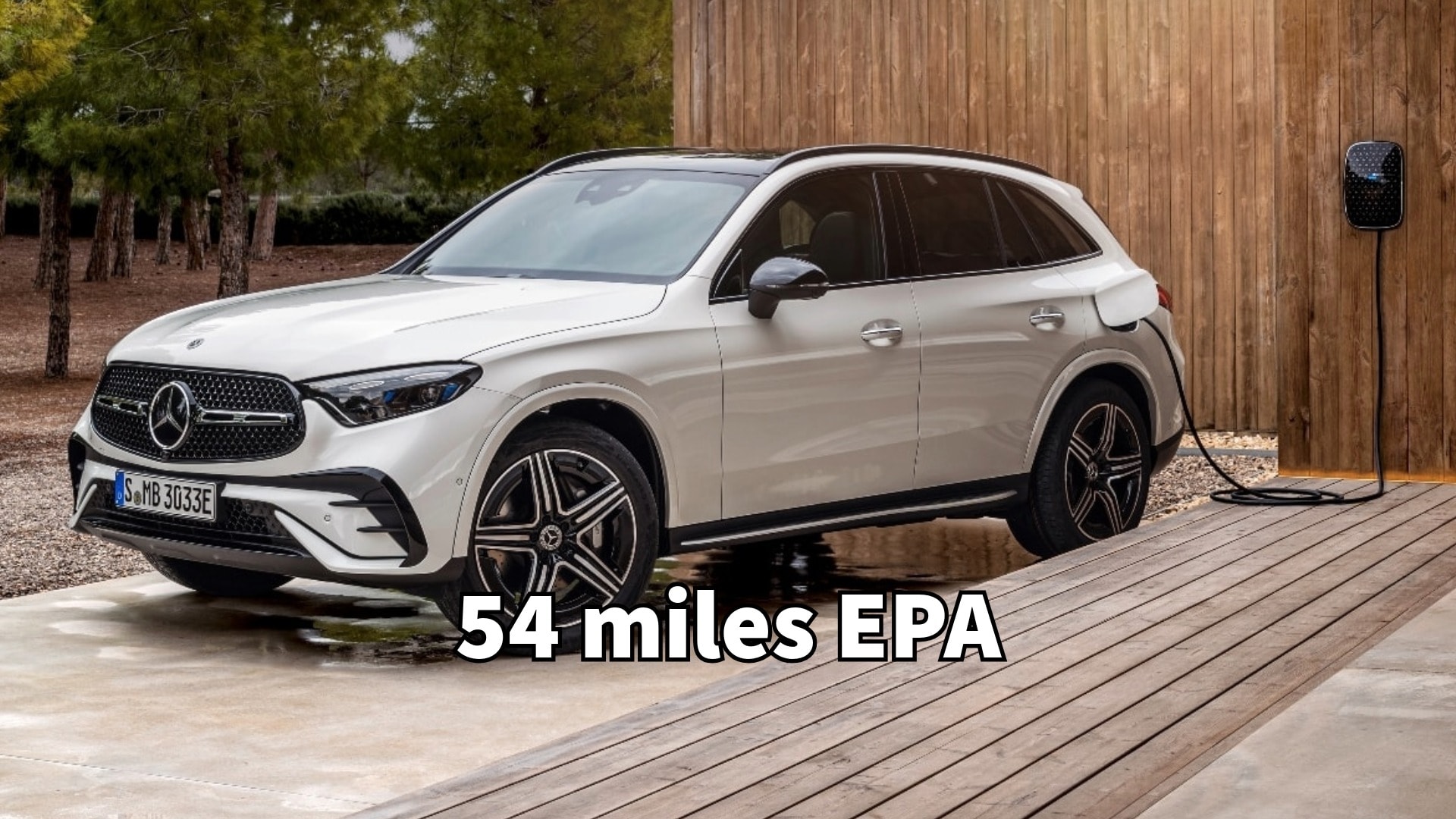
Eliminating both the EV tax credit and the fines carmakers had to pay for not meeting emission standards has made EVs a lot less attractive to build. This is why carmakers are aggressively promoting plug-in hybrids as better alternatives to electric vehicles. Here are ten PHEVs with the longest purely-electric range on the US market.
So-called “legacy carmakers” have been slow at adopting electric vehicles, mostly because it required overhauling their business model, supply chains, factories, and sales model. This left them in a predicament, as building EVs was expensive, but not having EVs in their lineups would’ve been even costlier, due to fines imposed for failing to meet their emissions quota.
With the current administration removing the tax credit, electric vehicles became suddenly more expensive. However, because the OBBB Act also removed the fines for not meeting the fleet emission targets, carmakers could return to business as usual. New EV projects were delayed or scrapped, while EV battery factories were put on the back burner.
The gas engine gained a new boost, especially as most carmakers now promote hybrids and plug-in hybrids as better alternatives to electric vehicles. The main line is that PHEVs provide the best of both worlds, enabling pure electric mobility while also alleviating range anxiety. The loss of the EV tax credit also made buying electric vehicles a lot less compelling for lower-income customers.
What are plug-in hybrid vehicles?Plug-in hybrids are, as the name suggests, hybrid vehicles with a plug. This means they have both a gas engine and an electric motor (or more), and a battery large enough to require a power source to charge in a reasonable amount of time. This contrasts with hybrids, which use the combustion engine and regenerative braking to charge a much smaller battery. However, unlike hybrids, which can only drive electrically for about a mile or so, plug-in hybrids can go much farther, usually 25-50 miles.
There are several types of plug-in hybrid vehicles, depending on how the battery and the combustion engines are used. In some cars, the gas engine can drive the wheels directly, and it does so most of the time, especially when full power is required. Others feature more powerful electric motors and only use the combustion engine to charge the battery.
These are also called extended-range EVs (EREVs) and are less common in the US. An example was the BMW i3 REx, although recently, more carmakers, including Jeep, Ram Trucks, and Scout Motors, announced EREVs. EREVs usually have even larger battery packs than PHEVs, allowing them to function more like an EV than a hybrid.
What advantages and disadvantages do PHEVs have?The main advantage of PHEVs is well known, because carmakers have made impressive efforts to promote it. It’s the flexibility of driving anywhere without worrying about range or the lack of charging infrastructure. Drive with zero emissions by charging the battery, thus benefiting from favorable zero-emissions-zone tariffs in some cities, and use the gas engine for longer trips when necessary.
However, carmakers and regulators failed to take into account people’s laziness. Instead of charging the battery every time, most people find it more convenient to just use the combustion engine. This effectively turns the PHEV into a regular hybrid vehicle, only less efficient due to the higher mass of its bigger battery pack.
PHEVs also sell for higher prices than hybrids and, in some cases, EVs. However, the biggest drawback is that the battery pack is aggressively cycled due to its small capacity. Whereas EVs can charge once a week and keep the battery below 80% to limit wear, PHEVs can be charged and discharged once or even twice a day. This led to accelerated wear and costly replacements, as some PHEV owners discovered.
When does a PHEV make sense, and when is a simple hybrid a better choice?Plug-in hybrids are not for everyone, just like electric vehicles are not for everyone. Every potential buyer should carefully consider their situation and driving habits before deciding to buy a PHEV. In some cases, a cheaper hybrid car might be more suitable, and in others, an EV makes more sense.
If you drive mostly in city traffic and your commute is no longer than the electric range of the PHEV you want to buy, then this is the ideal use-case scenario. If you can charge it at work, it’s even better, as this will ensure the most efficient operation, with the lowest costs. Don’t expect to drive exclusively on battery, though, because the combustion engine still starts when it’s cold or when full power is applied.
However, if you can’t or won’t charge it at home overnight or at work during the day, a PHEV will end up costing you more in gas and maintenance. Because the big battery is heavy, a PHEV will not be as efficient as a hybrid, and sometimes might have even worse fuel efficiency than a pure gas car. This is especially true when driving frequently on highways.
Finally, if you have a house equipped with a solar system, there’s no better way to use solar energy than in an electric vehicle. This will spread the costs of both the solar system and the EV, allowing the highest cost savings across both. However, if you decided that a PHEV is the best choice for you, here are the vehicles with the longest electric range sold in the US.
2026 Mercedes-Benz GLC 350eElectric range: 54 miles
Starting price: $61,550

Photo: Mercedes-Benz
It might not be the most affordable PHEV on the market, but the Benz SUV has never been cheap, regardless of the propulsion system. The GLC PHEV has a 24.8-kWh battery pack, which is enough to go the farthest in our roundup: 54 miles (87 km) according to the EPA.
Its biggest advantage, especially when compared to other plug-ins, is the support for DC fast charging up to 60 kW. This means it can charge the battery from 10% to 80% in 30 minutes. Level-2 charging support peaks at 11 kW, which ensures the battery can be charged from 0 to 100% in less than three hours.
The combustion engine is a four-pot 2.0-liter turbo, which, together with the electric motor, develops a total of 313 horsepower. This allows the GLC to accelerate from 0 to 60 mph (97 kph) in 6.3 seconds.
2026 Mercedes-Benz GLE 450eElectric range: 49 miles
Starting price $73,500

Photo: Mercedes-Benz
Despite being larger and heavier, the Mercedes-Benz GLC 450e still manages an impressive range estimated at 49 miles (79 km) according to EPA estimates. The battery capacity is listed at 23.3 kWh, which makes the GLE’s performance even more impressive.
Just like other Mercedes-Benz plug-in hybrids, the GLE 450e supports DC fast charging at 60 kW. Thanks to having a smaller battery, it only needs 20 minutes to charge from 10% to 80%. Level-2 charging is limited to 9.6 kW, which is still nothing to scoff at. Topping it fully takes the same amount of time as in the GLC 350e: 2.75 hours.
The same 2.0-liter inline-4 turbo engine as above is responsible for burning the gas in the tank. Helped by the electric motors, the hybrid system develops a total of 381 horsepower, making the GLE even faster. It only needs 5.8 seconds to accelerate from 0 to 60 mph.
2026 Toyota Prius PHEVElectric range: 44 miles
Starting price $35,455

Photo: Toyota
Toyota is never known for making cheap cars, but the Prius PHEV (also known as Prius Prime) somehow manages to be the most affordable PHEV on the market. Despite its price, it also offers one of the longest all-electric ranges, at 44 miles (71 km) in the base SE trim. Considering the 13.6-kWh battery capacity, this looks impressive.
Of course, the aerodynamics play an important role, and Prius shines in this department after decades of optimization. The Japanese plug-in doesn’t support DC fast charging, though, and charging the battery from a Level-1 120-volt outlet takes 11 hours. Thankfully, Type-2 (240-volt) charging slashes the time to 4 hours.
The third-generation Prius launched in 2023 with sportier specifications, thanks to a new 2.0-liter engine that raises the overall power to 220 horsepower. This allows the Prius to accelerate from 0 to 60 mph in only 6.6 seconds, quite an achievement for the compact sedan.
2025 Toyota RAV4 PHEVElectric range: 42 miles
Starting price $46,265

Photo: Toyota
Although far from being as affordable as the Prius, the RAV4 still manages to squeeze below the $50k mark. This is impressive, considering that the RAV4 PHEV packs three electric motors and an 18.1-kWh battery. The 2026 model will provide a serious upgrade in this department, with a 22.7-kWh battery offering a 50-mile (80 km) range.
The 2026 model will also introduce support for DC fast charging on higher grades, but the 2025 models are limited to 6.6-kWh Type 2 charging. A complete charge takes two and a half hours in these conditions.
The 2.5-liter inline-4 engine and the electric motors develop a total of 302 horsepower combined. This ensures a 0-60 time of about 5.5 seconds. However, with 320 horsepower, the upgraded 2026 models should be even faster.
2025 Mitsubishi Outlander PHEVElectric range: 38 miles
Starting price $43,270

Photo: Mitsubishi
Mitsubishi was among the first carmakers to launch a plug-in hybrid car, with the Outlander PHEV starting its career in 2013 as the first plug-in SUV. Fast forward to the current generation, the Outlander PHEV launched in the US as a 2023 model. It boasts a 20-kWh battery, enabling 38 miles of electric range.
The Outlander PHEV supports 22 kW DC fast charging, but only on CHAdeMO chargers, with 38 minutes required for a charge to 80%. Type 2 charging peaks at 3.7 kW and takes 6.5 hours for a complete charge. Meanwhile, Type 1 chargers (1.44 kW) require 16 hours for the same job.
In the combustion engine compartment is installed a 2.4-liter 4-cylinder powerplant, which develops 131 horsepower on its own. The combined power of the hybrid system, which also includes two electric motors, is 248 horsepower, enough to accelerate from 0 to 60 mph in 6.5 seconds.
2026 Lexus RX 450h+Electric range: 38 miles
Starting price $66,680

Photo: Lexus
It might not look like it, but that little + added to the model name makes all the difference. The 18.1-kWh battery allows the Lexus RX 450h+ to travel up to 38 miles (61 km) with zero emissions. This shows that weight matters, as the RX 450h+ uses a similar hybrid powertrain as the Toyota RAV4 PHEV.
Not only is the range affected, but also performance, with the 304-horsepower SUV needing 6.2 seconds to accelerate from 0 to 60 mph. Under the hood, we find the same 2.5-liter inline-4 powerplant as in the RAV4.
Charging performance is identical to the 2025 Toyota RAV4 PHEV. There’s no DC fast charging option, and the RX450h+ is limited to 6.6-kWh Type 2 charging. A complete charge takes two and a half hours.
2026 BMW X5 xDrive50eElectric range: 38 miles
Starting price $76,375

Photo: BMW
The BMW X5 xDrive50e plays in the same league as the Mercedes-Benz GLE, and yet it loses in the PHEV department. The Bimmer has a 25.7-kWh battery, trumping the GLC, and yet it can only go 38 miles on a full charge.
The X5 also lacks DC fast charging support and can only charge using the onboard AC charger, with a peak power of 11 kW. Charging the battery fully takes two to three hours using a Type-2 charger, whereas a Type-1 socket will take up to a full day.
To its credit, the BMW X5 xDrive50e provides more oomph, thanks to a turbocharged inline-six and an electric motor that combine for 483 horsepower. This translates into a 0-60 time of 3.9 seconds, almost two seconds faster than the Benz.
2025 Ford Escape PHEVElectric range: 37 miles
Starting price $38,395

Photo: Ford
After checking these luxury PHEVs, it’s time to get back on the ground to meet the affordable Ford Escape. It sports a 14.4-kWh Li-ion battery that allows it to travel a respectable 37-mile (60 km) trip on battery alone.
Charging the battery is not very fast, with only a 3.5-kW charger onboard. When plugged into a Type-2 plug (240 volts), the Escape PHEV needs 3.5 hours to charge completely. Doing the same at a regular 110-volt plug, it’ll take more than 10 hours.
The 2.5-liter inline-4 engine uses an Atkinson cycle for improved efficiency, which means the power is not its strongest point. The Escape develops a total of 210 horsepower and needs 7.7 seconds to reach 60 mph.
2026 Lexus NX 450h+Electric range: 37 miles
Starting price $59,105

Photo: Lexus
If the name sounds familiar, it’s because the Lexus NX PHEV shares the powertrain with the bigger brother RX. However, it somehow loses one mile of range compared to the RX, despite having the same 18.1-kWh battery.
It uses the same 2.5-liter Atkinson engine as the RX and the Toyota RAV4, with similar results. The power is still 304 horsepower when the combustion engine works in tandem with the electric motors. Acceleration takes 6.0 seconds, thanks to being a tad lighter.
Charging the battery from 0 to 100 using a Type-2 charger (240 volts) takes about three hours. The Lexus NX 450h+ is equipped with a 7-kW onboard charger and, you know it already, doesn’t support DC fast charging.
2026 Volvo XC60 PHEVElectric range: 35 miles
Starting price $61,150

Photo: Volvo
Slightly more expensive than its Lexus rival, the Volvo XC60 relies on an 18.8-kWh battery, although this doesn’t translate into more electric range. The Swedish crossover can go 35 miles (56 km) on a charge.
Volvo didn’t do its homework in the charging department either, with a Type-2 charging capability that peaks at 3.6 kW. This makes a full charge excruciatingly long, at five hours. That’s almost as bad as the Mitsubishi Outlander PHEV.
On the plus side, the XC60 is one of the most powerful PHEVs on the market, with 455 horsepower from its powertrain. However, this doesn’t translate into the same spirited driving as the BMW X5. Acceleration from 0 to 60 mph takes 4.5 seconds, which is still a respectable figure.