
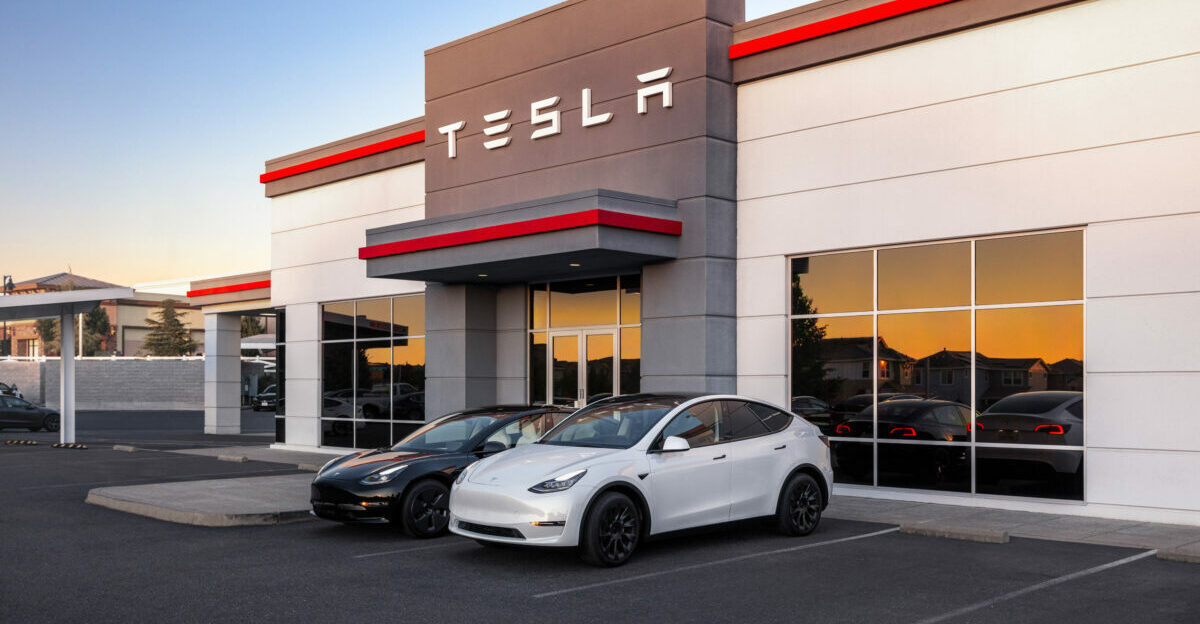
Surging fuel prices from the Iran war have arguably done far more for Tesla’s 2026 European recovery than any strategic play. By Stewart Burnett
Tesla continues to build its recovery in Europe, with April registrations more than doubling year-over-year in several European markets after a substantial collapse in 2025. Gains of 112% in France, 111% in Sweden, 102% in Denmark led the rebound, with Belgium up 47%, and the Netherlands recording a more modest 23% increase.
Tesla saw sales slide 28% Y.o.Y in 2025, due largely to widespread consumer backlash against Chief Executive Musk’s far-right political associations and fatigue towards an increasingly outdated and shrinking model lineup. Musk is no less outspoken today than a year ago, but is no longer associated with the US Trump administration—the most high-profile of his multiple contentious forays. A glancing observation of his social media account on X, the platform he also owns, is sufficient to know his politics are the same.
Before April, Tesla’s Q1 2026 European deliveries were up approximately 45% year-on-year, with the Model Y—Europe’s second-best-selling vehicle for the quarter—carrying most of the volume alongside a recovering Model 3. The Models S and X are in the process of being discontinued and their remaining inventory cleared out. Rumours of an entry-level affordable model have persisted for years but not materialised.
With little about Tesla’s model lineup or the antics of its Chief Executive having materially changed, it is difficult to offer direct praise. Interest in battery-electric vehicles (BEVs) has surged throughout Europe during 2026—particularly since the US-Israel war in Iran sent gasoline prices surging in March. For many consumers, this was sufficient reason to take the plunge on purchases otherwise deferred: BEV market share rose to 20.1% in Q1, marking an all-time high. A year prior, when Tesla was in its nadir, the figure had sat at 13.2%.
The same conditions are lifting every electric brand’s registrations, which means Tesla is recovering ground in absolute terms while the competitive landscape around it continues to shift. Analysts broadly expect BEV market share to continue rising toward 25% as the year progresses.
It should be noted that not all markets joined in the Tesla rebound. Norway, for example, fell 61% after a reduction in its VAT exemption threshold for BEVs took effect in January—a cut that placed both the Model Y at NOK 435,060 (US$45,000) and the Model 3 at NOK 333,217. Spain also dropped 47% and Portugal 33%, while Italy registered a more modest 5% decline.
The recovery’s limitations are most readily apparent in the markets where Tesla is ostensibly winning. In Denmark, Tesla sold fewer cars than Xpeng in April. In the UK, 831 Tesla registrations—up 62% year-on-year—were dwarfed by BYD’s 5,059. The latter saw its registrations rise BYD 101% in April and 124% through the first four months of the year. Tesla remains down 3% in the UK for the same period.
Tesla has not launched a new mass-market model since the Model Y in 2020, and the Cybercab—its next significant volume product—is entering production now but is not yet in consumer hands. Both a controversial model for its eschewing of manual controls in favour of fully-autonomous driving, and completely lacking the regulatory support that it requires to be sold, its impact on sales will arguably be detrimental due to the attention it takes away from Tesla developing the products consumers actually desire.
The April data confirms the Tesla brand is stabilising, but the widening gap between Tesla’s two-model range and the expanding lineups of its Chinese and European competitors can not be closed by a favourable gasoline price environment.