
© Emotors
If Europe’s automotive industry is to successfully transition to electric vehicles, it needs affordable components. These components also need to be energy efficient and recyclable, with minimal environmental impact. In addition, there is also the key challenge of minimising critical raw material use in these components to reduce current supply risks.
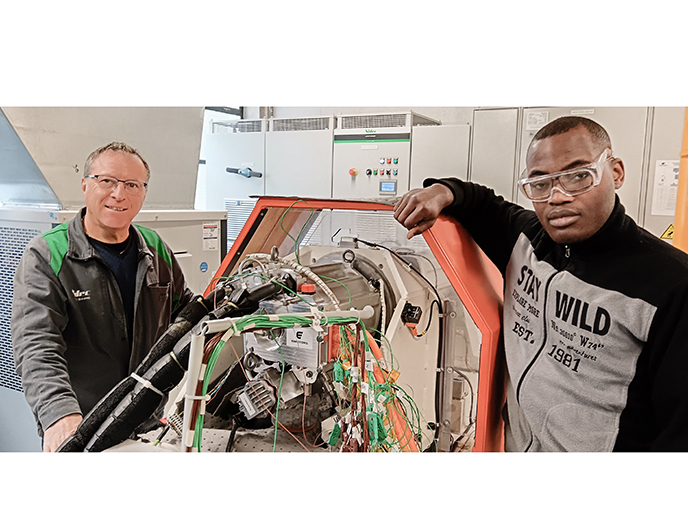
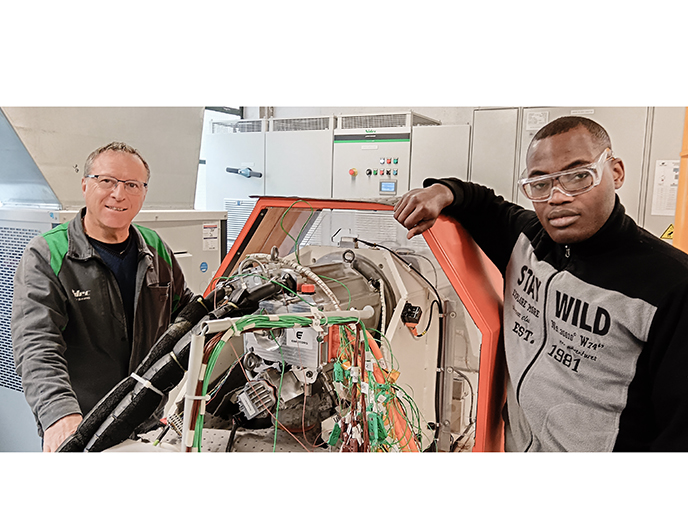
The MAXIMA(opens in new window) project was launched in 2023 to tackle these issues. MAXIMA (Modular AXIal flux Motor for Automotive) is addressing the need for scalable, sustainable electrification in the automotive industry by developing an affordable and adaptable axial flux motor. This motor is being designed to perform better, be kinder to the environment, and also reduce dependency on rare and critical raw materials, especially for permanent magnets.
On the digital front
“MAXIMA has established a pioneering multiphysics design and analysis platform that enables manufacturers and engineers to account for electromagnetic, structural and thermal performance, as well as recyclability, from day one,” reports Stéphane Clénet of project coordinator Arts et Métiers ParisTech. Making circularity a core constraint in the design process makes it possible to optimise efficiency, manufacturability, modularity and ease of disassembly.
Additionally, MAXIMA’s multiphysics digital twin allows for real-time system monitoring, predictive maintenance and adaptive control. Thanks to these capabilities, substantial advances in performance, reliability and system longevity can be achieved under real automotive operating conditions.
On the materials and manufacturing front
MAXIMA plans to deliver tested prototypes that combine soft magnetic composites and advanced electrical steels optimised to reduce losses and to facilitate manufacturability. “These process innovations are already lowering the CO₂ footprint and cost for new e-motor production,” comments Clénet.
Notable progress has further been made in end-of-life strategies for permanent magnets. MAXIMA researchers have successfully developed a recycling process in which neodymium-iron-boron magnets are recovered, purified and remanufactured for reuse. The process preserves most of their original properties despite contamination and wear. “This closes a crucial loop for high-value critical raw materials and points the way for sector-wide change,” observes Clénet.
Next on the agenda is to use the technology developed within the project until now in order to build and test multiple motor prototypes in realistic automotive environments. Recycling trials will be expanded, prototype production scaled up and life-cycle assessment models refined with real-world data.
By 2027, MAXIMA (Modular AXIal flux Motor for Automotive) intends to leave a tangible legacy that will play a role in accelerating the European automotive industry’s transition to circularity, strategic autonomy and climate neutrality. “In doing so, it will strengthen Europe’s global leadership in sustainable electrification technologies, creating long-term industrial, environmental and societal benefits,” Clénet concludes.
If you are interested in having your EU-funded project featured as a ‘Project of the Month’, please send us an email to editorial@cordis.europa.eu and tell us why!
Explore other similar articles