
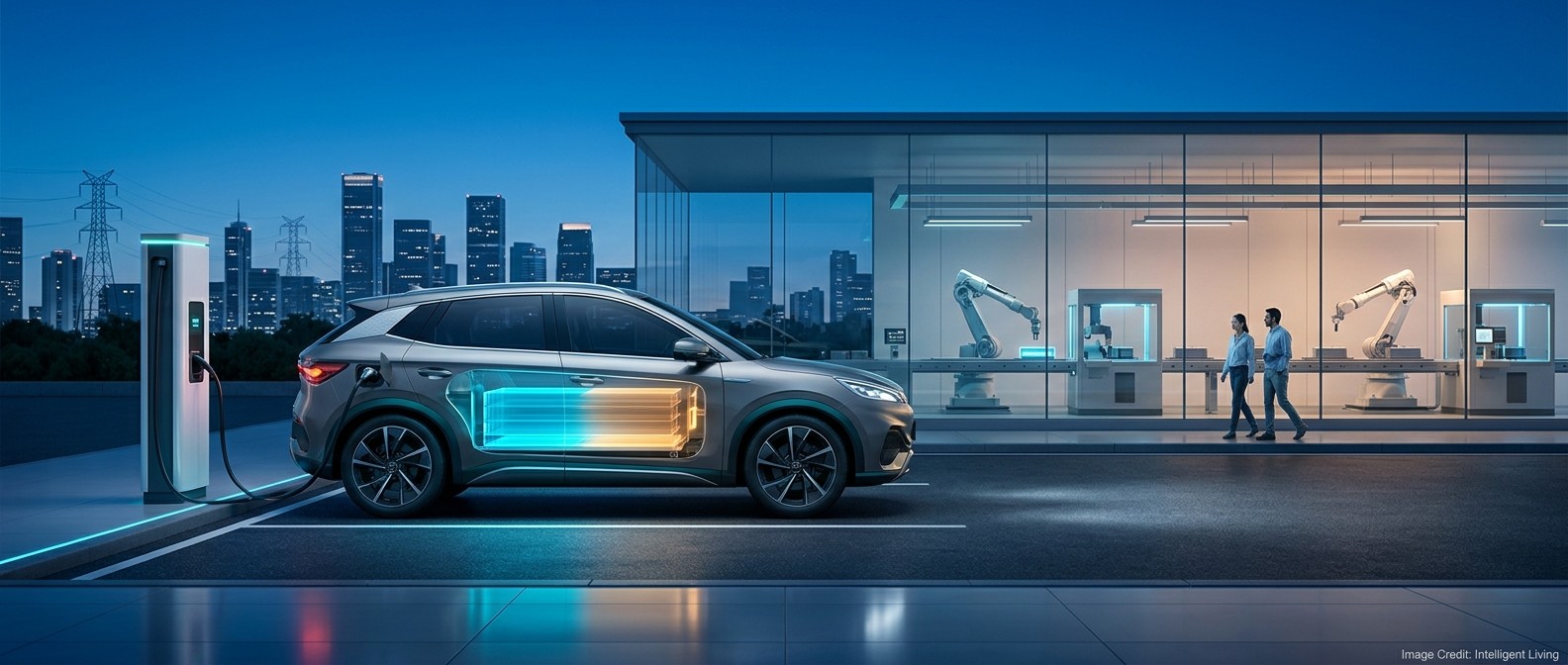
 Solid-state batteries are shifting from lab speculation toward real manufacturing milestones. The combination of fast charging, higher energy density, and safer battery chemistry is now being framed as a near-term EV transition rather than a distant promise. (Credit: Intelligent Living)
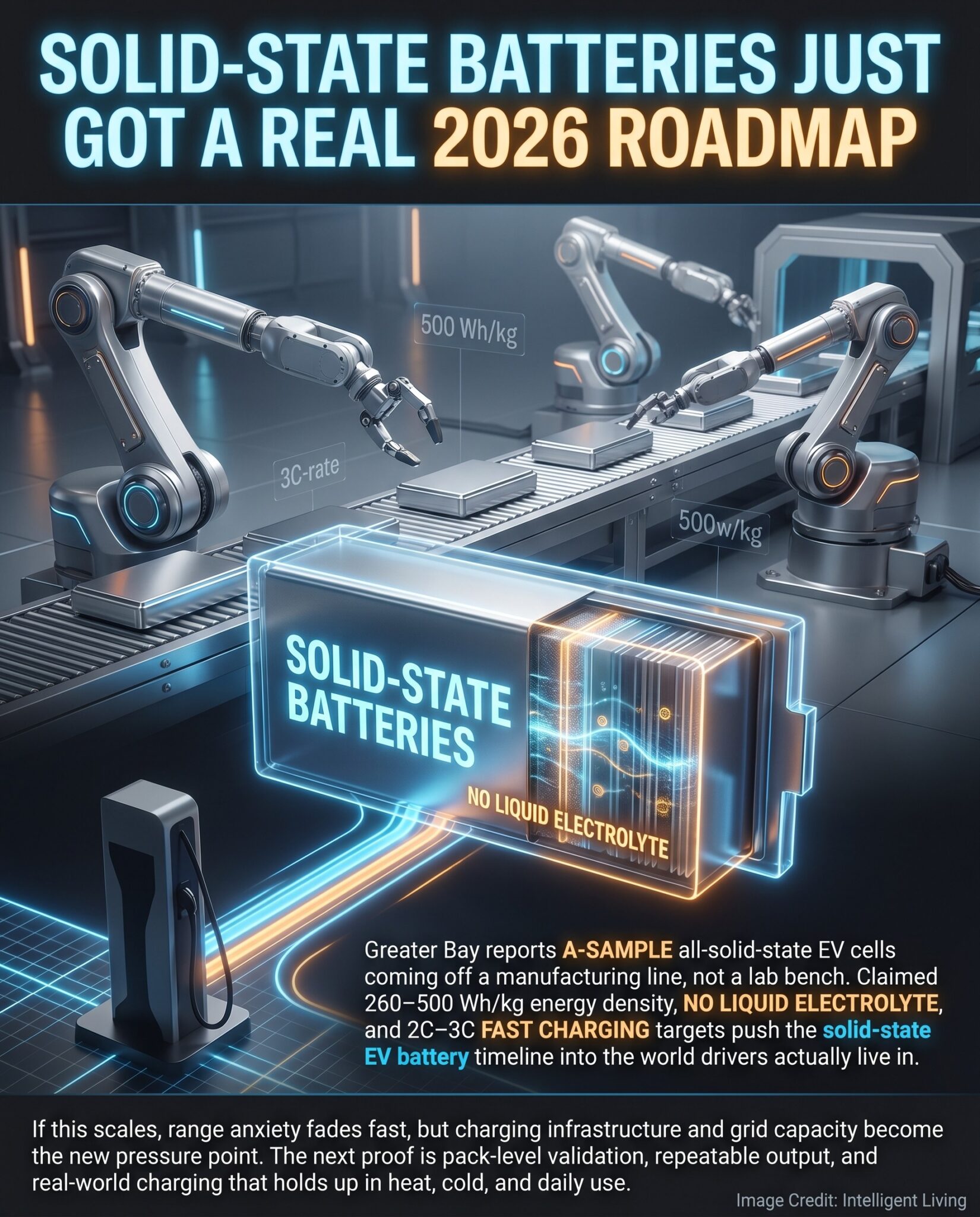
For years, electric vehicle drivers have been told that solid-state batteries represent the ultimate breakthrough in energy storage, promising a future of limitless range and zero-risk safety. Yet, the timeline often feels like it is drifting toward a distant horizon. Greater Bay Technology’s latest announcement shifts that narrative. The GAC-backed company says its all-solid-state A-sample battery cells have rolled off a production line designed for scale, not just laboratory experiments. Recent industry reporting highlights how the 2026 solid-state battery production timeline represents a definitive shift from small-scale laboratory experiments to high-volume industrial manufacturing.
If you have ever waited at a fast charger watching the battery percentage crawl upward during the last stretch of a road trip, you know the frustration of limited ionic conductivity in current liquid electrolytes. Drivers often rely on maintenance for hybrid and electric vehicles to manage degradation while waiting for more robust chemistries to hit the market. The promise of solid-state technology has always been simple: charge faster, drive farther, and worry less. By replacing flammable liquids with solid composite electrolytes to improve thermal stability, Greater Bay aims to ensure that high-speed charging no longer comes with a long-term reliability penalty.
 A-sample manufacturing milestones turn solid-state batteries from a vague promise into a calendar-driven EV charging and battery safety story. The next real test is whether 2026 scale-up delivers pack-level performance that holds up on everyday roads. (Credit: Intelligent Living)
When Will Solid-State Batteries Be Ready? Greater Bay’s 2026 Production Roadmap
Understanding the A-Sample Battery Validation Stage and its Impact
The A-Sample Stage in Plain English
Greater Bay Technology (Juwan Technology Research) recently debuted its first automotive-grade A-sample solid-state cells, built on a manufacturing line optimized for mass output. In battery development, an A-sample is an early validation stage. This validation phase demonstrates that a specific cell design can be manufactured reliably at scale. Establishing this consistency is a prerequisite before automakers move forward with full-vehicle integration and long-term road testing.
Why Pilot Lines Matter More than Lab Demos
Industrial proof carries more weight than a conceptual headline; while a lab-built battery proves a theory, cells produced on machinery meant for high-volume output demonstrate commercial viability. The current roadmap for solid-state battery commercialization highlights pilot lines as the primary proof of a company’s ability to scale.
Why 2026 is the Date to Watch
The 2026 roadmap centers on a transition to gigawatt-hour scale manufacturing, positioning this technology as a bridge between high-tech prototypes and everyday road use.
This momentum is defined by:
Aligning with broader GAC Group production targets.
Moving from isolated cell samples to full-scale vehicle integration testing.
Establishing the first firm industrial deadline for all-solid-state availability.
Solid-State vs. Lithium-Ion: Key Specs for 2026 EV Battery Production
To understand how this breakthrough impacts your daily drive, the following specifications provide a clear baseline for comparing these upcoming 2026 cells against current lithium-ion technology.
Greater Bay says its all-solid-state A-sample cells are now produced on a manufacturing line, not just in a laboratory.
The company reports no liquid electrolyte in the design.
Claimed energy density ranges from 260 to 500 watt-hours per kilogram.
Reported charging capability is 2C to 3C under stated conditions.
Targeted gigawatt-hour scale production is projected for 2026.
Most of these numbers come from the company’s own reporting, so the next proof point is independent testing and pack-level data. The two terms worth translating right away are energy density (Wh/kg) and C-rate. Once those are in plain language, it becomes easier to separate faster-on-paper specs from faster stops at the charger you actually use.
 Solid-state batteries change the electrolyte layer, but the real story is transport speed, interface stability, and how much energy you can store per kilogram. Clear numbers make it easier to understand why “solid” can mean safer chemistry without automatically meaning effortless fast charging. (Credit: Intelligent Living)
How Do All-Solid-State Batteries Work? Electrolytes and Energy Density Explained
What an All-Solid-State Battery Actually Is
Liquid Electrolyte vs. Solid Electrolyte
Current electric vehicles almost exclusively utilize lithium-ion packs containing liquid electrolytes. This fluid serves as the medium for ion transfer between the cathode and anode, a process that determines both the speed and efficiency of energy storage. These next-generation designs replace that fluid with innovative solid electrolyte materials, utilizing a broad category of sulfides and oxides to create a more resilient and thermally stable internal environment.
Why Replace the Liquid Electrolyte
Liquid electrolytes can be flammable under certain failure conditions. A solid electrolyte can reduce that risk and may allow lithium metal anodes, which can raise energy density. In practice, developing durable solid electrolyte chemistry is essential because brittle internal layers can easily crack under mechanical stress. This pursuit of stability explains why fire-resistant solid polymer batteries frequently appear in headlines as a safer alternative to liquid-based packs.
Why Interfaces and Dendrites Still Matter
Solid-state chemistry is not magic. Researchers have spent years studying lithium metal interfaces and the kind of needle-like growth that can trigger shorts, which is why solving battery dendrite growth remains a top priority for researchers aiming to extend the cycle life of next-gen cells.
Why Composite Electrolytes Keep Showing Up
Greater Bay says its composite solid electrolyte is part of the answer. That fits a wider research trend where advances in composite solid electrolytes focus on balancing high ionic conductivity with stable, cost-effective manufacturing.
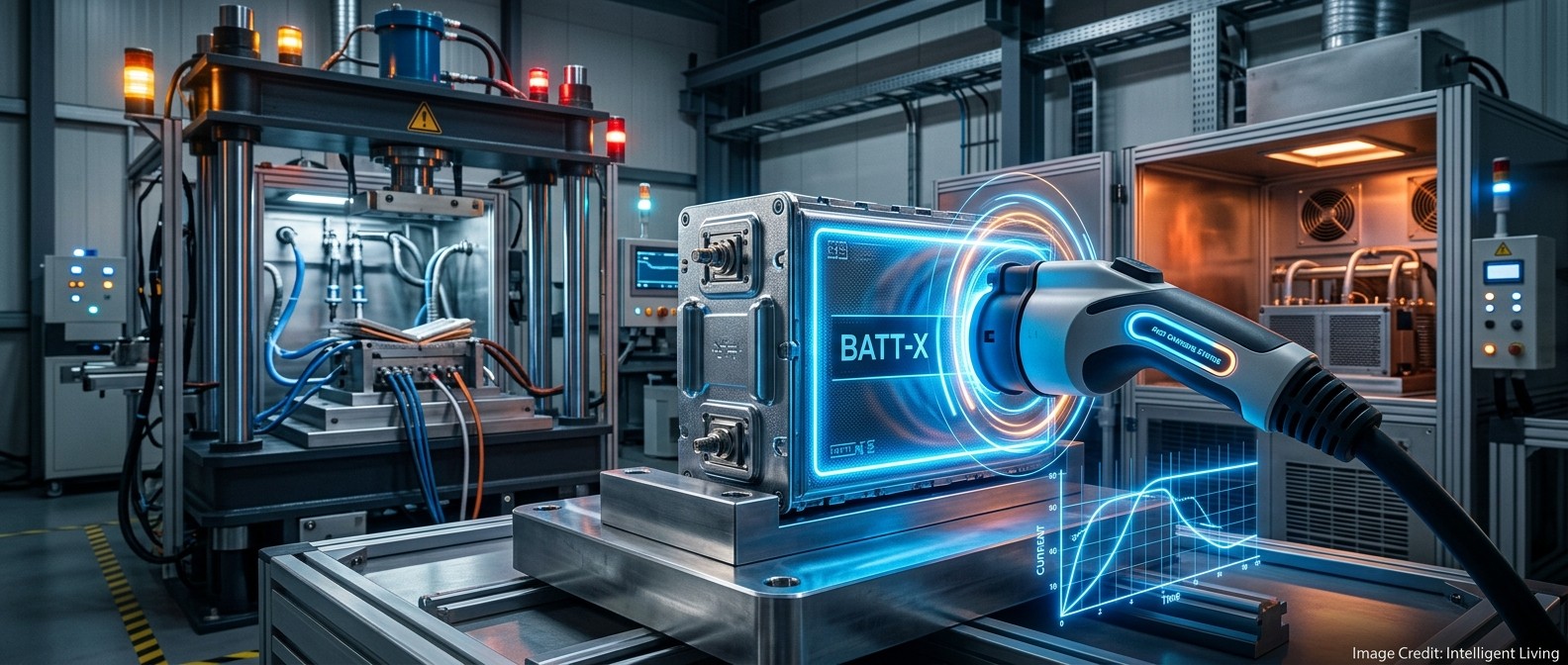 Energy density, safety tests, and charging speed are the numbers shaping the solid-state battery race. The real question is how those measurements hold up outside a spec sheet and inside a full electric vehicle pack. (Credit: Intelligent Living)
2026 Performance Benchmarks: Energy Density, Safety Tests, and Real-World Charging
Energy Density Explained
Energy density, measured in watt-hours per kilogram, essentially describes how much energy a battery pack stores relative to its total weight.
Greater Bay claims its new cells achieve a range of 260 to 500 Wh/kg. For context, research on ultra-fast EV charging shows that today’s high-performance lithium-ion designs typically peak near 300 Wh/kg at the cell level.
Should the upper limits of Greater Bay’s energy density reach vehicle packs, the result would be lighter electric vehicles capable of covering much longer distances on a single charge. Real packs also need cooling plates, wiring, and crash structure, so pack-level energy density usually lands lower than a cell-level spec sheet.
Safety Tests and What they Mean
Technical data from Greater Bay confirms that these all-solid-state cells maintained structural integrity during extreme stress tests modeled after the most severe real-world road accidents. These protocols ensure the electrolyte remains stable even when the physical integrity of the pack is compromised.
To ensure these cells can handle the rigors of the road, the validation process focused on three critical safety areas:
Internal Integrity: Nail penetration tests were used to simulate the risks of an internal short circuit.
Impact Resistance: Extrusion and compression protocols modeled the forces of a high-speed collision.
Environmental Stability: Thermal shock cycles followed ISO traction battery safety standards to verify performance in extreme climates.
Achieving these safety benchmarks is a critical prerequisite for road certification. You likely won’t think about battery chemistry during a school run or a grocery trip, but the knowledge that your vehicle’s core is structurally fire-resistant changes the fundamental safety profile of your commute.
Charging Speed and the 2C to 3C Reality
The company says the battery supports 2C to 3C charging. The C-rate describes how quickly a battery charges relative to its capacity. A 1C rate typically means a full charge in about one hour. A 2C rate can mean roughly 30 minutes, and a 3C rate may approach 20 minutes. Vehicles also precondition packs before fast charging, so a cold morning or a hot afternoon can change what 2C feels like in minutes. That does not automatically equal a five-minute full recharge, even though the emergence of five-minute extreme fast charging has set a high bar for consumer expectations.
The physics behind EV charging curves and heat management often force power to taper off as the battery reaches 80% capacity, which is also why ultra-fast charging battery breakthroughs often require optimal thermal conditions to hit their peak advertised speeds.
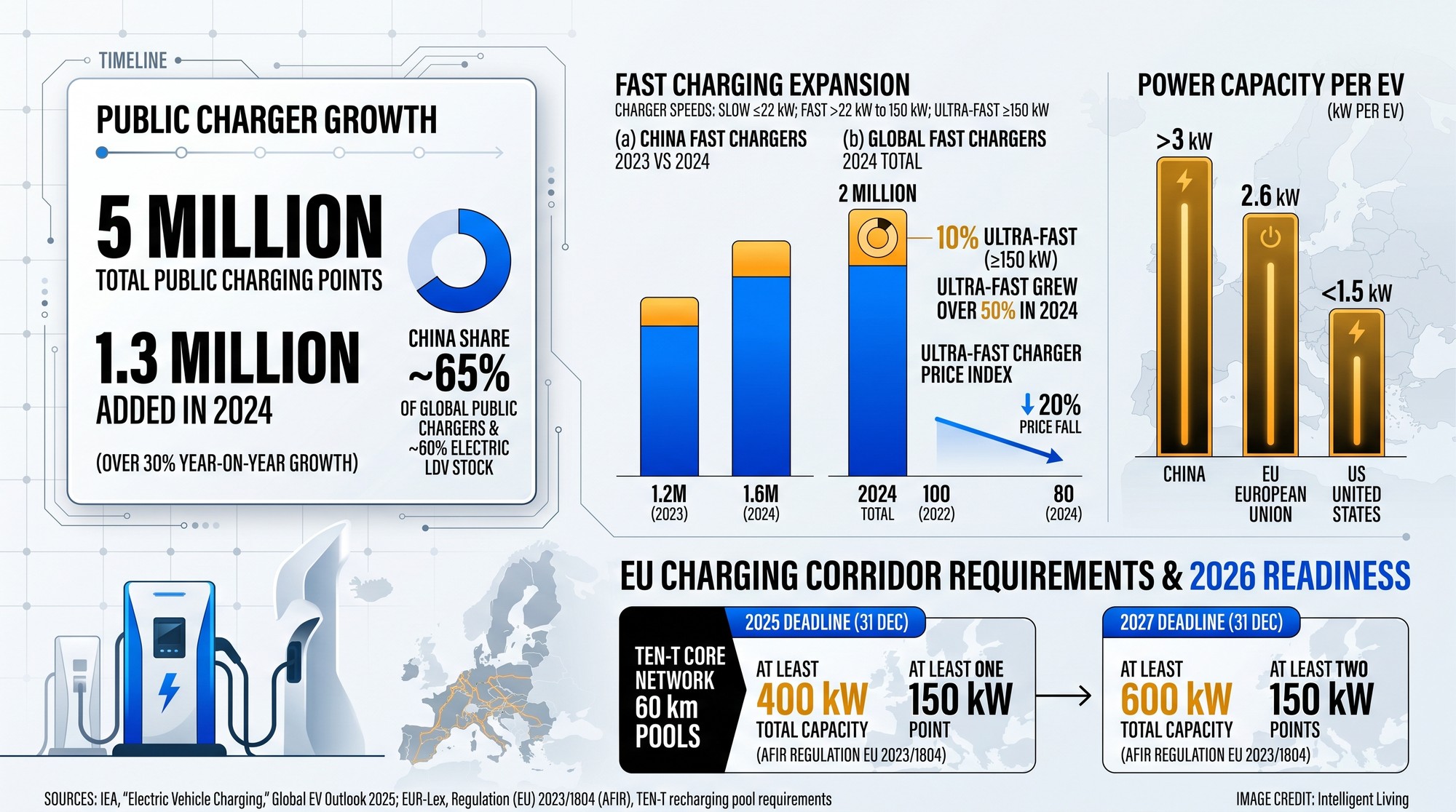 Faster batteries only feel fast when charger power, site capacity, and grid connections keep pace. Real readiness is a mix of charger count, charger speed, and how much kilowatt capacity exists per electric vehicle. (Credit: Intelligent Living)
Is Charging Infrastructure Ready for Solid-State EVs in 2026?
The Reality Check: Chargers and the Grid Have to Keep Up
A battery that accepts energy faster is only half the solution. If the electrical grid cannot deliver that power to the station, the advantage disappears. Recent global EV charging network reports suggest that while 150kW ultra-fast chargers are becoming more common, access is still determined by your zip code.
Faster charging creates a massive surge in peak power demand that local electrical grids were not originally built to handle.
As chargers move toward megawatt-class output, local utilities face new challenges:
Preventing localized grid congestion during peak travel holidays.
Managing transformer limits at high-volume charging hubs.
Ensuring that infrastructure upgrades keep pace with battery performance.
This is where hardware, software, and grid upgrades intersect. In high-power stations, advanced power semiconductor wafers are being developed to minimize energy loss and heat during high-power transfer.
The 2026 Scoreboard: Who Else is Close?
Greater Bay is not alone. The partnership between Stellantis and Factorial is another one to watch. Their solid-state validation milestones recently highlighted 77 amp-hour cells hitting 375 Wh/kg. In testing, these cells demonstrated the ability to charge from 15% to 90% in just 18 minutes.
To secure its supply chain, Toyota established a partnership for mass-producible cathode materials that are specifically optimized for solid-state architectures.
Energy companies are also investing heavily in the future; specifically, Idemitsu is scaling lithium sulfide production to build a robust precursor pipeline for the specialized sulfide-based electrolytes used in many all-solid-state designs. The clearest metrics for success are simple: a verified production line, transparent cell capacity, and a validation path that moves beyond isolated performance claims.

Solid-State Battery Applications: From eVTOL Aviation to Grid Storage
Beyond Cars: Where Solid-State Could Show Up Earlier
Analysis of electric aviation battery safety standards suggests that 300-kilometer regional flights will require densities far beyond what current lithium-ion can provide.
High power is a constraint aviation cannot dodge. Studies tracking battery degradation during vertical takeoff reveal how the high-power pulses required for flight can rapidly compromise cell stability.
A steep climb demands bursts of power that feel more like sprinting than cruising. This heavy workload punishes weak thermal control and accelerates cell degradation if the electrolyte interface is not perfectly stable.
Next-gen batteries are equally vital for robotics and stationary storage, where longevity is the primary requirement. Strategic renewable energy storage solutions using battery swapping currently provide one of the most effective ways to balance the grid while ensuring drivers have access to immediate, high-power replenishment.
Future Milestones: How to Verify Solid-State Battery Commercialization
You can tell the technology is moving from the lab to your driveway when it clears these specific real-world hurdles.
Independent third-party validation of performance and safety.
Long-term cycle life data under automotive stress conditions, including findings consistent with research on solid-state electrolyte interfaces that identify critical mechanical and chemical failure modes under long-term stress.
Named vehicle programs confirming integration timelines.
Pricing can eventually drop toward DOE electric vehicle battery cost targets, making the technology viable for mass-market cars.
Manufacturing yield metrics that show consistent quality can be produced at scale.
 The next phase of the solid-state battery story depends on proof beyond prototypes, including validation, manufacturing scale, and charging infrastructure. The future feels closer when battery performance, grid readiness, and vehicle adoption begin moving together. (Credit: Intelligent Living)
The 2026 Industrial Reality: Is Your Next EV Solid-State?
Greater Bay’s A-sample milestone marks a definitive shift in the 2026 solid-state battery outlook. While headlines often focus on ‘breakthroughs,’ this specific development is about industrial receipts. Moving cells from a lab bench to a GWh-scale pilot line proves that the composite electrolyte approach can survive the rigors of mass manufacturing. For consumers, this signals that the wait for 500 Wh/kg energy density is moving into the final validation phase.
Strategic integration of these cells into GAC-backed vehicle programs later this year will provide the first real-world data on high-power thermal management. We are moving beyond the era of ‘on-paper’ specs. The next two years will be defined by how these batteries handle extreme cold, repeated fast-charging stress, and the economic challenge of bringing pack-level pricing down to meet mass-market expectations.
Consumer confidence will grow when solid-state technology proves it can provide a seamless experience that rivals the convenience of a traditional gas station stop. As we approach the 2026 production window, watch for independent validation of cycle life and named vehicle integration timelines. The future of electric mobility isn’t just about driving farther—it’s about a seamless, worry-free ownership experience that starts with safer, more efficient chemistry.
Solid-State Battery FAQ: Fast Charging, Safety, and 2026 Timelines
How does a solid-state battery improve EV range?
Solid-state batteries allow for lithium-metal anodes, which can double the energy density compared to traditional graphite. This allows vehicles to travel significantly farther—often 500 to 700 miles—on a single charge without increasing the battery’s physical weight.
Are solid-state batteries really safer than lithium-ion?
Yes. By replacing flammable liquid electrolytes with solid materials like sulfides or oxides, the risk of thermal runaway is nearly eliminated. These batteries can pass extreme ‘nail penetration’ tests without catching fire or exploding.
Can I charge a solid-state battery in 10 minutes?
Greater Bay Technology’s A-sample cells support 2C to 3C charging, which targets a 20-to-30-minute full charge. While 10-minute charging is a long-term goal, the current milestone focuses on consistent, high-power charging without damaging the battery’s internal structure.
Why is 2026 a major year for solid-state batteries?
2026 is the target for ‘gigawatt-hour’ scale manufacturing. This moves the technology from small pilot runs to the volume needed for actual vehicle production, marking the first time solid-state EVs will enter the mass-market validation phase.
Will solid-state batteries make EVs cheaper?
In the long term, yes. While early production is expensive, the high energy density allows for smaller, lighter packs that require less cooling infrastructure. Companies like SAIC suggest that solid-state packs could eventually be 30% cheaper than today’s best lithium-ion options.