
Key Takeaways Before You Read:
1. A West Sacramento family walks away from a 50 to 60 mph rear impact on stopped I-5 traffic.
2. First responders express surprise, and the battery pack survives completely intact.
3. The crash raises urgent questions about distracted driving and what car buyers must prioritize.
4. Scroll to see the comments or be the first to voice your opinion.
A rainstorm stopped traffic on Interstate 5 in California. A distracted driver did not stop. What happened next stopped Joe Wood and his son from becoming another crash fatality statistic, and it is now a story spreading across Tesla owner communities worldwide.
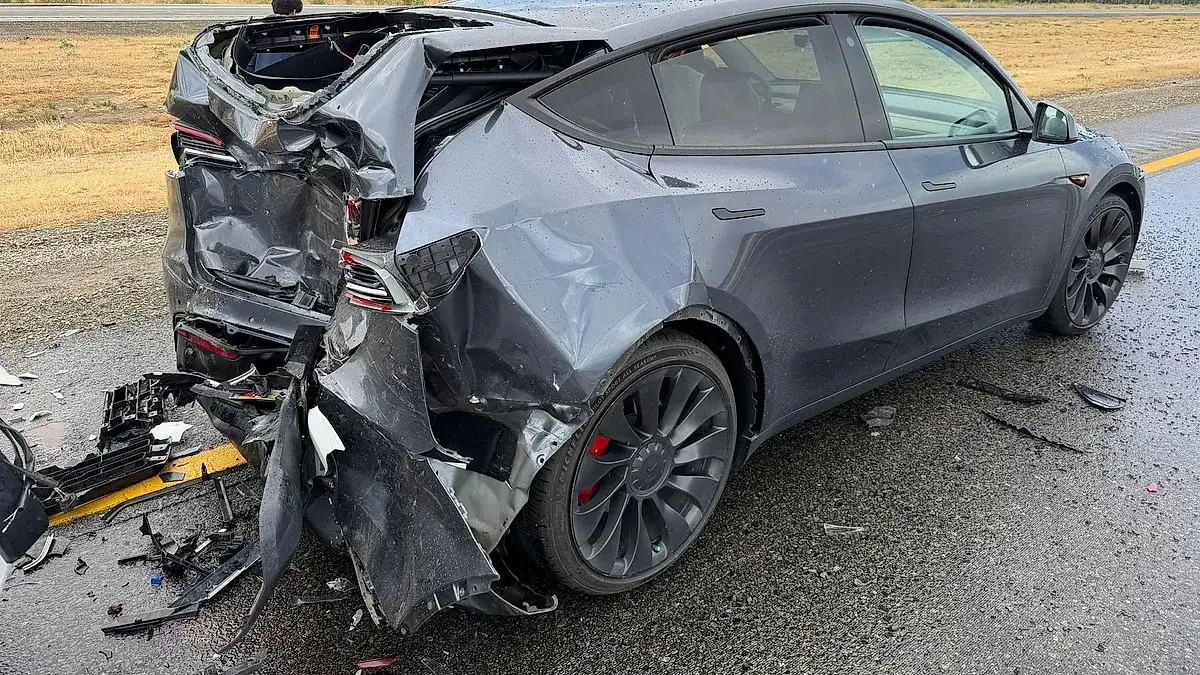
Joe Wood, whose mother owns a Tesla Model Y, posted a detailed account to the Tesla Model Y Owners Worldwide public Facebook group. He wrote this, and it deserves to be read in full. “I know folks have lots of strong emotions regarding Tesla lately, but I wanted to give a shout out to the engineers who developed such a safe vehicle. Last weekend a distracted driver drove into the back of our Model Y going 50 to 60 mph while traffic was stopped due to a rainstorm on I-5 in California. My son and I walked away from the car with some whiplash and minor bruising. The CHP officers and paramedics on scene were genuinely surprised. The car is totaled and we are sore but thankful. If you’re one of those engineers, thank you! For those who are curious, according to my adjuster the battery pack was still completely intact. I’ve already picked up a Juniper replacement and wow these things are quiet!”
Read that again. A vehicle struck from behind at 50 to 60 miles per hour while traffic was fully stopped. The two occupants walked away. The first responders were surprised. The battery pack held.
What Does a Tesla Model Y Rear End Crash Actually Do to Occupants?
In the automotive journalism world, where I have spent 15 years covering everything from truck reliability to EV engineering, post-crash survivor stories are not uncommon. But the details in this account carry real weight. The speed involved, the complete battery pack integrity, and the reaction of trained emergency personnel all point to something worth examining seriously.
Tesla engineers designed the Model Y with front and rear crumple zones that redirect crash energy around the passenger cabin. The rear underbody uses a single piece casting that, according to Tesla’s own documentation about the design, significantly expands the collision avoidance structure and improves crash safety. That one piece rear casting replaced a 70 part assembly in earlier platforms. The structural dividend is measurable. This is the engineering story behind why Joe Wood and his son walked off that California interstate.
Advertising
Our Torque News coverage of the Tesla Model Y IIHS crash test results explained in detail how the Model Y’s crash penetration into the driver footwell area was reduced to just 0.3 inches compared to 8.2 inches in the Model 3, and that number matters when a distracted driver hits you from behind at highway speed. It also helps explain why the Model Y earned IIHS Top Safety Pick Plus status, achieving the highest rating across all six crashworthiness categories.
Why the Battery Pack Surviving Intact Matters So Much
Here is the part of Joe Wood’s account that deserves its own conversation. His insurance adjuster confirmed the battery pack remained completely intact after a 50 to 60 mph rear strike. That is not a minor detail. That is the difference between a totaled car and a totaled car with a catastrophic fire risk.
EV skeptics frequently cite battery fires as a defining safety concern. What this I-5 crash demonstrates is that the structural protection surrounding the battery pack functioned as designed under extreme real world conditions. Tesla’s rear underbody casting, combined with the fortified battery pack, provides crash strength to the safety cell that helps maintain compartment integrity, and that strength allows the restraint systems inside the cabin to deploy effectively, as we learn it directly from Tesla.
The Juniper refresh that Joe’s family immediately purchased after the crash also brought additional improvements. The Model Y Juniper features stronger aluminum casting that makes the cabin less likely to bend in side impacts, along with a reinforced battery shield that gives better protection against impacts with the underbody. So the replacement vehicle they drove away in is structurally even better than the one that saved their lives.
The Real Problem This Story Exposes: Distracted Driving
Let us be direct about the pressing problem this story surfaces. Joe Wood and his son survived because their vehicle was engineered exceptionally well. But the crash happened because a driver was not paying attention. Rainstorm conditions on a busy interstate, stopped traffic, and a driver who failed to brake. That scenario plays out thousands of times across the country every year, and not every family walks away.
The solution is not simply to drive a safer vehicle, though that clearly matters. The solution also requires every driver to treat distracted driving with the same urgency as impaired driving. A car doing 50 to 60 mph into stopped traffic in the rain is not a weather event. It is a decision failure. Our reporting on Tesla’s Autopilot safety data has shown that driver assistance systems can reduce crash rates dramatically. The Model Y has automatic emergency braking. Whether it was active in this situation is unknown. What is known is that the passive structure performed when the active avoidance failed.
What Tesla Critics and Supporters Both Get Wrong
The Facebook comments following Joe’s post reveal the familiar divide. One commenter named Skipped Church wrote that media coverage of Tesla problems serves to distract people from how good the vehicles actually are, suggesting financial interests in the repair and fuel industries drive negative narratives. Lindsey Sipe noted that even third row passengers would likely have survived given how the rear structure held up. Chuck Rondeau praised the structural integrity and mentioned his own 2026 Model Y, hoping it never faces the same test.
Advertising
These reactions are understandable and human. But the full picture is more complicated. Structural integrity in standardized crash tests and real world survival rates measure different things. Crash structure is one variable. Driver behavior, road conditions, vehicle speed, and crash type all shape outcomes differently. A car that survives a rear end impact perfectly may perform differently in another scenario. This matters because Tesla owners who rely heavily on FSD and Autopilot sometimes extend their trust in active systems beyond what current technology warrants.
The honest truth is that Tesla builds one of the most structurally rigid and crash tested vehicles available to consumers. The NHTSA five star rating and the IIHS Top Safety Pick Plus award confirm that in controlled conditions. Tesla’s stated goal with the Model Y was to engineer the vehicle to distribute crash forces around the cabin and away from occupants, greatly reducing injury risk through front and rear crumple zones and optimized side structures. The Wood family crash validates that goal under live conditions.
How to Choose Your Next Vehicle With Crash Safety as the Priority
If this story sends you back to the car market, here is what actually matters in a crash safety evaluation. Five star NHTSA ratings and IIHS Top Safety Pick Plus designations are the right starting points for any family vehicle purchase. Look specifically at the small overlap front test results, the rear impact performance, and the head restraint scores. These tests simulate the types of crashes that actually kill people on public roads.
Electric vehicles often have structural advantages over combustion vehicles. The absence of a large front engine block changes how crash energy moves through the vehicle, and the low center of gravity provided by a floor mounted battery pack changes rollover risk profiles in meaningful ways. Those are engineering advantages worth understanding before your next purchase.
Car and Driver, in its ongoing Model Y coverage, has consistently highlighted that the vehicle’s structural approach represents a departure from conventional unibody architecture, with the gigacasting process enabling stiffness levels that traditional welded assemblies struggle to match.
The Moral Behind the Metal
Joe Wood ended his post by thanking the engineers who built the car. That impulse, to recognize the people behind an outcome that saved lives, reflects something important. Safety engineering is anonymous work. The people who calculated crumple zones and validated casting tolerances will never meet the family they protected on a rainy California highway. Their decisions, made years ago in a testing facility, showed up in real time on I-5.
Choosing a vehicle with proven passive safety systems is one of the most consequential decisions a family makes. It is also one of the least dramatic, right up until the moment it is not. The moral here is simple. Do not let the noise of brand loyalty, political sentiment, or online discourse override the basic responsibility of choosing a vehicle that will protect the people you love. Joe Wood’s son is home. That is what this is about.
Have you or someone you know survived a serious crash and credited the vehicle’s structure for the outcome? And do you think distracted driving laws need to be significantly stronger before we see real reductions in rear end collisions on American highways? Share your experience and your thoughts in the comments section below.
Image by Joe Wood, used for news reporting purpose for this news from the above-mentioned public Facebook group.
About The Author
Armen Hareyan is the founder and Editor-in-Chief of Torque News and an automotive journalist with over 15 years of experience writing car reviews and industry news. Now based in the Charlotte region (Indian Land, SC, he founded Torque News in 2010, which since then has been publishing expert news and analysis about the automotive industry. He can be reached at Torque News on X, Linkedin, Facebook, and Youtube. Armen holds three Masters Degrees, including an MBA, and has become one of the known voices in the industry, specializing in the landscape of electric vehicles and real-world stories of actual car owners. Armen focuses on providing readers with transparent, data-backed analysis bridging the gap of complex engineering and car buyer practicality. Armen frequently participates in automotive events throughout the United States, national and local car reveals and personally test-drives new vehicles every week. Armen has also been published as an automotive expert in publications like the Transit Tomorrow, discussing how will autonomous vehicles reshape the supply chain, and emerging technologies in vehicle maintenance.
Follow us today…


