
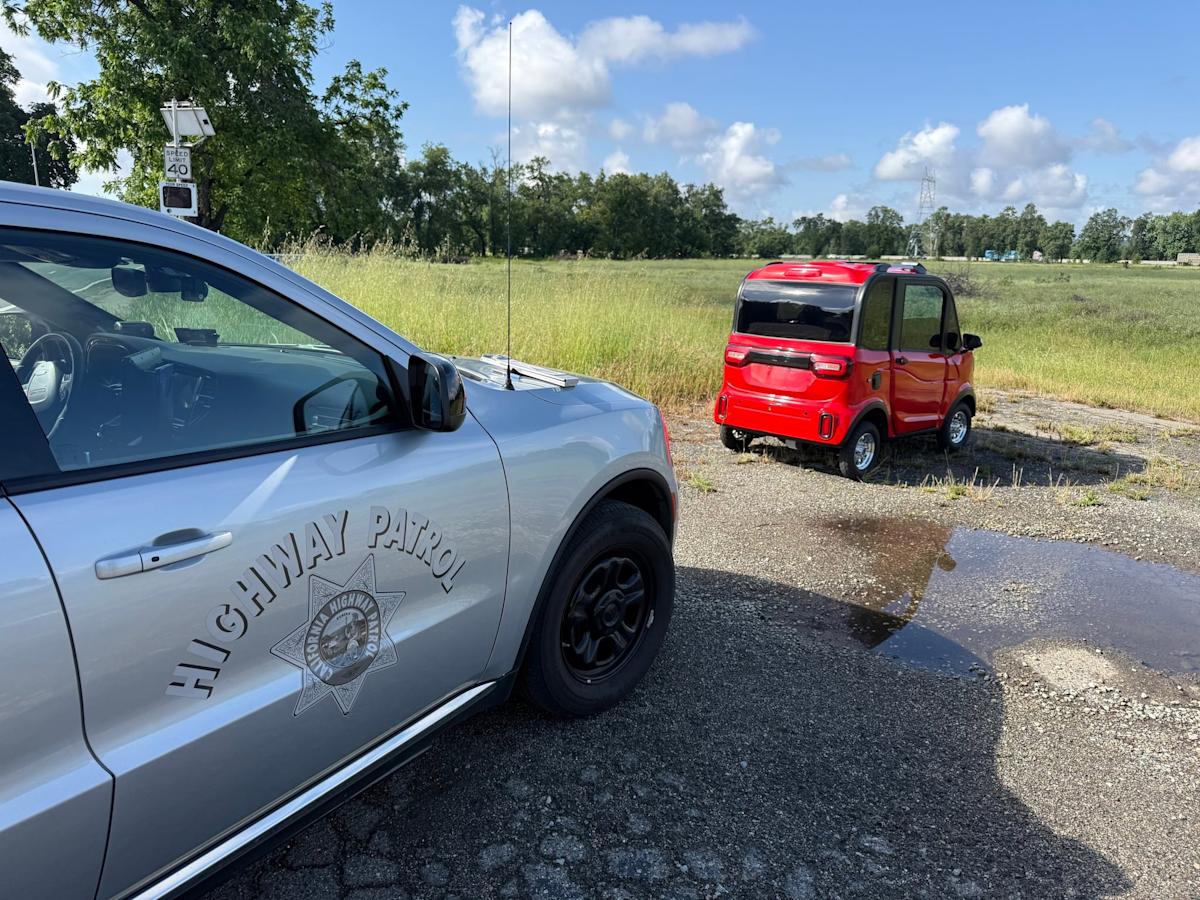
If you have ever been stuck behind one of those tiny electric vehicles puttering down a main road at 22 miles per hour, you probably had some thoughts. One California Highway Patrol officer in Redding recently had the same thought, did something about it, and ended up uncovering a problem that had nothing to do with the vehicle itself.
A Redding CHP officer initiated a traffic stop on a driver operating a low-speed vehicle, or LSV, after the vehicle was observed impeding the flow of traffic. These compact, four-wheeled electric cars are a common sight in retirement communities, resort towns, and increasingly on regular suburban streets. They are quiet, slow, and generally harmless. What this particular stop revealed, however, is that the person behind the wheel had no business being behind any wheel at all.
During the stop, officers discovered that the driver was operating the vehicle with a suspended driver’s license. That is the kind of detail that turns a routine traffic stop into a citation with real consequences. It also serves as a timely reminder that just because a vehicle looks like something you would find at a mini golf course does not mean the rules of the road stop applying to you.
California has a well-defined set of rules governing low-speed vehicles, and while they are more accessible than your average car or truck, they are not a workaround for drivers who have lost their license privileges. The Redding CHP shared the details of the stop on their Facebook page as a public reminder, and it is one worth paying attention to.
What Exactly Is a Low-Speed Vehicle in California?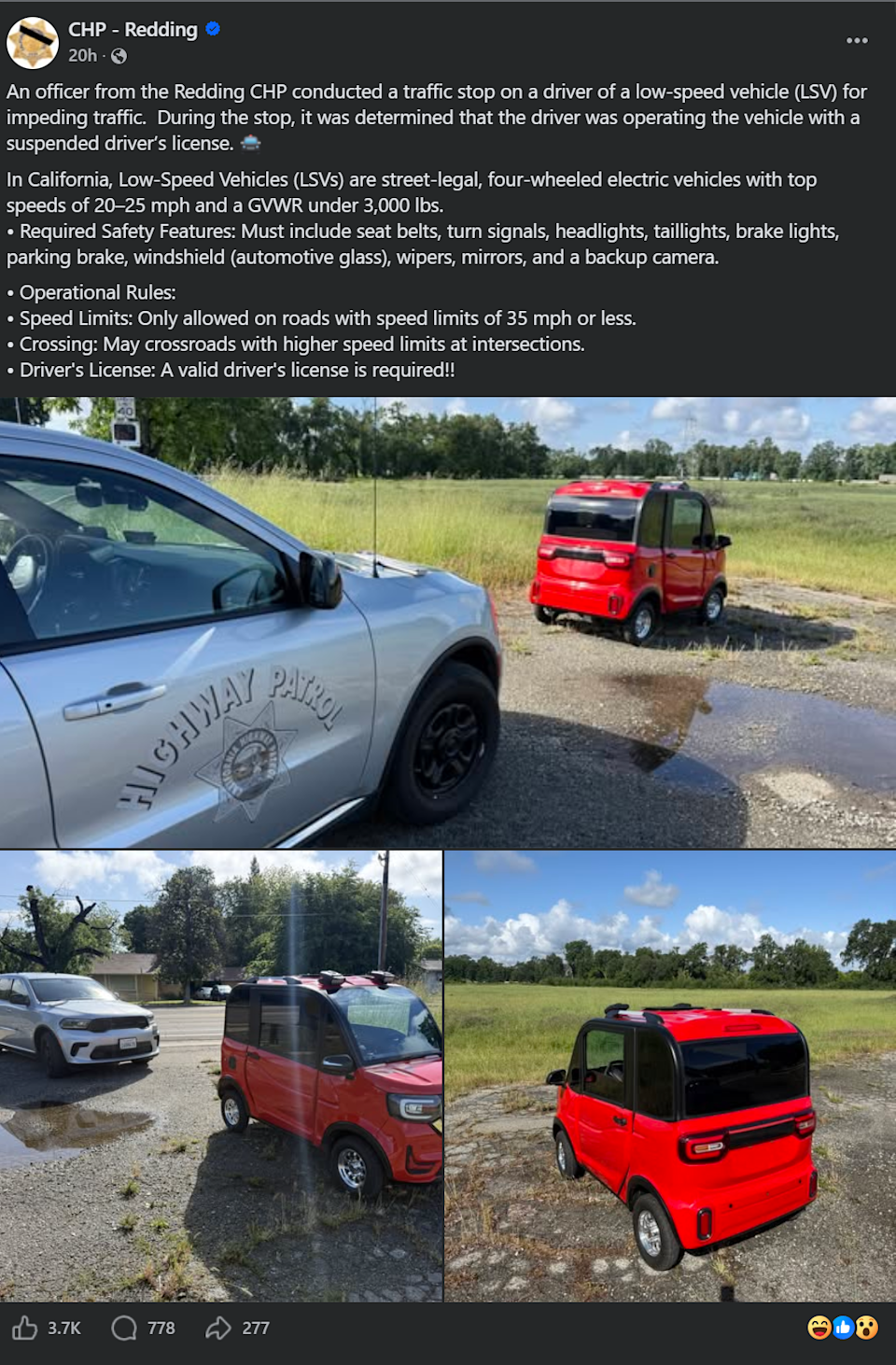
Image Credit: CHP – Redding / Facebook.
Low-speed vehicles are street-legal, four-wheeled electric vehicles that top out between 20 and 25 miles per hour and weigh in under 3,000 pounds in gross vehicle weight. Think of them as a step up from a golf cart that has passed a real inspection. California law requires them to be equipped with seat belts, turn signals, headlights, taillights, brake lights, a parking brake, a windshield made of automotive-grade glass, windshield wipers, mirrors, and a backup camera.
That last requirement tends to surprise people. Yes, your neighborhood LSV is legally required to have a backup camera, the same feature that became mandatory on new passenger vehicles starting in 2018. California does not cut many corners when it comes to minimum safety standards, even on vehicles that look like they belong at a beach resort.
Where Can You Legally Drive One?
This is where a lot of LSV owners get fuzzy on the details. California only permits these vehicles on roads with posted speed limits of 35 miles per hour or lower. They are not allowed on highways, freeways, or any road where traffic regularly moves faster than that threshold. However, drivers can legally cross intersections where the connecting road has a higher speed limit, as long as they are crossing and not traveling along that road.
That means taking your LSV from one neighborhood to another across a 45 mph arterial street? Allowed, as a crossing. Cruising down that same 45 mph road for a mile to get to the grocery store? Not allowed, and a good way to end up with a ticket or worse. The impeding traffic element of the Redding stop is a useful data point here. Driving well below the flow of traffic, even on a legal road, can still attract enforcement attention.
A Valid Driver’s License Is Not Optional
Here is the part of California’s LSV law that catches people off guard: you absolutely need a valid driver’s license to operate one. There is no LSV-specific permit, no restricted license workaround, and no assumption that a small, slow vehicle means relaxed licensing requirements. If your license is suspended, revoked, or simply expired, you cannot legally get behind the wheel of an LSV any more than you could a full-size pickup truck.
This is the detail that tripped up the Redding driver. The stop initially had nothing to do with licensing and everything to do with traffic flow. But once an officer makes contact, a records check is standard procedure, and a suspended license is going to come up every time.
What This Incident Can Teach Other LSV Drivers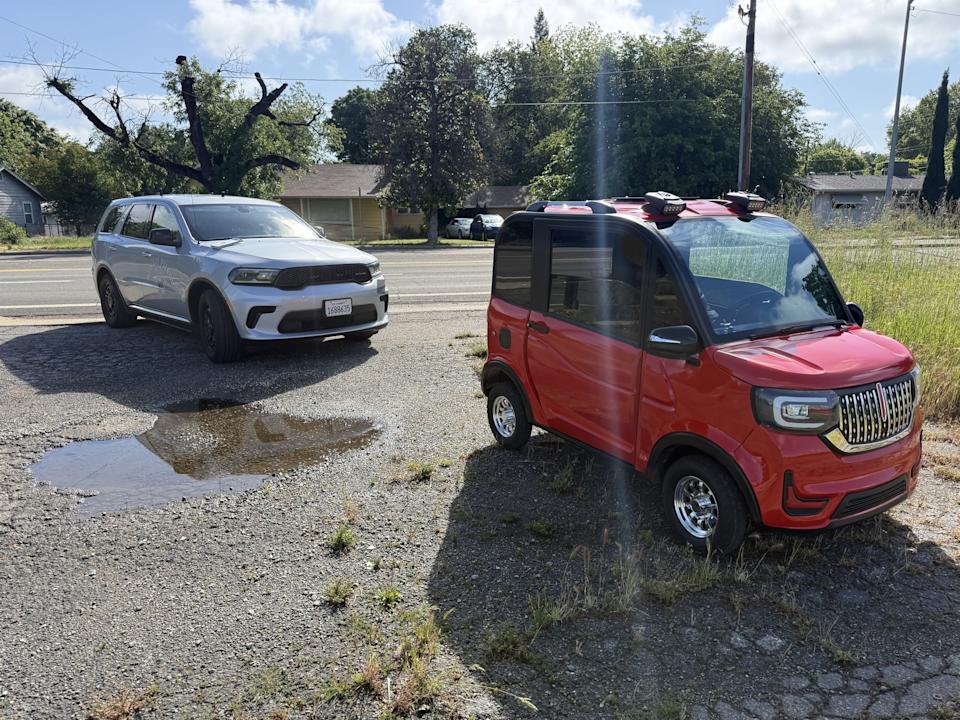
Image Credit: CHP – Redding / Facebook.
The Redding stop is a good case study in how easily a minor traffic situation can escalate when there are underlying violations in play. The driver was not speeding. The vehicle itself was presumably road-legal. The stop began because the LSV was slowing traffic, which is a real concern on roads where cars expect to move at 30 to 35 miles per hour.
For anyone who owns or regularly drives a low-speed vehicle, the takeaways are straightforward. Know the roads you are allowed to use and stay off the ones you are not. Keep your speed appropriate for the context even when you are technically on a legal road. And most importantly, make sure your license is valid and in good standing before you get behind any wheel. California treats LSV drivers as drivers, full stop, and the Redding CHP made that point clearly without needing to say very much at all.
If you want more stories like this, follow Guessing Headlights on Yahoo so you don’t miss what’s coming next.