
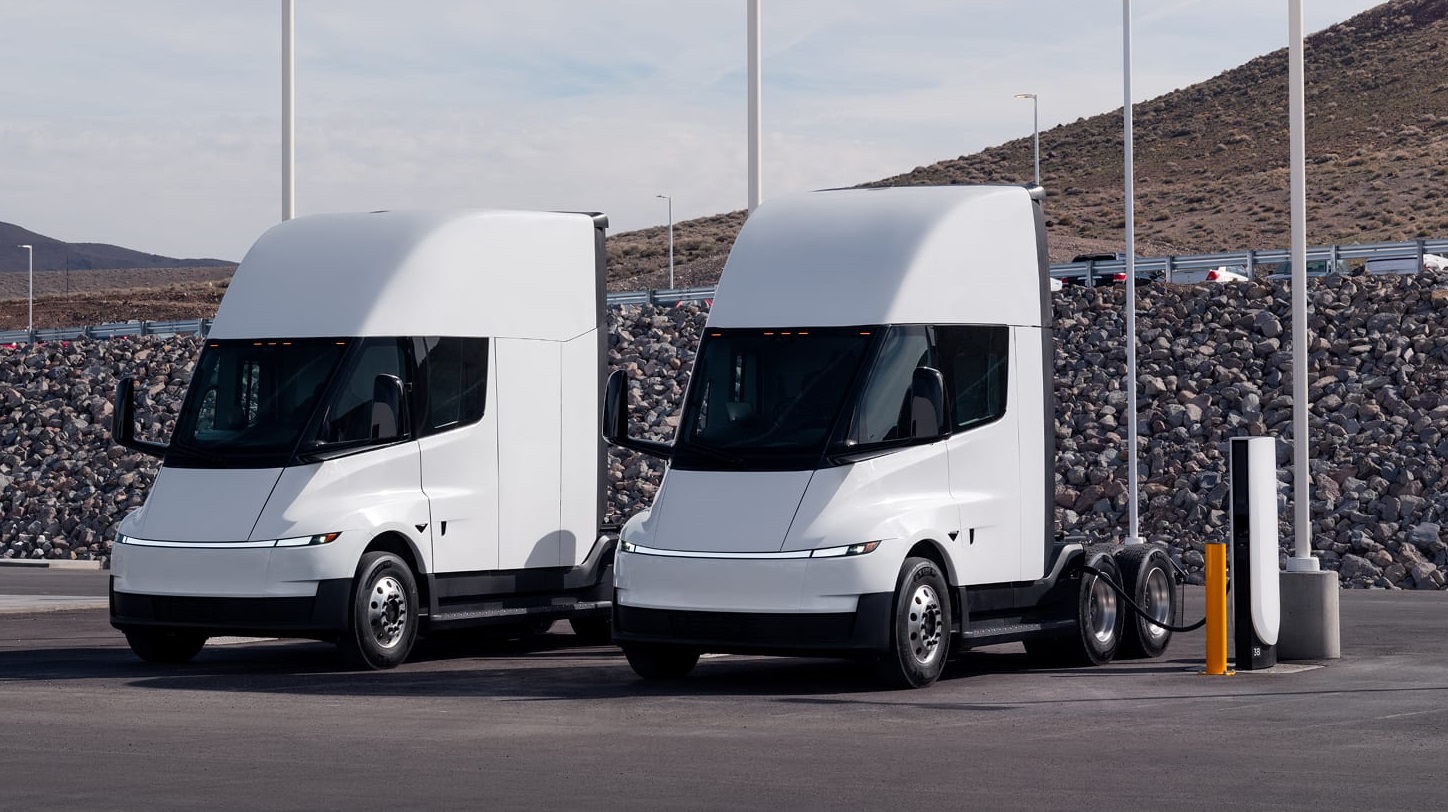
Tesla has just announced a new Semi Charging for Business program, which enables third-party businesses to purchase DC fast-charging infrastructure for heavy-duty electric vehicles (primarily for the Tesla Semi, which recently entered series production).
The offer consists of two major elements — Megachargers and Basechargers (a new type of depot chargers). Both are equipped with the Megawatt Charging System (MCS) charging connectors.
Overall, the Semi Charging for Business program reminds us of the previously launched Tesla Supercharger for Business program.

Tesla Semi Charging for Business: 1.2-MW Megacharger post (Image credit: Tesla)

Tesla Semi Charging for Business: 125-kW Basecharger (Image credit: Tesla)
Tesla Semi Charging for Business
Megacharger
The Tesla Megacharger is a distributed DC fast-charging system with a peak output of 1,200 kW (1.2 MW). It’s based on Tesla’s V4 Supercharging cabinet (1.2 MW), here called Megacharger cabinet, combined with V4 dispensers, equipped with a Megawatt Charging System (MCS) charging connector, instead of NACS (SAE J3400) like in the Supercharging network.
Tesla uses Megachargers for its Mecharging network (see an interactive map here), which can deliver up to 1.2 MW of power to a Tesla Semi.
In the Semi Charging for Business, Tesla offers 1.2-MW Megacharger cabinets, which can supply power to two dispensers. The dispensers themselves also can supply up to 1.2 MW each, although if two vehicles are charging, the power is shared between them.
This type of charging infrastructure is for quick stops. A Tesla Semi can replenish up to 60 percent of its range in 30 minutes.
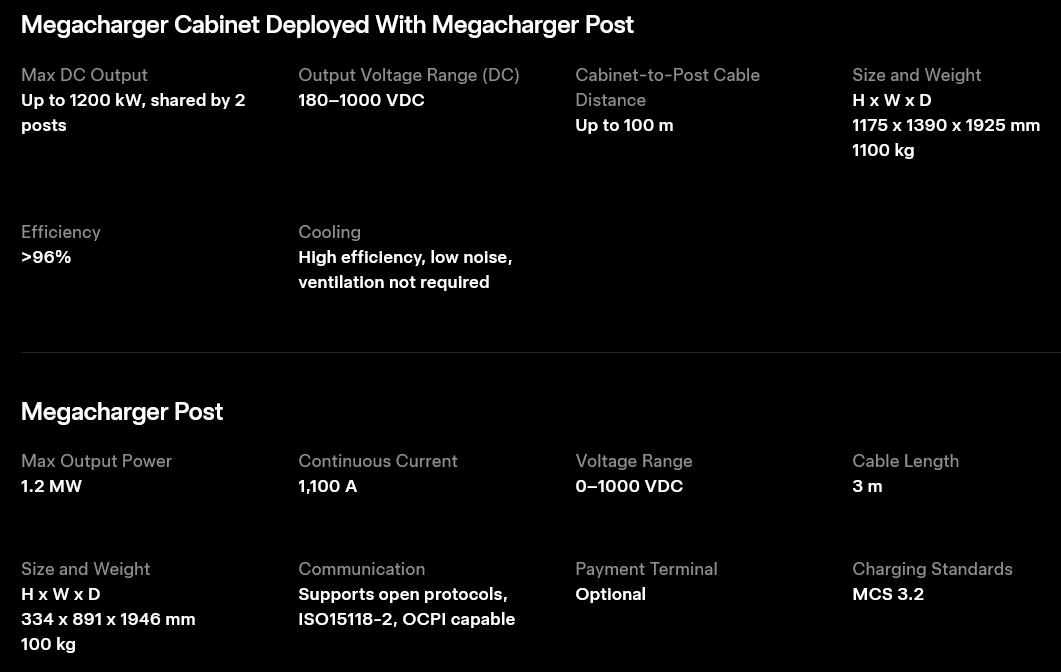
Tesla Semi Charging for Business: 1.2-MW Megacharger hardware details (Image credit: Tesla)
Basecharger
The Tesla Basecharger is a new type of charger. Although it looks like a V4 dispenser, it’s not a dispenser but a full-blown, all-in-one DC fast charger that operates standalone (without an external cabinet). The peak power output is 125 kW, and it features the MCS charging connector.
Another change compared to the Megacharger dispenser is a much longer cable (6 m instead of 3 m) with a cable management system.
“It features a fully integrated design that eliminates the need for a separate AC-to-DC cabinet, simplifying installation. The 6 meter cable offers layout flexibility for all depots.”
The Basecharger is a depot charger for heavy-duty EVs (an equivalent to home charging of private cars). Fleet operators usually install multiple of these at their depots.
Tesla says that “Up to 3 Basechargers can be daisy-chained on a single breaker (sharing 125 kVA) to further reduce installation and operational costs.” It means that smart load management is implemented.
According to Tesla, a Semi at a 125-kW Basecharger can replenish up to 60% of its range in four hours. That’s more than enough for overnight use.
Customer deliveries of the Tesla Basecharger are expected to begin in early 2027.
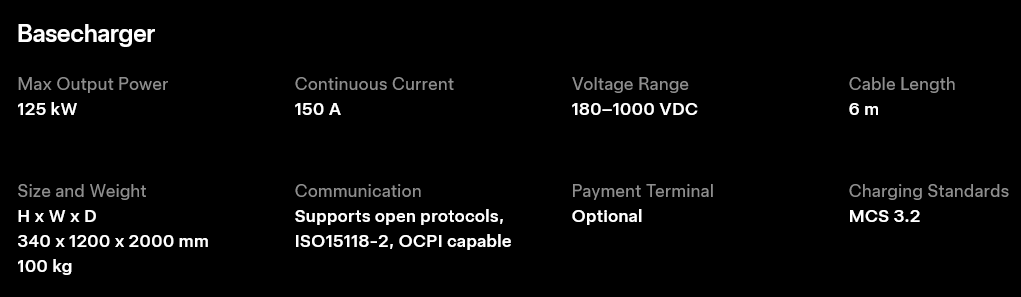
Tesla Semi Charging for Business: 125-kW Basecharger hardware details (Image credit: Tesla)
Costs
The Tesla Semi Charging for Business website includes pricing for the Megacharger and Basecharger infrastructure, as well as a cost calculator based on the number of units.
Megacharger: $188,000 For Two Stalls
The minimum order of Megachargers is two stalls, which is reasonable considering that a single 1.2-MW cabinet can be combined with up to two dispensers.
The price of the base 2-stall system is $188,000, but that’s only for the hardware and does not include taxes and installation.
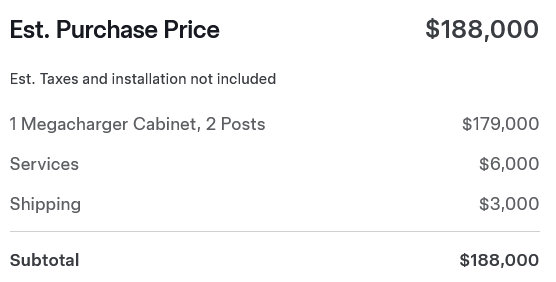
Tesla Semi Charging for Business: Estimated Cost of Megachargers (Image credit: Tesla)
One can order more stalls (up to 100 at once), although it only makes sense to buy an even number (2, 4, 6, 8…) because if you order three or five, the bill is almost as high as for four or six, respectively (the difference is several thousand).
Basecharger: $20,000/Unit
The minimum order for Basechargers is two, and each pair costs $40,000, excluding taxes and installation. It means that a single 125-kW Basecharger costs $20,000, which isn’t bad for an all-in-one charger.
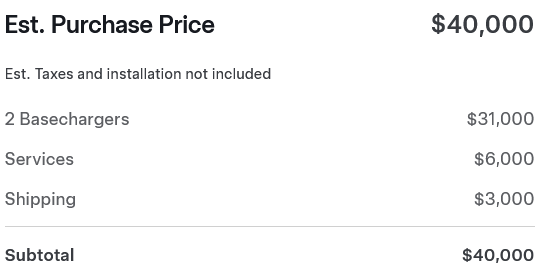
Tesla Semi Charging for Business: Estimated Cost of Basechargers (Image credit: Tesla)
Tesla’s All-Inclusive $0.08/kWh Fee
For revenue-generating sites (concerns primarily Megachargers), Tesla offers an all-inclusive fee of $0.08/kWh. With this flat rate, third-party businesses can easily start operating publicly available DC-fast charging stations for heavy-duty vehicles.
We assume that the infrastructure will work not only with Tesla Semi, but also with other compatible EVs (with a MCS 3.2 charging port).
The rate of $0.08/kWh is lower than the analogous fee for the Superchargers ($0.10/kWh).
Here is what is included:
“For revenue-generating sites, Tesla offers an all-inclusive fee of $0.08/kWh.”
Maintenance Package
97% uptime guarantee and 10+ year equipment service agreement (parts and labor included).
Annual preventative maintenance and scheduled service visits.
Tesla technicians: experts in Semi Charging systems, with parts on hand and direct feedback loops to Engineering.
Trip Planner & Dynamic Rerouting
Increased utilization powered by intelligent routing that considers state of charge, efficiency, site availability, and weather.
Host-owned sites added to our Trip Planner and in-vehicle navigation, subject to the terms of the service agreement.
Network Operation, Remote Diagnostics, Driver Support
Network Operations Center verifying customer escalations and Semi charger disruptions 24/7/365.
Remote detection, automatic triage, and repair, plus routine firmware updates by Tesla Service Engineering.
Phone support for troubleshooting charging issues for all drivers (Tesla & Other).
Evolving Software Enhancing the EV Driver Experience
Plug & Charge: Built in from day one for Teslas and compatible vehicles- no setup, no failures, and no hassle at the point of sale.
Forecasted Availability: Real-time monitoring of stall occupancy, wait times, and outages to avoid drivers being routed to full or unavailable sites.
Down stalls and maintenance events are reflected instantly, while dynamic forecasting utilizes anonymous data to predict availability specifically at the driver’s arrival time.
Preconditioning: Vehicles automatically optimize battery temperature for faster charging, when using Trip Planner to navigate to Semi charger sites.
Pricing: Flexible pricing tools and controls based on Tesla’s decade plus in charging operations.
Resilient Design: Plug & Charge works even without connectivity. Billing resumes automatically once reconnected.
In-App Customer Satisfaction Score (CSAT) & Report an Issue: Drivers can rate their experience and flag issues directly in the Tesla app for faster feedback and resolution.
And more as we release new features.
Management Software & Revenue Remittance
Tesla for Business with full session data, monthly usage reports, uptime insights, and pricing controls.
Open Charge Point Interface (OCPI): Live, automated data sharing.
Automatic revenue payouts on a set schedule, minus Tesla’s fee.
Other
Utility rate and tariff optimization to help you optimize energy costs.
Internet Connectivity Management Services (includes managing and paying for the internet connection).
Ongoing improvements and firmware updates – your chargers get better over time.
Example Order (2x Megacharger and 2x Basecharger)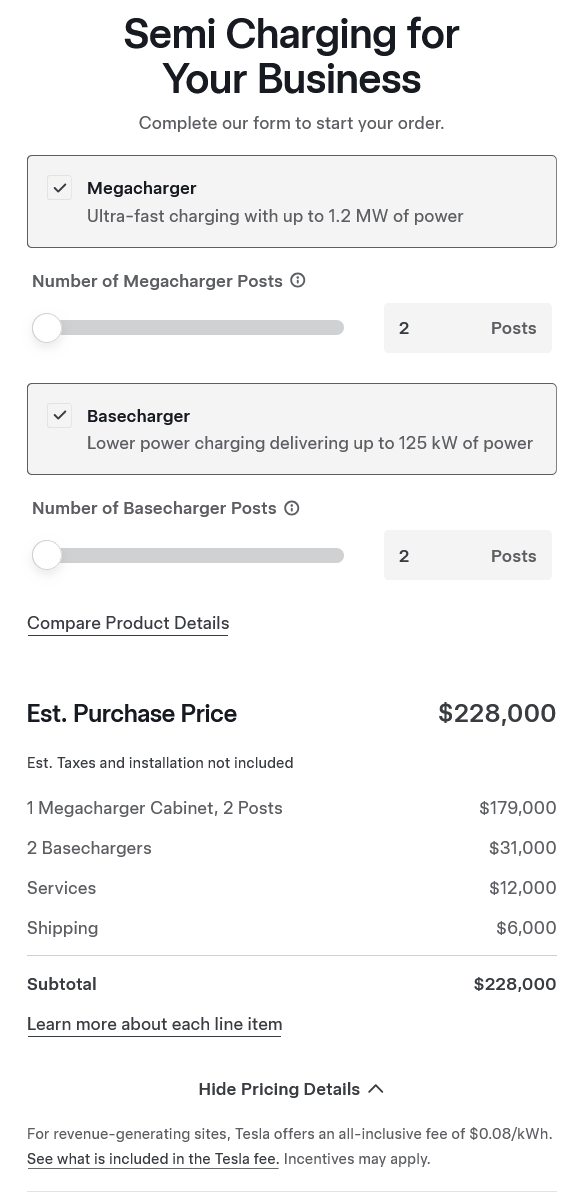
Tesla Semi Charging for Business: Estimated Costs (Image credit: Tesla)