
KeysQuestions4Vehicles2
A Tesla Model Y owner’s meticulous 18-month tracking reveals 17% battery capacity lost in under 42,000 miles, and the degradation curve he documented from day one tells a story Tesla probably wishes stayed buried.
What makes this especially damning is that a recent industry study found most EVs retain 88% to 95% capacity past 100,000 miles, which means this isn’t just bad — it positions Tesla as a striking outlier against the broader EV market.
If you’re shopping for an electric vehicle or already own a Tesla, the growing chorus of owners reporting similar numbers — and the whispers of a potential class-action lawsuit — suggest this could become the next major headache that hits your wallet and your resale value.
Ask The Box →
Considering the Model Y?
Model Y vs rival?Best trimReal MPG
AI-generated summary from reviews, comparisons and articles by AutoNotion
Tesla is in trouble for a lot of things. There are lawsuits over its unsafe Full Self-Driving mode that doesn’t seem to work as promised, the ongoing delay of the “flying” second-generation Tesla Roadster, its alarming earnings call, those super ugly Cybercabs, and, of course, the haters calling out Elon Musk’s questionable claims. Always.
But there is somehow more stuff we can add to the list: battery health.
One driver on X (@scotsrule08) tweeted that the battery health on his 2024 Model Y Performance has already hit 83% at 42,000 miles. It was at 85% health at 31,000 miles, about 11,000 miles ago. He noted that the degradation had slowed, but the initial decline was “so steep,” pointing out that he lost 17% of capacity in under two years of ownership.
The Tesla driver has been documenting the battery health since he purchased the vehicle. At 11,000 miles, it was at 91.8% health. At 20,000 miles, it declined to 87% health. When it hit 85% at 31,000 miles, he tweeted: “Absolutely brutal degradation for just 31,000 miles and 18 months of ownership.”
It’s now at 83% capacity.
Tesla Model Y · The Lot
1 owner scored this · “Seeing 2024 Model Y Long Range for around $35k with 20k mile…”
See reviews
“Would you consider this acceptable?” he asked.
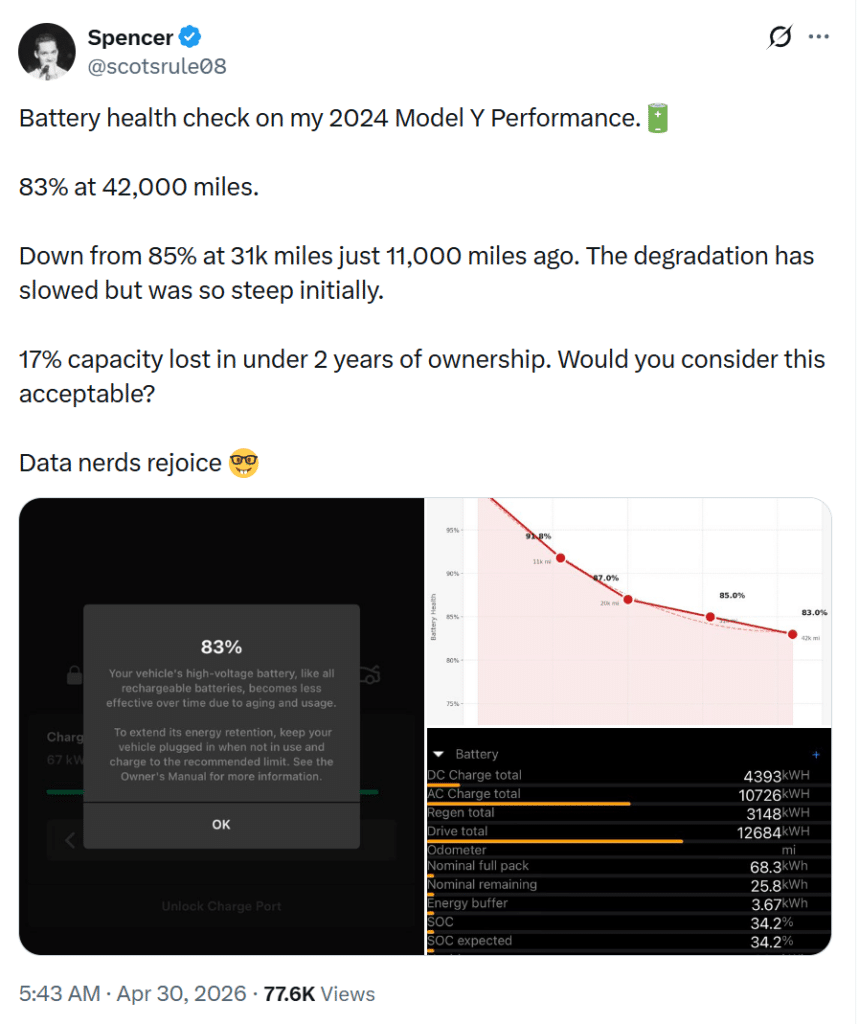 Image Credit: @scotsrule08 / X.
“Battery degradation has been so unusually bad for recent Teslas”
Most EV enthusiasts on X were quite shocked by the data. Many called it “bad,” “awful,” and “a big oof.” Some have pointed out that Tesla’s battery technology has been “getting worse.” Some reports back this claim up, stating that the 4680 “dry electrode” battery has been facing yield issues and struggles to meet Musk’s original performance promises. Welp, that sounds familiar.
“Customers should be informed about the costs associated with parts and failures caused by radical battery degradation. Otherwise, Tesla is also leading commercial customers around by the nose,” one hater said on X. Another response said they wouldn’t be surprised if a class-action lawsuit over battery degradation pops up.
Autonoción Newsletter
No spam. Unsubscribe anytime. Privacy policy (opens in new window)
Of course, there are always Tesla supporters out there as well, especially on X. One Tesla driver blamed @scotsrule08 rather than the car, accusing him of supercharging his car too often. Someone agreed, saying he is “punishing” his car. It’s true that Tesla advises against Superchargers for daily driving, saying they’re only recommended for long trips to preserve battery health. Frequent fast charging can degrade battery capacity. However, @scotsrule08 replied that he sticks to an 80% charge limit and only uses Superchargers for road trips. He also claims to use FSD over 99% of the time.
In the replies, there were plenty of other Tesla drivers sharing similar degradation timelines, as well as some claiming their Tesla has perfect battery health despite putting 100,000-plus miles on it. I think both are telling the truth. Maybe. Either way, it doesn’t add up with a recent study that claims EV batteries are lasting way longer than the warranty. Most EVs with over 100,000 miles had a battery capacity of 88% to 95%. This means Tesla is an extreme outlier, even if both sides are being honest.
Yikes.
While Tesla can be credited with many early EV innovations — like making EVs cool with the first-generation Roadster and plastering big screens all over their cabins — it feels like the competition is surpassing it at this point. Tesla has changed its vehicles very little, probably because Musk is more focused on the Cybercab and the Optimus robot. Being spread thin across all these projects has left EVs without many improvements and has hurt build quality.
At this point, it feels like Tesla is relying on brand recognition and Musk fanboys rather than addressing real issues with its vehicles. I mean, if you can get people to defend your batteries after seeing proof of rapid degradation, I guess you don’t really have to do anything about it.