
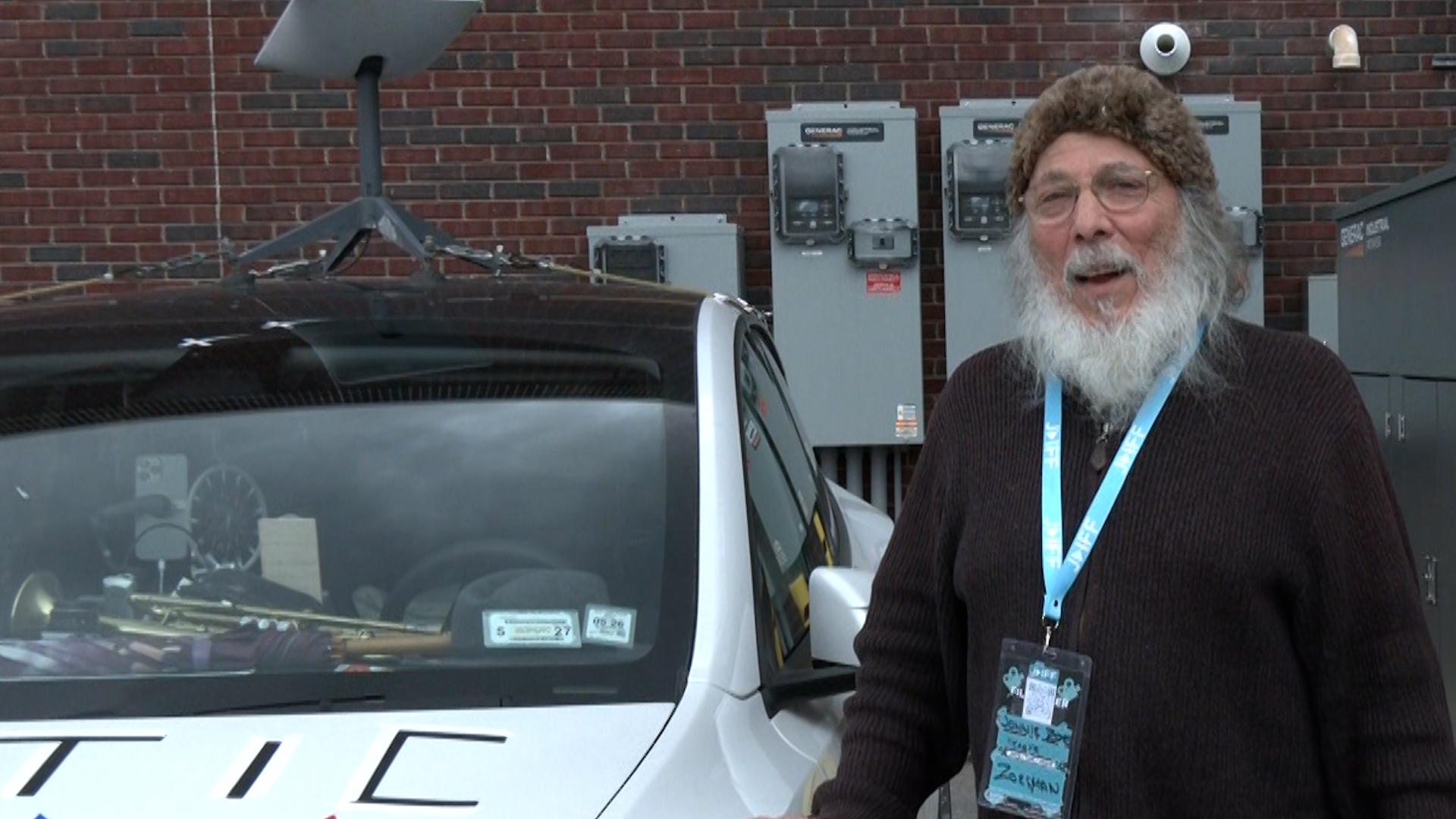
TRAVERSE CITY — The plates may say New York, but Jonnie Zoesman considers himself a digital nomad at heart.
For the last four years, the 73-year-old filmmaker has been sleeping in the back of a Tesla. Not staying in hotels between road trips, living in it, as he crosses and recrosses North America on a network of free charging stations, building a film project that has grown far beyond what he originally set out to make.
The Tesla is not just transportation. Zoesman converted it into a mobile production studio, a satellite dish bolted to the roof, cameras mounted inside the windows, Starlink connection running continuously. It is his office, his cutting room, and his home.

The film started as “1000 Days: The True Story of Maggie and Jonnie” — a love story rooted in his own life and his time living in northern Canada in the early 1970s. But four years on the road, thousands of miles of highway, and an uncountable number of strangers who became something closer to friends have turned it into something larger.
The travels themselves — the people, the places, the highway camp workers and Yukon government officials and indigenous leaders and Sundance filmmakers and grocery store clerks who stopped him cold with their warmth — have become part of the story.
Zoesman, whose full name is Asa Jonathan Zoesman, now describes the project as a global co-production, built in real time from the back of that Tesla.
He uses artificial intelligence tools to help organize thousands of hours of footage, photographs, and written material, then collaborates with editors and writers around the world, including a London-based script editor he connected with through Sundance contacts.
The journey’s most dramatic chapter came when he drove north up the Alaska Highway in winter, in an electric car, with no generator, relying entirely on the kindness of strangers for charging. He made it all the way to the Arctic Ocean at Tuktoyaktuk in Canada’s Northwest Territories, reportedly the first person to do so in an EV in the dead of winter.
“When I went north, nobody wanted to see me die,” Zoesman said. “Every place I needed to charge, somebody would plug me in.”
The Starlink dish on his roof was sent to him by SpaceX when the company was first rolling out service in the far north. He rigged it to the Tesla’s roof with $35 Canadian worth of hardware from a Whitehorse hardware store. It has held there ever since.
Zoesman came to Traverse City for the film festival, working a circuit that has already taken him through Sundance in Park City, Utah, and the Julien Dubuque International Film Festival in Iowa. He had been north to Marquette, came through Petoskey on the way down, and found northern Michigan matched the warmth he has encountered in most places he has stopped.
“It is beautiful in northern Michigan, and it’s amazing,” he said. “Traverse City, Petoskey, Marquette, all these places have just so many nice things. Natural beauty uplifts people. It gives them hope. It gives them dreams. It makes life better.”
He described stopping in Petoskey and encountering a woman stocking produce at a grocery store who greeted him with a warmth he said stopped him cold.
“All I could say was, you have such beautiful eyes,” Zoesman said. “ I asked her if she was happy with eyes like that, and she said, ‘ Yes, I’m very happy. Just loving living here.’”
Four years sleeping in the back of a Tesla and knocking on strangers’ doors for a place to plug in has left Zoesman with a philosophy he has refined the hard way.
People, he says, are fundamentally good. The further from comfort he has traveled, the more consistently that has proven true. Highway maintenance workers in the Yukon who moved equipment out of the way so he could pull in and charge. A Park City health department that invited him to use their charger and pointed him to a free electric bus into town. Hundreds of names in his phone, from Inuit leaders in the far north to schoolteachers in small midwestern towns, who have kept in touch ever since.
“Basically everybody is good,” he said. “Certainly with their family, and we’re all kind of the same family. Discovering that people want to become more like a family with everybody, this is good.”
He draws a direct line between the digital nomad lifestyle he lives and the nomadic indigenous peoples he learned about in Dawson City, in Canada’s Yukon, whose territory spanned a million square miles of the north and who traveled in small groups, finding everything they needed along the way.
“A modern digital nomad travels, and they find whatever it is that they need to find,” he said. “The possibilities for a digital future are essentially endless.”
His advice for anyone thinking about a leap they have been putting off is short, and delivered without hesitation.
“You can do it, even if you’re ancient like I am, you can do it,” Zoesman said. “My elevator pitch is, do it. Just do it. Do it now. Don’t wait.”
Next stop is Sleeping Bear Dunes National Lakeshore, on the recommendation of a friend who told him it was not something to miss. After that, Zoesman says, he will get to the intersection, check his instincts, and go whichever way they point.
“I’m just going to wake up in the morning and get ready to go,” he said. “Then I’ll go left or I’ll go right. I don’t even know. I get to the intersection, and some instinct will drive me.”
More information about the Arctic Tesla Film project is available at arctictesla.org.