
 Market Overview
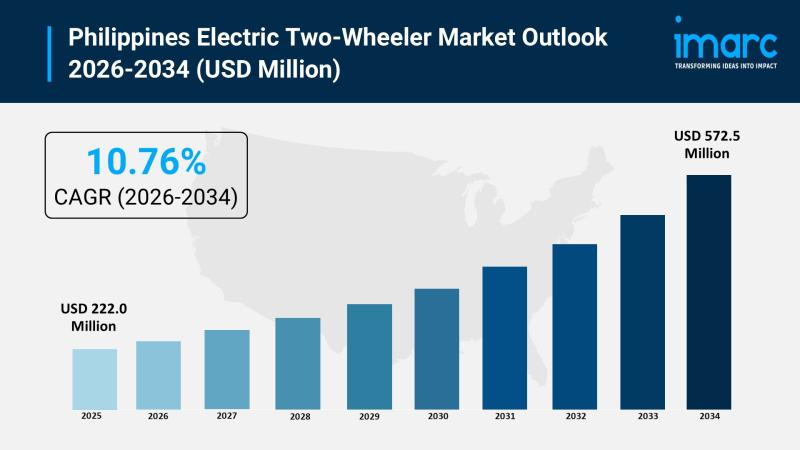
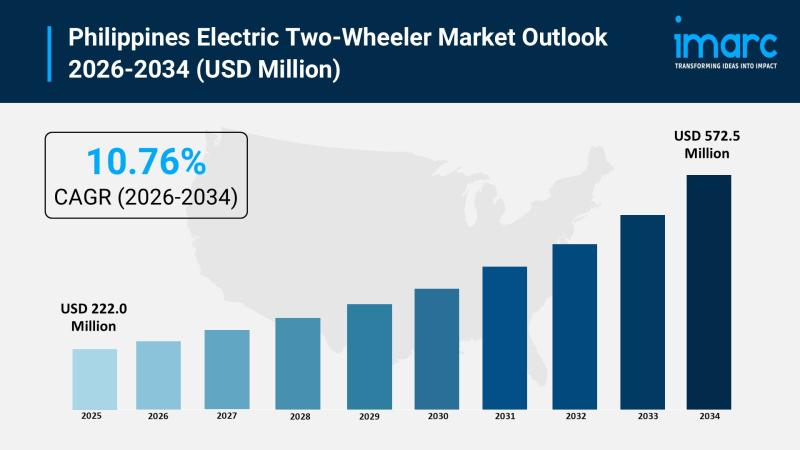
The Philippines electric two-wheeler market size reached USD 222.0 Million in 2025 and is projected to reach USD 572.5 Million by 2034, exhibiting a growth rate (CAGR) of 10.76% during 2026-2034. The market encompasses diverse vehicle types, battery technologies, voltage categories, and motor configurations tailored to various commuter and commercial mobility needs, covering electric scooters, mopeds, and motorcycles across lithium-ion and sealed lead acid battery types serving urban, suburban, and rural Filipino riders. The market is driven by rising fuel costs, government initiatives promoting sustainable mobility, and growing environmental awareness among consumers. Increasing urban congestion encourages the adoption of compact, efficient electric scooters and bikes. Advancements in battery technology reducing charging time and improving range, expanding charging infrastructure, and the affordability of entry-level models further support market growth – positioning the sector for sustained expansion throughout the forecast period.
Request for a sample report PDF: https://www.imarcgroup.com/philippines-electric-two-wheeler-market/requestsample
Philippines Electric Two-Wheeler Market Summary
• Expansion is driven by continuously rising fuel prices that make conventional motorcycle operation increasingly expensive – compelling daily commuters and delivery service providers to shift toward electric two-wheelers offering significantly lower cost-per-kilometer running expenses
• Strong government support through reduced import tariffs on electric motorcycles, proposed tax incentives, Department of Energy charging station expansion programs, and local government unit perks including free parking for EVs is creating a progressively supportive regulatory and policy environment
• As of mid-2024, only 354 electric motorcycles existed out of approximately 15,300 total EVs in the Philippines – penetration well under 1% – indicating extraordinary untapped market growth potential as awareness, infrastructure, and product availability improve
• Market includes electric scooter/moped and electric motorcycle vehicle types across lithium-ion and sealed lead acid battery categories spanning voltage ranges from below 48V to above 96V and peak power outputs from below 3 kW to above 10 kW
• Demand is rising for removable battery designs that allow convenient home or workplace charging without proximity to a dedicated charging station – addressing Filipino consumers’ practical concerns about charging infrastructure availability
• Growth in e-commerce and food delivery platform demand is generating commercial fleet interest from businesses seeking cost-efficient and low-maintenance last-mile delivery vehicles in congested urban environments
• Honda Philippines launched its first fully electric two-wheeler – the Honda EM1 e: – priced at PHP 155,400 in September 2024, marking a pivotal mainstream brand entry that validates the market and builds consumer confidence in electric mobility
• VinFast announced its May 2024 entry into the Philippine EV market, introducing six motorcycle models alongside electric cars and the VF DrgnFly e-bike – reflecting growing international EV brand interest in the Philippines’ developing electric mobility ecosystem
• Luzon anchors regional market leadership through Metro Manila’s extraordinary traffic congestion, high fuel cost exposure, delivery service density, and superior charging infrastructure relative to Visayas and Mindanao
How AI is Reshaping the Philippines Electric Two-Wheeler Market
Artificial intelligence is playing an increasingly pivotal role in reshaping the Philippines electric two-wheeler market, enabling manufacturers, fleet operators, charging infrastructure providers, and digital mobility platforms to streamline operations, improve rider experiences, and deliver more responsive, data-driven electric mobility solutions across diverse Filipino commuter and commercial segments.
• AI-Powered Battery Management and Range Optimization: Electric two-wheeler manufacturers are embedding AI-driven battery management systems that continuously analyze charge state, temperature, discharge rates, and usage patterns – enabling adaptive energy distribution, optimized regenerative braking performance, and more accurate real-time range prediction that reduces rider range anxiety and improves the functional reliability of electric motorcycles in the Philippines’ varied urban and provincial riding environments.
• Predictive Maintenance and Vehicle Health Monitoring: E-two-wheeler fleet operators and individual owners are integrating AI-powered vehicle health monitoring platforms that analyze motor performance, battery cell degradation, brake system condition, and electrical component status – enabling early fault identification, proactive maintenance scheduling, and reduced unexpected breakdown incidents that are particularly critical for delivery riders who depend on continuous vehicle availability for their livelihoods.
• AI-Enabled Smart Charging Network Management: Charging infrastructure operators are deploying AI-powered network management systems that analyze charging demand patterns, grid load conditions, and station utilization rates – enabling dynamic pricing, predictive station maintenance, and optimized charging capacity allocation that improve charging reliability and convenience for Filipino electric two-wheeler riders across urban and semi-urban deployment locations.
• Intelligent Fleet Management for Commercial Delivery Operators: E-commerce platforms and food delivery companies operating electric two-wheeler fleets are leveraging AI-driven fleet management tools that optimize rider route assignment, monitor vehicle utilization efficiency, and analyze delivery performance data – enabling more productive fleet operations, reduced per-delivery energy costs, and data-driven fleet expansion planning as commercial electric motorcycle adoption scales across Metro Manila and regional cities.
• AI-Driven Consumer Finance and Credit Scoring for E-Two-Wheeler Access: Digital lending platforms and motorcycle financing companies are deploying AI-powered credit assessment tools that analyze alternative data sources – including mobile payment history, e-wallet transaction patterns, and delivery platform earnings – enabling more inclusive lending decisions that extend affordable electric two-wheeler purchase financing to Filipino consumers without traditional credit histories.
• Fraud Detection and Vehicle Authentication Systems: E-two-wheeler platforms and insurance providers are deploying AI-powered authentication systems that verify vehicle identity, monitor usage patterns for fraud indicators, and identify unauthorized vehicle sharing or misrepresentation – protecting both consumers and financial institutions involved in electric two-wheeler purchase, rental, and insurance arrangements.
• Data Privacy and Secure Digital Mobility Infrastructure Through AI Governance: In alignment with the Philippines’ Data Privacy Act and evolving transportation sector digital compliance frameworks, AI-powered governance tools are enabling electric mobility platforms and fleet management systems to maintain regulatory compliance – ensuring secure management of rider location data, vehicle performance records, and personal identification information within digital electric mobility ecosystems.
Key Trends Shaping the Philippines Electric Two-Wheeler Market
• Government initiatives and supportive policy frameworks are the foundational market enablers, with the Department of Energy and local government units actively developing charging infrastructure, national government policy reducing import tariffs on electric motorcycles, and proposed tax incentives progressively improving the economic competitiveness of electric two-wheelers – while government-backed awareness campaigns are helping overcome consumer hesitancy and building confidence in electric mobility as a practical and reliable transportation alternative.
• Rising fuel costs and cost-efficiency imperatives are the most powerful consumer adoption driver, with continuously escalating gasoline prices making the significantly lower cost-per-kilometer running expense of electric two-wheelers increasingly compelling for daily commuters and delivery riders – with the long-term operational savings advantage of electric mobility becoming more visible and persuasive as fuel price volatility continues and affordable electric models become more widely available across the Philippine market.
• Rapid urbanization and severe traffic congestion in Metro Manila and major provincial cities are making electric scooters and motorcycles practically advantageous mobility solutions, with their compact dimensions enabling effective navigation of congested streets, their low noise levels appropriate for dense residential areas, and their zero tailpipe emissions aligning with urban air quality improvement priorities – making electric two-wheelers particularly well-suited to the daily mobility challenges facing millions of Filipino urban commuters.
• Advancements in battery technology are progressively addressing the range anxiety and charging convenience concerns that historically limited consumer confidence in electric two-wheelers, with improving lithium-ion energy density delivering greater range per charge, faster charging capability reducing downtime, and removable battery designs enabling convenient home charging that eliminates the need for dedicated charging station access – collectively improving the practical reliability of electric motorcycles for daily Filipino commuter and commercial use cases.
• Mainstream brand entry is accelerating market legitimacy and consumer adoption, with Honda Philippines’ September 2024 launch of the EM1 e: at PHP 155,400 representing a watershed moment that positions electric two-wheelers as credible and quality-assured products – supported by Honda’s extensive dealer and after-sales service network that addresses the post-purchase support concerns that significantly influence Filipino motorcycle buyer confidence and brand selection decisions.
• The commercial delivery sector is emerging as a high-growth demand driver, with e-commerce platforms, food delivery companies, and logistics operators increasingly recognizing the compelling total cost of ownership advantages of electric motorcycles for urban last-mile delivery – where high daily mileage, frequent stop-and-go operation, and fuel cost sensitivity make the efficiency and running cost advantages of electric two-wheelers most financially impactful.
• Luzon dominates market activity through Metro Manila’s extraordinary fuel cost exposure, congestion severity, delivery service density, and relative charging infrastructure maturity – while Visayas markets including Cebu City and Mindanao centers including Davao represent growing secondary markets as regional urbanization, rising fuel costs, and improving electric vehicle awareness extend electric two-wheeler adoption beyond the National Capital Region.
Browse the full report with TOC and list of figures: https://www.imarcgroup.com/philippines-electric-two-wheeler-market
Market Growth Drivers
Fuel Cost Escalation, Urban Congestion, and Government Policy Momentum
The Philippines electric two-wheeler market growth is anchored in the powerful convergence of rising and volatile gasoline prices – which continuously strengthen the financial case for switching from conventional to electric two-wheelers among cost-sensitive Filipino commuters and commercial riders – and the severe urban congestion that makes compact, maneuverable electric scooters and motorcycles practically superior mobility solutions for daily travel in Metro Manila and rapidly growing provincial cities. The government’s multi-dimensional policy support – encompassing reduced import tariffs, proposed tax incentives, charging infrastructure development programs, and local government unit initiatives providing additional EV user benefits – is creating a progressively more favorable regulatory environment that reduces both the upfront cost and the operational friction barriers to electric two-wheeler adoption across income levels. The extraordinary untapped market potential – with electric motorcycle penetration well under 1% of total registered EVs as of mid-2024 – provides a compelling structural growth foundation that is progressively being activated by improving product availability, expanding mainstream brand participation, and growing consumer awareness of electric mobility’s practical and financial benefits throughout the 2026-2034 forecast period.
Battery Technology Advancement, Commercial Fleet Adoption, and International Brand Entry
Continuous advancement in battery technology – delivering improved energy density, faster charging, extended cycle life, and the practical convenience of removable battery designs – is progressively eliminating the technical limitations that historically constrained consumer confidence in electric two-wheelers, enabling manufacturers to offer products that reliably meet the daily range requirements of Filipino commuters without the charging infrastructure dependency that previously deterred potential buyers. The accelerating commercial adoption of electric two-wheelers by e-commerce and food delivery operators – motivated by compelling total cost of ownership advantages across high-mileage urban delivery operations – is simultaneously creating large-volume fleet demand that improves market economics for manufacturers and infrastructure providers while establishing visible real-world evidence of electric two-wheeler reliability that builds broader consumer confidence. The entry of major international brands including Honda and VinFast into the Philippine electric two-wheeler market is catalyzing mainstream consumer acceptance – with established brands’ quality assurance credentials, dealer network coverage, and after-sales service capability addressing the trust and support concerns that are decisive purchasing considerations for Filipino motorcycle buyers evaluating their first electric vehicle purchase throughout the forecast period.
Market Segmentation
IMARC Group provides an analysis of the key trends in each segment of the Philippines electric two-wheeler market, along with forecasts at the country and regional levels from 2026-2034. The market has been categorized based on vehicle type, battery type, voltage type, peak power, battery technology, and motor placement.
By Vehicle Type:
• Electric Scooter/Moped
• Electric Motorcycle
By Battery Type:
• Lithium-Ion
• Sealed Lead Acid (SLA)
By Voltage Type:
• Less than 48V
• 48-60V
• 61-72V
• 73-96V
• Greater than 96V
By Peak Power:
• Less than 3 kW
• 3-6 kW
• 7-10 kW
• Greater than 10 kW
By Battery Technology:
• Removable
• Non-Removable
By Motor Placement:
• Hub Type
• Chassis Mounted
By Region:
• Luzon
• Visayas
• Mindanao
Key Players
The Philippines electric two-wheeler market features competition among global motorcycle manufacturers entering the EV segment, regional Asian electric vehicle brands, domestic electric mobility startups, and international EV companies establishing Philippine market presence. The market research report provides a comprehensive analysis of the competitive landscape including key player positioning, market structure, top winning strategies, competitive dashboards, and detailed company profiles.
Key Aspects Required for Philippines Electric Two-Wheeler Market
• Demand structure includes daily urban commuters, delivery riders and commercial fleet operators, students, provincial two-wheeler users seeking fuel cost reduction, and environmentally conscious buyers across all income segments and geographic regions
• Balanced growth between affordable entry-level electric scooters and mopeds serving first-time buyers and budget commuters and mid-range electric motorcycles serving daily commuters requiring greater range, performance, and durability
• Vehicle segmentation includes lightweight electric scooters for urban short-distance commuting, step-through mopeds for accessible urban mobility, and full-size electric motorcycles for highway-capable long-distance daily commuting and commercial delivery applications
• Increasing preference for lithium-ion battery systems over sealed lead acid given superior energy density, longer cycle life, faster charging, and removable design convenience that enables charging without dedicated station infrastructure
• Consumers prioritize purchase affordability, daily range adequacy, charging convenience, after-sales service network coverage, brand reliability, and total running cost in electric two-wheeler purchasing decisions
• Growing demand for affordable financing options, installment payment plans, and government-facilitated purchase incentives that reduce the upfront cost barrier to electric two-wheeler ownership for budget-sensitive Filipino consumers
• Competitive landscape includes Honda Philippines, Yamaha, VinFast, and Chinese electric motorcycle brands alongside domestic Philippine electric mobility startups and emerging delivery platform-affiliated fleet procurement programs
• Distribution channels include branded motorcycle dealer networks, specialty EV retail stores, e-commerce platforms, fleet procurement programs, and government-facilitated community electric mobility initiatives
• Expansion of public and private charging infrastructure across Metro Manila transportation hubs, commercial centers, workplaces, and residential communities as a critical enabler of sustained electric two-wheeler adoption and range confidence
• Rising investments in after-sales service network development, spare parts availability, battery replacement programs, and technician training that address post-purchase support concerns decisive to Filipino motorcycle buyer confidence
• Increasing role of Land Transportation Office EV registration frameworks, Department of Energy charging infrastructure standards, and Department of Trade and Industry import tariff policies in shaping market access conditions and consumer economics
• Growing penetration of electric two-wheelers in provincial urban centers as improving product availability, dealer network expansion, and rising local fuel costs extend electric mobility adoption beyond Metro Manila
Recent News and Developments
April 2026: The Philippines electric two-wheeler industry is witnessing accelerated momentum as global manufacturers expand aggressively in the country. Notably, VinFast signed agreements with 14 local distributors ahead of its planned June 2026 e-scooter launch, aiming to rapidly scale its retail and service ecosystem and strengthen its footprint in one of Southeast Asia’s fastest-growing two-wheeler markets. This expansion reflects increasing competition and signals growing confidence among international players in the Philippines’ electric mobility transition.
March 2026: The broader electric vehicle ecosystem in the Philippines experienced a significant surge, with EV sales more than doubling in March 2026 and battery electric vehicles showing nearly 486% growth month-on-month, indicating strong underlying demand that is also benefiting the electric two-wheeler segment as part of the wider electrification trend.
March-April 2026: Rising fuel prices and energy market volatility continue to play a crucial role in accelerating the shift toward electric mobility. Ongoing fuel price pressures and transport disruptions linked to the 2026 energy crisis have reinforced the cost advantages of electric two-wheelers, which offer significantly lower operating costs compared to conventional motorcycles. This macroeconomic environment is pushing both individual commuters and delivery operators toward electric alternatives.
January 2026: Regulatory developments impacted the sector as authorities implemented restrictions on e-bikes and e-trikes on major roads in Metro Manila, aiming to address road safety and traffic management concerns. While this move creates short-term challenges for adoption in certain urban areas, it is also expected to push the market toward better-regulated, higher-quality electric two-wheelers that comply with national standards.
2025 (Full Year): The Philippines electric two-wheeler market reached a value of USD 222.0 million, supported by rising fuel costs, urban congestion, and increasing consumer awareness of sustainable mobility solutions. Despite this growth, penetration remains relatively low, with only 354 electric motorcycles out of approximately 15,300 EVs, indicating substantial headroom for expansion. Affordability improvements and expanding charging infrastructure are key factors driving adoption.
Note: If you require any specific information that is not covered currently within the scope of the report, we will provide the same as a part of the customization.
Speak to an analyst for a customized sample report: https://www.imarcgroup.com/request?type=report&id=41405&flag=C
Contact Us
IMARC Group
134 N 4th St., Brooklyn, NY 11249, USA
Email: sales@imarcgroup.com
Tel. No.: (D) +91 120 433 0800
United States: +1-201-971-6302
About Us
IMARC Group is a global management consulting firm that helps the world’s most ambitious changemakers to create a lasting impact. The company provides a comprehensive suite of market entry and expansion services. IMARC offerings include thorough market assessment, feasibility studies, company incorporation assistance, factory setup support, regulatory approvals and licensing navigation, branding, marketing and sales strategies, competitive landscape and benchmarking analyses, pricing and cost research, and procurement research.
This release was published on openPR.