
April 28, 2026
By Nehal Malik
Tesla is moving quickly to refine the user experience for its Full Self-Driving (FSD) users. In a surprise software release, software update 2026.2.9.9 has started rolling out to vehicles, and while it notably keeps the core FSD software at version 14.3.2, it brings a much-needed change to the way drivers interact with the car after taking over control.
Update 2026.2.9.9
FSD Supervised 14.3.2
Installed on 2.6% of fleet
Last updated: Apr 28, 7:40 pm UTC
This update focuses on the new disengagement menu, a feature that originally debuted just last week with FSD v14.3.2 in software update 2026.2.9.8. That previous update was a major milestone, introducing significant improvements to Actually Smart Summon (ASS) by unifying the AI models across consumer FSD and Tesla’s Robotaxi platform. Now, Tesla is using the 2026.2.9.9 revision to address immediate community feedback regarding the data it collects from human drivers.
The New “Navigation” Option
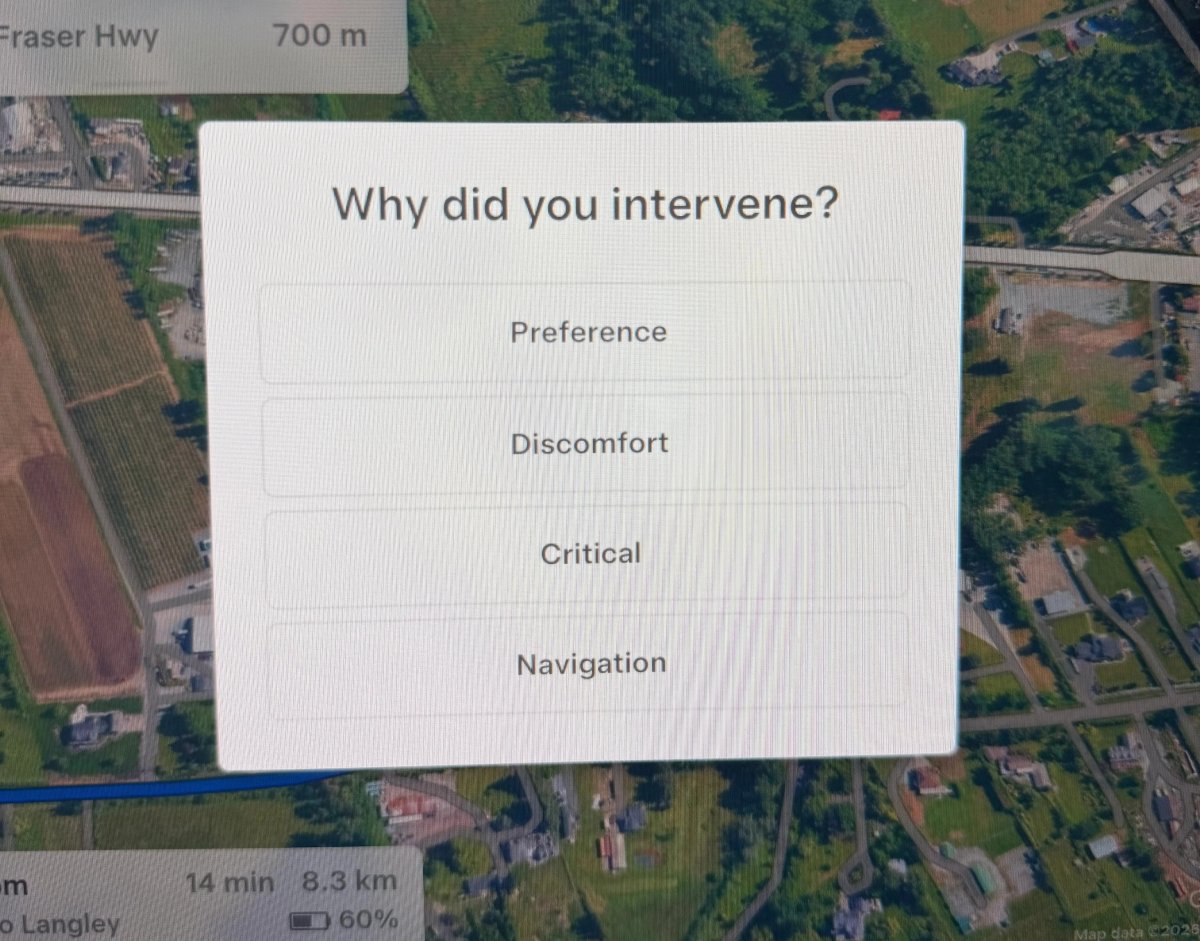
The headline change in this build is the addition of a “Navigation” button in the post-disengagement menu. When Tesla first introduced this menu, the release notes stated: “Help Tesla improve Self-Driving by selecting an intervention reason on the main screen after taking over”. Previously, drivers were presented with four options to categorize their intervention: “Preference,” “Discomfort,” “Critical,” and “Other”.
In the latest 2026.2.9.9 update, “Other” has been replaced by “Navigation”. This is a massive addition because navigation errors — such as the car being in the wrong lane for an upcoming turn or simply not driving your preferred route — are among the most common reasons a driver feels the need to intervene. Tesla Senior AI Engineer Yun-Ta Tsai confirmed over the weekend that this option was on the way, and the speed at which it has been deployed suggests that Tesla realized not including it at launch was a significant oversight.
Screen Real Estate and Forced Feedback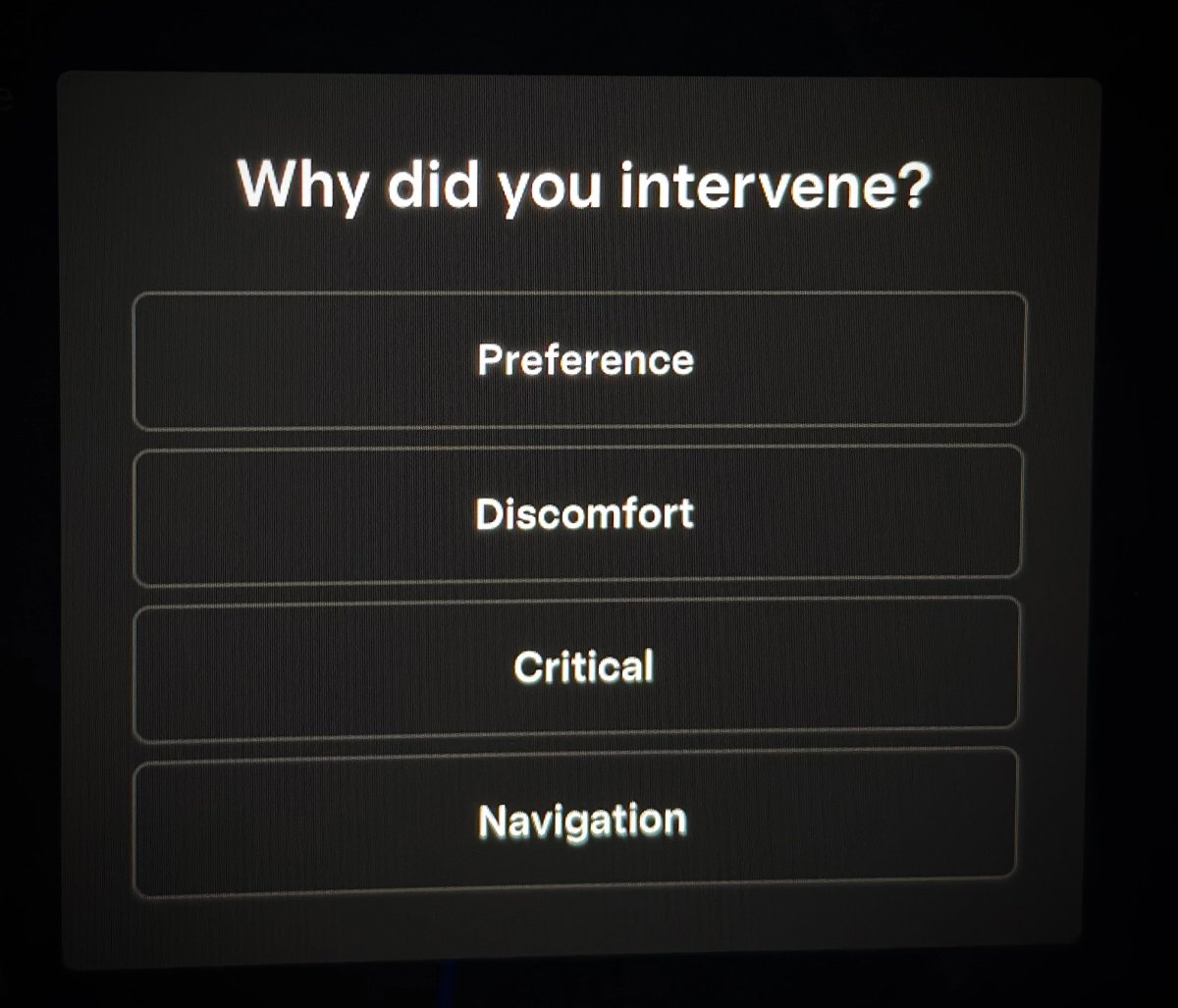
While the extra option is helpful, the menu itself remains a point of contention for many owners. Currently, the feedback prompt takes up a large portion of the center display, effectively blocking the navigation maps in the background. Even more frustrating for some is that the menu cannot be dismissed without selecting an option; it stays on the screen until the driver provides a reason for the intervention.
Ideally, we would love to see Tesla move this menu to a less intrusive location or allow it to be dismissed immediately (or at least deferred) with a “Close” button. Another community suggestion is to display the feedback prompts at the end of a drive or when the car is shifted into Park, rather than forcing a driver to interact with a large pop-up while they are busy navigating a tricky intersection they just took over from the car. There’s an argument to be made that Tesla could get higher-quality data if it didn’t force the prompt on users; drivers would likely be more accurate in their reporting if they weren’t picking an option on the fly just to get their maps back.
Seat Belt Behavior and Future Improvements
Beyond the UI changes, this update includes a small but appreciated quality-of-life tweak for FSD users. When FSD is engaged and you are nearing your destination, you can now unbuckle your seat belt before you engage Park, while the car is still moving toward or pulling into a parking spot. This was confirmed by @DirtyTesLa on X and makes it easier for drivers to prepare to exit the vehicle as it completes its final maneuvers.
Tesla updated FSD so you don’t have to wait for the car to go into park to take your seat belt off
THANK YOU 🤩 seemingly small but makes the entire experience much better pic.twitter.com/h0ABcimNZN
— Dirty Tesla (@DirtyTesLa) April 27, 2026
As Tesla’s FSD subscription revenue continues to climb — now reaching an impressive $546 million per year from nearly half a million active monthly subscribers — the pressure to polish the software is higher than ever. These small iterations are the lead-up to FSD version 15, which is expected to arrive later this year or early next year with a model featuring roughly 10 billion parameters. With Yun-Ta Tsai also previously teasing a way for drivers to provide feedback without disengaging, it is clear that the “Navigation” button is just the first of many community-led changes Tesla could make to its FSD feedback funnel.
Subscribe to our newsletter to stay up to date on the latest Tesla news, upcoming features and software updates.
April 28, 2026
By Nehal Malik
Tesla can breathe a sigh of relief regarding one of its older safety concerns. The U.S. National Highway Traffic Safety Administration (NHTSA) announced on Tuesday that it has officially closed its investigation into 120,089 2023 Tesla Model Y vehicles without requiring any further action or recalls from the automaker.
According to a report from Reuters, the regulator’s decision ends a preliminary evaluation that began in early 2023. The agency originally stepped in after receiving two separate reports of steering wheels detaching from the steering column while the vehicles were in motion.
The Root of the Detachment
According to the NHTSA, the issue was traced back to a missing retaining bolt. Both affected vehicles were manufactured during the first week of January 2023 at Tesla’s Austin, Texas, and Fremont, California, plants. Interestingly, both cars had undergone end-of-line repairs before they were delivered to customers. These repairs required the steering wheel to be removed and reinstalled, which is where the critical retaining bolt was missed.
Tesla confirmed the error and fixed both vehicles under warranty at the time. In its closing statement, the regulator mentioned it found no additional incidents. Furthermore, because the two known failures occurred within the first 400 miles of driving, the agency believes any other affected vehicles would have already experienced a detachment by now. While the case is closed for now, the NHTSA warned that this “does not constitute a finding that no safety-related defect exists,” reserving the right to take further action if new information surfaces.
Tesla’s Ongoing Regulatory Dance
This outcome is a rare “win” in what has been a busy season of oversight for Tesla. The company has a long and documented history of landing in hot water with the regulator over its hardware and autonomous ambitions. For instance, the NHTSA recently upgraded a probe into Full Self-Driving (Supervised) regarding low-visibility performance to a much more serious “engineering analysis”.
The agency has also scrutinized everything from FSD’s aggressive “Mad Max” speed profile to the design of Tesla’s emergency door releases. Even steering hasn’t been a stranger to controversy; back in 2023, the agency also investigated 280,000 Tesla vehicles over reported power steering failures. However, Tesla has seen some progress lately, with the NHTSA also ending a year-long investigation into Actually Smart Summon, which notably got a major upgrade last week with FSD v14.3.2.
A Safer Path Forward
The closure of the steering wheel probe is good news for 2023 Model Y owners who might have been worried about their hardware. It shows that the issue was likely a very isolated manufacturing fluke rather than a widespread design flaw. Tesla is already moving to address other hardware concerns, such as its plan for a new interior door release that combines electronic and mechanical latches into a single button.
As Tesla continues to refine its software with regular updates, keeping the physical hardware reliable is just as important as the code. With this investigation now in the rearview mirror, Tesla can focus on the massive software leaps expected later this year.
April 28, 2026
By Karan Singh
During the Q1 2026 earnings call, Tesla provided an anticipated update on its unsupervised Robotaxi program. While the company is actively testing uncrewed vehicles on public roads, executives confirmed that a significant, wide-scale expansion of the commercial Robotaxi fleet will not occur until the release of Full Self-Driving v15.
FSD V15
To understand why Tesla is pausing a nationwide rollout, one must look at what v15 actually represents. Elon Musk described v15 as a “major architectural improvement” that would “improve the probability of safety significantly.” Ashok Elluswamy added that FSD v15 will be a major upgrade over the current v14.3 variance that’s running on Robotaxis today.
While Tesla claims the current v14 build is already statistically safer than a human driver, v15 is explicitly designed to reach the superhuman reliability required for mass commercialization. While Tesla has already said that FSD v15 will run on existing HW4 vehicles, it may also be optimized to run on AI4+ hardware, which Tesla plans to introduce next year.
FSD v15 will allow the vehicle to navigate even more complex, multi-layered edge cases, such as predicting the movement of pedestrians obscured by large trucks or navigating chaotic, multi-lane urban roundabouts without hesitation.
Delayed Gratification
While Tesla is proceeding with the launch of Robtaxi in two new cities, they’re also intentionally holding back on mass deployment, as Musk said they don’t want to launch at scale while they have major improvements in the pipeline.
Deploying tens of thousands of uncrewed vehicles into major metropolitan areas introduces a staggering amount of physical risk, regulatory scrutiny, and corporate liability. If Tesla were to scale its Robotaxi fleet today, it would be scaling a v14 architecture that the engineering team already knows is about to be deprecated.
Validating a brand-new foundational AI model requires caution and millions of rigorous testing miles to ensure there are zero regressions in safety. By waiting for the v15 software branch to be deployed, Tesla ensures that when thousands of uncrewed vehicles finally flood public streets, they are operating on the definitive, long-term “brain” of FSD.
As a result, the massive commercial rollout of the Robotaxi fleet has been strategically aligned with the V15 timeline, targeting the end of 2026 or early 2027.
Next Robotaxi Cities
Despite pausing a nationwide rollout, Tesla is not sitting idle. The Q1 2026 slide deck reveals a highly targeted list of cities where the company is actively ramping up unsupervised rides and preparing the groundwork for future operations.
State
Metro Area
Status / Target
California
SF Bay Area
Safety Driver (Current)
Texas
Austin
Ramping Unsupervised
Texas
Dallas
Ramping Unsupervised
Texas
Houston
Ramping Unsupervised
Arizona
Phoenix
Preparations Underway
Florida
Miami
Preparations Underway
Florida
Orlando
Preparations Underway
Florida
Tampa
Preparations Underway
Nevada
Las Vegas
Preparations Underway
Tesla will likely deploy relatively small fleets into each of these specific markets. These limited deployments will serve as testing and validation beds, allowing the vehicles to learn the unique localized driving behaviors of each city ahead of the larger v15 rollout.