

Tesla reported past first-quarter 2026 results with revenue rising to US$22.39 billion and net income to US$477 million, while unveiling a sharply higher US$25 billion capital spending plan focused on AI, robotics, and new products like the Cybercab robotaxi and Optimus humanoid robot. Much of the quarter’s profit improvement came from one-time automotive benefits, underscoring how Tesla’s valuation is increasingly tied to its ambitious, cash-intensive shift from car manufacturing toward AI infrastructure, autonomy platforms, and robotics. We’ll now explore how Tesla’s sizeable 2026 AI and robotics capital spending plan reshapes the company’s investment narrative and risk profile.
We’ve uncovered the 13 dividend fortresses yielding 5%+ that don’t just survive market storms, but thrive in them.
Tesla Investment Narrative Recap
To own Tesla today, you have to believe it can successfully evolve from an auto manufacturer into a “physical AI” platform spanning robotaxis, humanoid robots, chips, and energy. The Q1 2026 beat, coupled with the sharply higher US$25 billion capital spending plan, reinforces that the near term catalyst is progress on autonomy and robotics, while the biggest current risk is prolonged negative free cash flow if these projects take longer or cost more than expected.
The most telling announcement alongside earnings is the US$25 billion 2026 CapEx guide, nearly triple last year’s spend, aimed at AI infrastructure, Cybercab, Optimus, and new factories. This spending directly affects how quickly Tesla can scale its robotaxi network in cities like Austin, Dallas, and Houston and move Optimus from prototype to production, so it sits right at the center of both the upside story and the execution risk investors are weighing.
Yet against the excitement around Cybercab and Optimus, investors should also be aware of the growing tension between Tesla’s heavy AI spend and its still thin profit margins, which…
Read the full narrative on Tesla (it’s free!)
Tesla’s narrative projects $140.8 billion revenue and $12.5 billion earnings by 2029.
Uncover how Tesla’s forecasts yield a $415.30 fair value, a 10% upside to its current price.
Exploring Other Perspectives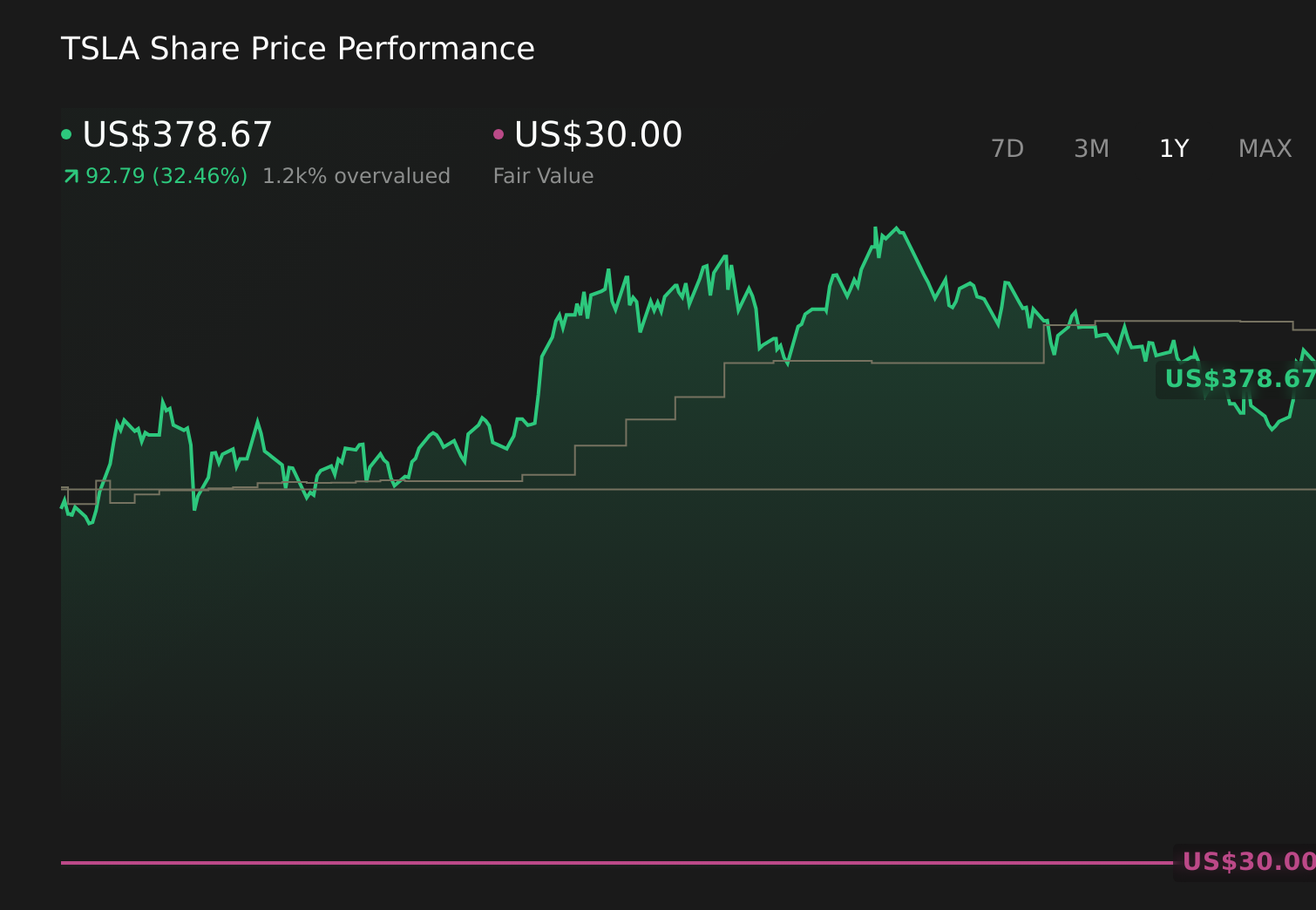 TSLA 1-Year Stock Price Chart
Some of the most optimistic analysts were already assuming Tesla could lift revenue to about US$193.2 billion and earnings to US$19.0 billion by 2028, so this latest US$25 billion AI and robotics spending surge might either support that ambitious view or expose how much execution and tariff risk those forecasts, and your own expectations, really carry.
Explore 115 other fair value estimates on Tesla – why the stock might be worth less than half the current price!
The Verdict Is Yours
Disagree with existing narratives? Extraordinary investment returns rarely come from following the herd, so go with your instincts.
Curious About Other Options?
Right now could be the best entry point. These picks are fresh from our daily scans. Don’t delay:
This article by Simply Wall St is general in nature. We provide commentary based on historical data
and analyst forecasts only using an unbiased methodology and our articles are not intended to be financial advice. It does not constitute a recommendation to buy or sell any stock, and does not take account of your objectives, or your
financial situation. We aim to bring you long-term focused analysis driven by fundamental data.
Note that our analysis may not factor in the latest price-sensitive company announcements or qualitative material.
Simply Wall St has no position in any stocks mentioned.
Valuation is complex, but we’re here to simplify it.
Discover if Tesla might be undervalued or overvalued with our detailed analysis, featuring fair value estimates, potential risks, dividends, insider trades, and its financial condition.
Have feedback on this article? Concerned about the content? Get in touch with us directly. Alternatively, email editorial-team@simplywallst.com