
![First Look at Tesla FSD 14.3.2: Major Summon Improvements [VIDEO]](https://www.evshift.com/wp-content/uploads/2026/04/1777074437_fsd-14-3-2-first-impressions-1.jpg "First Look at Tesla FSD 14.3.2: Major Summon Improvements [VIDEO]")
April 24, 2026
By Nehal Malik
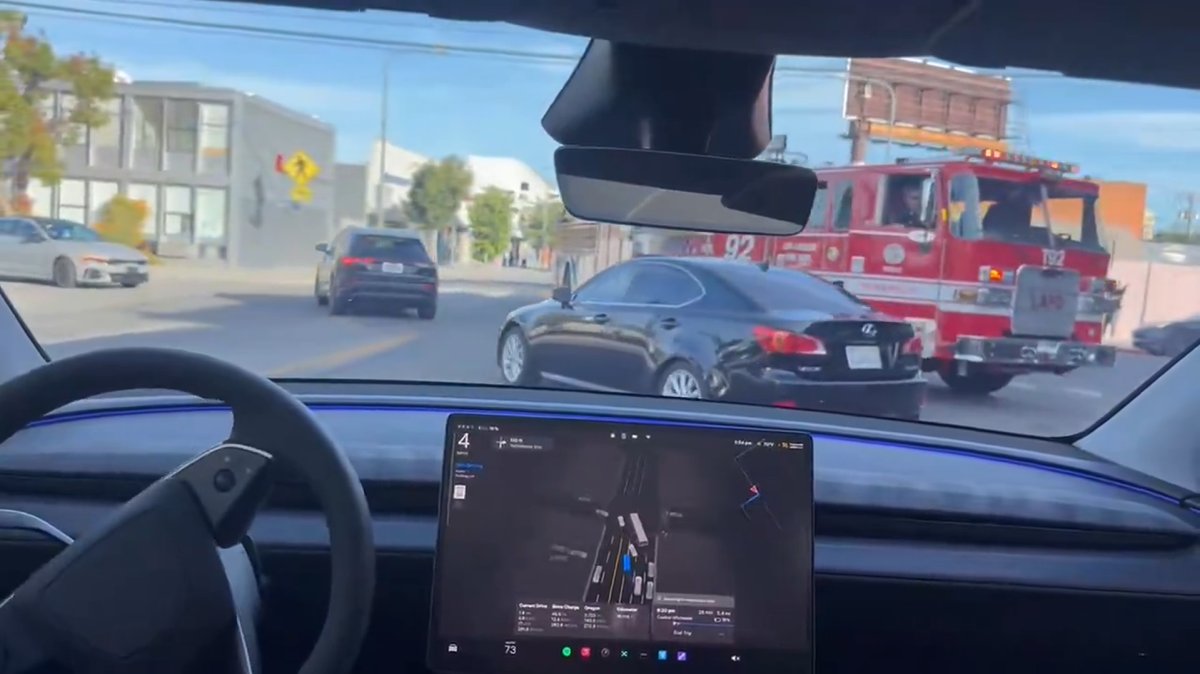
Tesla has officially dropped FSD v14.3.2, and for those who have been waiting for the “Actually” in Actually Smart Summon (ASS) to really mean something, this is the one. This latest point release isn’t just a minor bug fix; it is a fundamental architectural shift that unifies Tesla’s AI models across its Robotaxi, consumer FSD, and Summon platforms for the first time.
Update 2026.2.9.8
FSD Supervised 14.3.2
Installed on 0.5% of fleet
Last updated: Apr 24, 4:50 pm UTC
According to Zack (@BLKMDL3), who has already spent over seven hours testing the new build, the results are “mind-blowing.” By moving to a unified stack, the car’s behavior in parking lots now mirrors the confidence and smoothness of the unsupervised Robotaxis that have been operating in Austin and recently launched in Dallas and Houston.
Actually Smart Summon: The Robotaxi Treatment
The biggest winner in this update is undoubtedly Actually Smart Summon. Historically, Summon felt like a separate, slower “brain” was trying to navigate the car through a parking lot. With v14.3.2, that silo has been knocked down. “Actually Smart Summon response time on FSD v14.3.2 is instant,” Zack noted, sharing footage of the car reacting the moment the button is pressed on the phone.
Actually Smart Summon response time on FSD v14.3.2 is instant. pic.twitter.com/AMRnMHBAUG
— Zack (@BLKMDL3) April 24, 2026
Actually Smart Summon on FSD v14.3.2 pulls over to the curb when it’s done like a Robotaxi does. pic.twitter.com/Fd8BstHEkY
— Zack (@BLKMDL3) April 24, 2026
Because the system is now using the same underlying AI as Tesla’s commercial autonomous fleet, it has inherited some high-end behaviors. Zack observed that the car now pulls over to the curb near the spot you instructed it to come to, just like a Robotaxi would, rather than just stopping awkwardly in the middle of a lane. The system also showed “superhuman” confidence when handling heavy pedestrian and shopping cart traffic, navigating tough scenarios with a level of courtesy that previous versions lacked.
Superhuman Driving and Curvy Roads
FSD v14.3.2 handles curvy roads really well, here it takes me through Mulholland Drive at the top of LA with zero interventions. pic.twitter.com/JXYZhF5XvW
— Zack (@BLKMDL3) April 24, 2026
Beyond the parking lot, FSD v14.3.2 brings a massive amount of polish to street driving. While FSD v14.3 was already a major step forward, this latest iteration feels even more “sentient.” During a night drive on the windy roads of Mulholland Drive, the car handled the curves with zero interventions, even spotting and avoiding road debris in the dark before the driver could see it.
FSD v14.3.2 spots road debris and avoids it, mid corner, in the dark and on a windy road. pic.twitter.com/KYYtVfbBTu
— Zack (@BLKMDL3) April 23, 2026
Elon Musk mentioned during the Q1 2026 Earnings Call that Tesla has already achieved “safer than human” driving with the v14 branch. The focus now is on making the system orders of magnitude safer. Version 14.3.2 demonstrates this through its reaction speed — now 20% faster thanks to an AI compiler rewrite introduced in 14.3 — and its ability to handle complex emergencies, like automatically rerouting when a fire truck pulls up to block an accident scene.
The Road to v15 and 10 Billion Parameters
This update serves as a high-performance bridge to the next major milestone: FSD v15. While v14.3.2 is incredibly polished, it still operates on a smaller model compared to what is coming. Musk recently confirmed that FSD v15 will run on current AI4 hardware, ending rumors that the 16GB of memory in current cars wouldn’t be enough for the upcoming 10-billion-parameter model.
With v15 expected to debut by the end of this year or early 2027 at the latest, version 14.3.2 represents the “peak” of the current architecture. It also includes a new intervention-reasoning UI that allows drivers to give more personalized feedback after a takeover, helping the Tesla AI team refine the system even faster. As Tesla continues its rapid-fire release cadence, the line between “driver assist” and “fully autonomous” is becoming thinner with every mile.
Ordering a New Tesla?
Use our referral code and get 3 months free of FSD or $1,000 off your new Tesla.
April 24, 2026
By Karan Singh
While the recent Q1 2026 earnings call delivered the hard truth that Hardware 3 vehicles will not achieve Unsupervised Full Self-Driving, Tesla is not abandoning its legacy fleet. To bridge the software gap, the company has officially confirmed that v14 lite, a massive upcoming software update designed to bring next-generation autonomous behaviors to older cars, will arrive in late June 2026.
Optimizing for Aged Hardware
During the investor Q&A portion of the earnings call, Tesla’s AI chief Ashok Elluswamy jumped in to clarify the immediate software roadmap for the millions of HW3 vehicles currently on the road.
He revealed that while the raw compute power and camera resolution of HW3 cannot safely handle the massive neural nets required for uncrewed Robotaxi operations, the engineering team has successfully optimized the core V14 architecture to run efficiently on older hardware.
Features Included in V14 Lite
The “Lite” moniker refers strictly to the compressed size of the underlying neural net rather than the user experience. According to Elluswamy, v14 lite is designed to achieve functional feature parity with the newer AI4 fleet.
Elluswamy specifically called out that HW3 owners, without a hardware upgrade, will be able to start FSD from park and “basically have all the features that V14 for HW4 has.”
This means highly anticipated v14 capabilities, such as the seamless Start from Park, driver profiles with Mad Max and Sloth Modes, Parking Destination Options, and the ability to reverse and shift gears, are all expected to be natively supported on HW3.
This update isn’t just focused on adding new features to FSD for HW3 vehicles, but it will also improve FSD with smoother, more decisive, and more human-like driving dynamics that define FSD v14.
The vehicle will be able to pull out of a parking space, navigate complex city streets, and reach a destination using the same advanced behavioral logic as an AI4 vehicle, provided a human driver remains attentive behind the wheel. However, keep in mind that this update will still be a distilled version of FSD v14, so reaction times may be slower, and decisions may not be as thorough as those of an HW4 vehicle.
HW3 Upgrade
During the same earnings call, Tesla also discussed the HW3 upgrade and said it will cover cameras as well. Owners will also have the option to trade in their vehicles instead of upgrading, and will receive an additional discount on a new vehicle.
The Release Timeline
Elluswamy confirmed during the call that the v14 lite build is expected to be available by the end of June, just two months away.
HW3 vehicles haven’t received a new FSD build since early 2025, when FSD v12.6.4 was released, well over a year ago. While dedicated owners who want their cars to become fully autonomous will eventually need to schedule a physical hardware retrofit, v14 lite ensures that the daily driving experience for the average HW3 owner remains as close as possible to HW4 vehicles.
April 24, 2026
By Karan Singh
For years, Tesla executives and Elon Musk have maintained that every vehicle produced since 2019 possessed all the necessary hardware to eventually achieve full, unsupervised autonomy. During the Q1 2026 earnings call, Tesla officially reversed course, admitting for the first time that Hardware 3 (HW3) will not be capable of Unsupervised Full Self-Driving.
While this admission marks the end of a long-standing promise, Tesla immediately outlined a mitigation strategy to ensure early adopters are not left behind as the Robotaxi era begins.
No Unsupervised FSD for HW3
The admission came during the investor Q&A portion of the earnings call (read our summary). HW3 vehicles will still receive FSD updates, as Tesla shared new details on the features included in the upcoming FSD V14 Lite update. While many of the HW4 FSD features will migrate to HW3 vehicles, the hardware simply lacks the compute power and camera resolution required to operate safely without a human in the driver’s seat.
To bridge this gap, Tesla announced it will eventually offer a massive hardware upgrade to owners who previously purchased the Full Self-Driving package. This is not a simple computer swap like previous retrofits.
Tesla also stated for the first time that cameras will need to be updated, bringing them up to the much higher-resolution cameras of HW4 vehicles. Upgrading a HW3 vehicle to the AI4 standard will require new cameras, an updated vehicle computer, and an extensive overhaul of the internal wiring harnesses to support the increased data bandwidth.
At the earnings call, Tesla also announced a new AI4+ computer that will come with double the memory and more computing power. This could potentially be the hardware that makes its way to HW3 vehicles. However, it’s not expected to enter production until mid-2027.
New Hubs to Focus on Retrofit
Because this retrofit is incredibly labor-intensive and requires partial vehicle disassembly, Tesla will not be burdening its existing Service Centers with the workload. Instead, the company plans to establish bespoke conversion facilities located in major urban hubs specifically dedicated to tearing down and upgrading older vehicles.
Alternative to Upgrading
For owners who purchased FSD but are uncomfortable with the idea of their vehicle undergoing such invasive surgery, or simply want to get into a newer vehicle, Musk noted that Tesla will offer a compelling alternative. Affected owners will have the option to accept a special discount on the trade-in of their vehicle, which will go toward the purchase of a brand-new AI4-equipped vehicle.
Tesla didn’t go into further detail about the discount, but we would expect it to be roughly equivalent to the cost of the new FSD hardware and labor. We’d expect about a $4-$6k discount toward a new vehicle. The discount would have to be less than the cost of FSD, or Tesla would simply offer a refund of the FSD purchase.
Paid Upgrades
Tesla is prioritizing owners who already paid for the FSD software suite, but the hardware upgrades will eventually expand. Once the initial wave of purchased FSD conversions is complete, Tesla will likely offer the hardware upgrade as a paid option for the rest of the HW3 fleet, similar to how it handled older MCU upgrades. This will include owners who subscribe to FSD.
Given the massive amount of labor required to gut the interior, route new wiring, and install new cameras, owners should expect a steep fee for this out-of-pocket upgrade, likely landing somewhere in the $3,000 to $5,000 range.
Despite the sheer cost and logistical nightmare of retrofitting hundreds of thousands of cars, Musk emphasized that this effort is absolutely crucial for the company’s long-term financial goals. By upgrading these older vehicles, Tesla can dramatically increase the number of compatible cars eligible to join the upcoming Robotaxi network, effectively turning an aging fleet into a revenue-generating asset and keeping existing owners happy.