
“Hearst Magazines and Yahoo may earn commission or revenue on some items through these links.”
This article was updated in April 2026 with new information and products
For years we’ve relied on ice to keep our food and drinks cold, and we’re sick of dealing with the inevitable downside: ice runs and waterlogged snacks as the ice melts. Thankfully, that’s no longer the only option. Modern electric coolers have changed the game, with many models offering the flexibility to plug into a standard 120-volt wall outlet or a 12-volt car socket.
Best Electric Car Coolers
Best Compact Electric Cooler: Versatemp 28-qt Portable
Best Value: BougeRV 12V 23-qt
Best for Overlanding and Off-Grid Camping: Anker SOLIX EverFrost 2
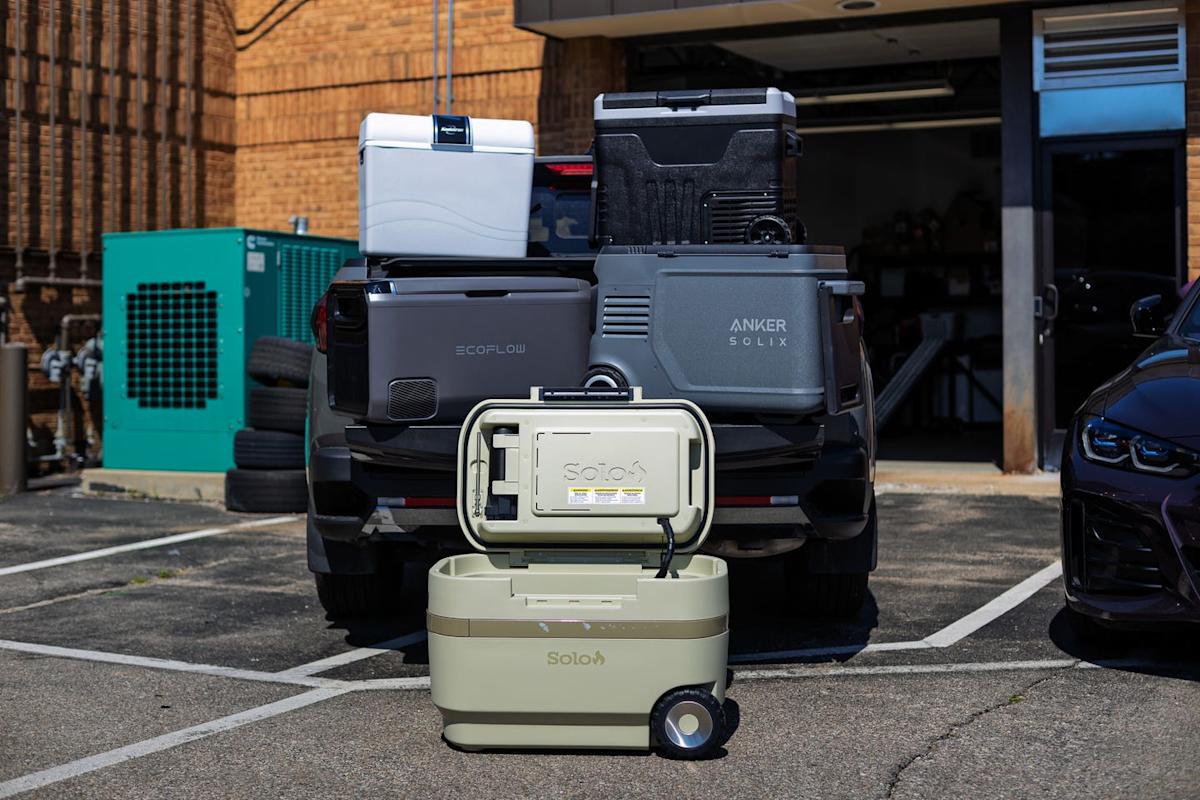
Over the past three years, we’ve put a wide range of these coolers to the test. From thermoelectric designs to compressor-powered units, we’ve used them on the road in RVs, at home, and at parties, and the results have been consistently impressive.
These coolers not only eliminate the mess of melted ice, but they also maximize storage space, giving you more room for food and drinks. And best of all, no more soggy meals. After extensive hands-on testing, we’re fully converted. Join us as we rank the best portable electric coolers available today.
Best Electric Car Coolers of 2026, TestedIgloo Versatemp 28 Qt Portable Electric Cooler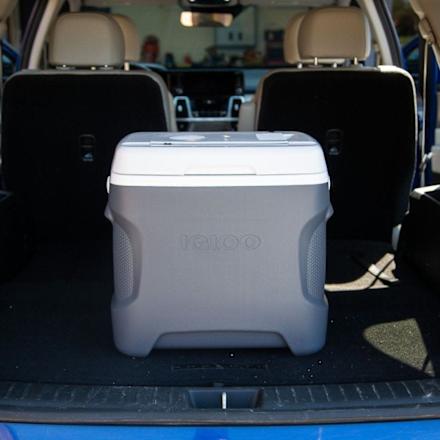
Gannon Burgett
For most of us, this 28-quart cooler from Igloo nailed the sweet spot. The thermoelectric powerplant provides cooling power to 36 degrees Fahrenheit below the ambient temperature and can also heat the inside up to 136 degrees Fahrenheit. This flexibility allows you to keep cold things cold and hot things hot. It’s the best of both worlds.
The Igloo lacks a freezer function, but the attractive price point reflects that. The design isn’t anything impressive, but it’s what Igloo is known for: functional and durable. The small size is perfect for road trippers and truckers—it fits just about anywhere in the vehicle, even the front floorboard—and the price is undeniably great, which is why we picked it as the best compact electric car cooler.
We wish it had an alternate power source besides its 12-volt cig-lighter plug, but there are plenty of affordable DC-to-AC adapters available at Amazon.
ProsSpacious but compactCooling and heating function provides excellent usabilityConsLacks an AC power cord; plugs into 12-volt car outlet onlyBougeRV BougeRV 23-Quart Electric Cooler/Freezer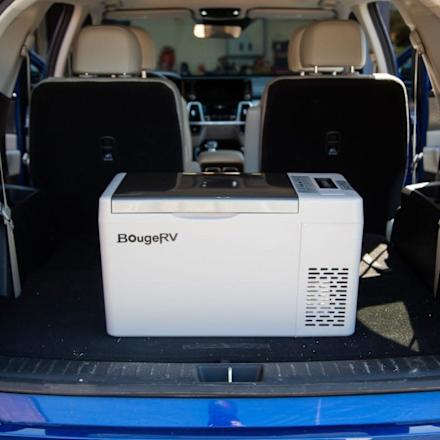
Gannon Burgett
If you’re looking for a great deal on a portable electric freezer for the car, you’ve found it. We really liked the compact size of the BougeRV; its dimensions are ideal for road trips in small cars. (Most of these devices come in multiple sizes; which one you need is up to you.) As far as performance, the BougeRV was comparable with the competition but came up just short with its insulation; once unplugged, it lost its internal temp just a tad faster than the rest. But, it costs less.
It performed well in our vehicle space test; it’ll fit just about anywhere. If you need to keep frozen items from melting in a compact space, this is the portable cooler to get. If you’re just looking for an affordable portable car cooler, it’s a great choice.
ProsCompact and portableLots of color and size choicesConsInternal insulation isn’t as good as othersAnker Solix Everfrost 2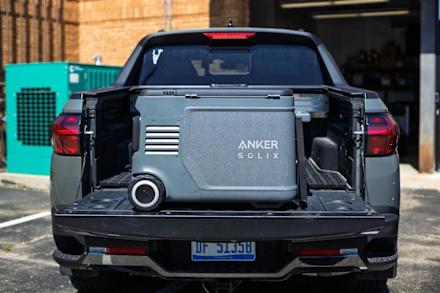
Gannon Burgett
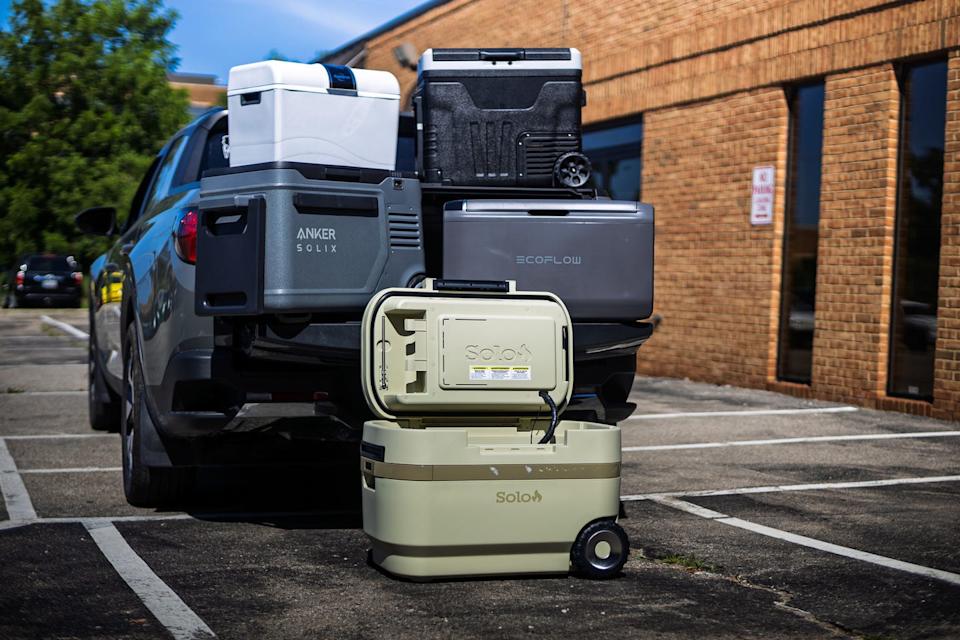
During our first round of testing, we tried the original Anker EverFrost 30. Since that model has been discontinued, we tested the new Anker Solix EverFrost 2.
This cooler has all the bells and whistles for making camping easier. It’s got big chunky wheels that roll well on rough ground and a foldable handle that not only makes it easy to pull but also doubles as a side table. There is also a bottle opener and our favorite detail: a soft-closing lid.
Performance-wise, Anker claims it can drop from 77 to 32 degrees Fahrenheit in 15 minutes. But according to our results, it took 54 minutes. Not ideal, but if you’re off the grid for a few days, what’s a few more minutes?
Power flexibility is its biggest plus. It can run off a battery, but with the Anker, that battery is included. The claimed battery time is up to 52 hours—solid performance for a weekend off the grid. We love that the Anker comes with so many power options, and you could even buy a second battery for swapping. Perfect for an extended trip in the wild.
ProsBattery Included Soft-close lidMultiple capacities availableConsComparatively heavy and bulkyEF ECOFLOW EcoFlow Glacier Classic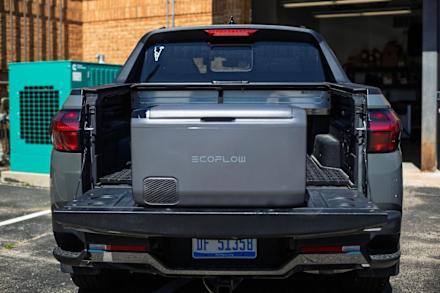
Gannon Burgett
The EcoFlow Glacier is a popular option for van lifers who want a sleek refrigerator in their rig. Its low-profile design and reversible lid make it easy to slide under benches and customize access. Combine that with six different power options—AC, DC, solar, USB-C, alternator, and battery—and you have plenty of choices while on the road. You can even combine power options for a faster cooldown.
Performance is comparable to the Anker EverFrost. Both took 54 minutes to cool from an ambient 73 degrees to 32. Both offer impressive battery-powered operation, though EcoFlow’s battery is sold separately and offers just a claimed 43 hours (compared to Anker’s claimed 52). But if you’re committed to the popular EcoFlow ecosystem, you’ll probably lean on the plethora of available power inputs—especially if your cooler is parked in a van full time.
It’s quiet, packed with power options, and gets cold quickly. But for us, its lack of portability kept it from being a top pick. There are no wheels, and while the side handles are strong, carrying it solo, while fully loaded, is hard. However, slotted between two captain’s chairs or under a built-in bed in the back of a van, it would be a great stationary choice. Van lifers, are you convinced yet?
ProsQuick to cool Incredibly quiet operation ConsNot very portableExternal battery not included Solo Stove Windchill 47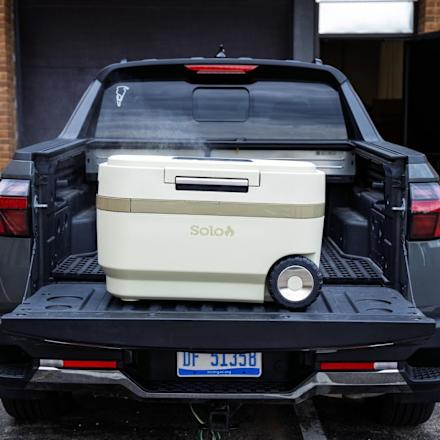
Gannon Burgett
At first glance, the Solo Stove Windchill 47 looked like a fun, stylish take on an electric portable cooler. But once we got it in-hand, it became clear that this isn’t an electric cooler with a compressor; rather, it’s an ice chest with a built-in “air-conditioning” and misting feature. There’s no compressor or thermoelectric-driven cooler.
But we proceeded to test it for its other qualities, and there were many things we liked about the design and build. For one, we loved the telescopic handle that nestles into the body of the cooler. We also appreciated the sturdy plastic panels that cover the battery port, AC input, and charging port. They could be somewhat challenging to line up, but it was necessary to have a strong seal because the misting features get the inside top of the cooler quite wet.
However, we found the fan and mister take up quite a bit of real estate compared to a traditional cooler, and the need for ice and water reduces usable space even more. We managed to fit 63 cans—but that was without any ice. The fan unit in the lid is large too.
In the end, this is a beautiful, thoughtfully designed ice chest—but don’t expect true electric cooling. You’ll still need to stock up on ice and water to make it work. Think of it not as a fridge on wheels but a modern ice chest with powered airflow and misting. And quite an expensive one.
ProsLarge wheels make it easy to maneuverRuns on AC or battery ConsStill needs ice Top has a kickstand, but it seems to get in the way more than it helpsAir-conditioning function didn’t have much of an effect on a muggy day—ideal for dryer conditions to feel the “AC”Koolatron Koolatron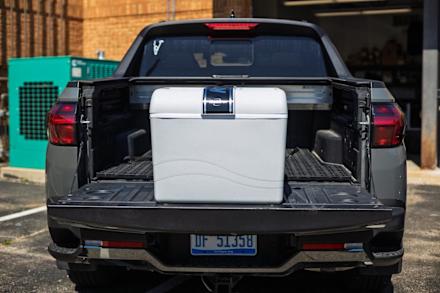
Gannon Burgett
The first thing that stands out about the Koolatron is its look: Some of us loved the retro filing-cabinet vibe, while others couldn’t get past the plain, gray styling. It can also stand up vertically like a compact fridge, where you can add a shelf for better organization, or sit horizontally like a traditional cooler.
The Koolatron is small and lightweight while empty. But once loaded, it’s not so easy to move around. There are no wheels or extendable handles—just shallow insets on either side. It can both heat and cool, though.
Our previous best-overall cooler was a thermoelectric model, so we wanted to see how another option in that category would perform. After running the Koolatron through our paces, it lost points on portability and car-friendly convenience despite its distinctive design. In the end, we still recommend a compressor-style portable car cooler over a thermoelectric one.
ProsHeats and coolsStands vertically or sits horizontallyEUHOMY Euhomy Portable Cooler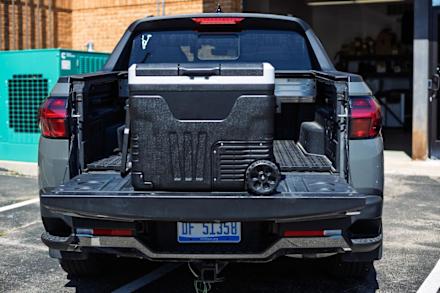
Gannon Burgett
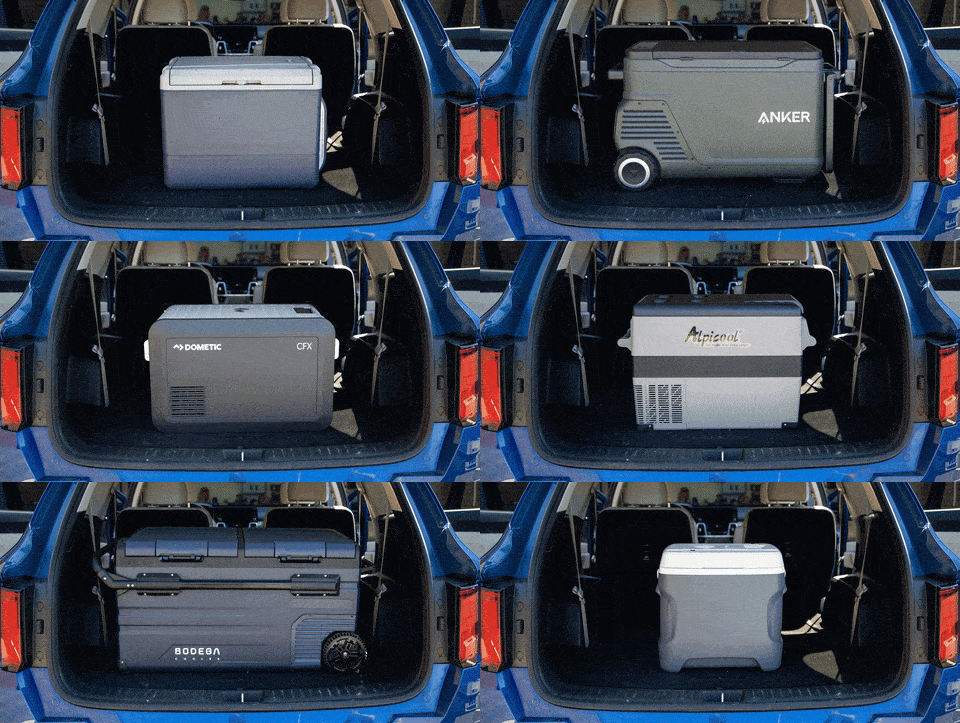
Euhomy has a traditional cooler design rather than the fancy materials of more premium models. The Euhomy is taller and deeper than other large, portable car coolers we’ve tested, prioritizing height over width. This design will be a pro or a con based on your storage space, but it did seem to help with capacity. We were able to fit a whopping 70 cans in both the cooling zones.
Yet, there were still some things that left us wanting more, particularly in the build-quality category. The reversible lid is a clever feature, but it tends to pop off a little too easily. The drain plug is also just a thin silicone piece that feels flimsy.
Overall, the Euhomy is capable and roomy but didn’t wow us enough to break into our top contenders.
ProsCan connect to an app for remote controlDual cooling zonesConsWheels are smallMaterials and construction aren’t on par with the competitionDometic Dometic CFX3 Electric Cooler/Freezer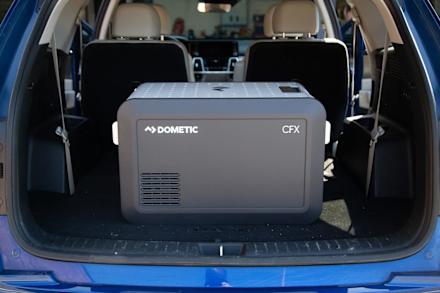
Gannon Burgett
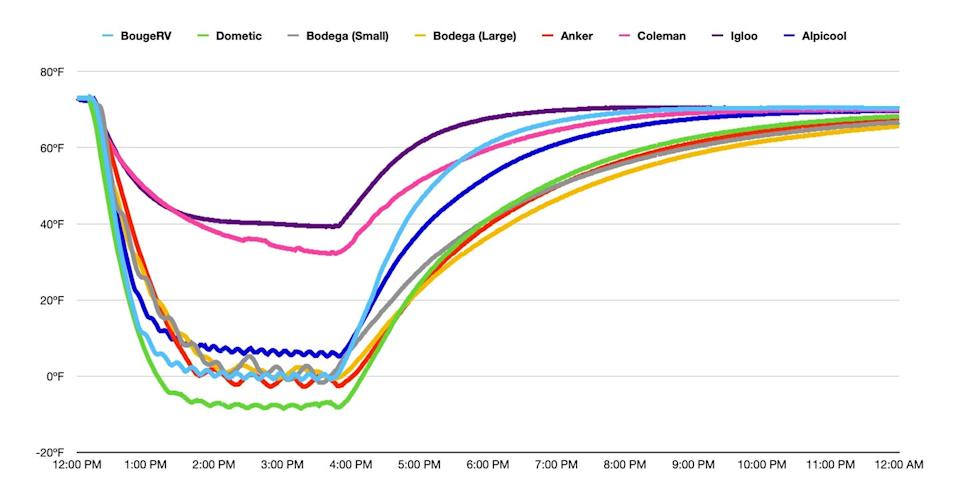
One of the industry leaders in portable cooling and refrigeration, Dometic is renowned for its RV air conditioners. That said, if you want to splurge on a top-of-the-line electric cooler/freezer to take along in your car or truck, this is the one you want. It reached the coldest temps in our test (see graph below) by a good margin. It’s extremely well built, featuring spring-loaded handles, an easy-to-use interface, and a sturdy hinge.
Temperature control is accessible through an app, and the option to power it by a separate solar panel opens it up for use off the grid. Yes, it’s pricey, but well worth the money.
ProsReached the coldest temps out of any cooler in this testTop-notch quality and usabilityalpicool Alpicool CF45 48-Quart Electric Cooler/Freezer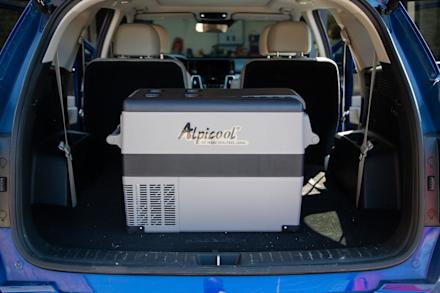
Gannon Burgett
The electric car coolers/freezers in this test vary wildly in price, but this Alpicool 48-quart entry held its own against the more expensive options. It boasts a healthy capacity, holding 59 soda cans (without the internal basket). The cooler comes with 12-volt and 120-volt power cords, so you can pre-cool it at home, keep it cooling on the road, and plug it in when you arrive at your destination.
The Alpicool didn’t get as cold as some of the others we tested (see graph below), but it was definitely cold enough to keep frozen items frozen. This is a great choice.
ProsGreat price for the performanceLarger capacity than expectedConsHandles protrude, making fitment a potential issueThings to ConsiderCapacity
Ensure your cooler has enough room to store all the food and drinks you’ll need for your trip. The size should align with the length of your journey and the number of people involved.
Also, bear in mind that the cooler’s capacity determines its size. The electric car cooler you buy needs to fit nicely in your vehicle while leaving room for passengers and cargo, whether that’s in the back seat, the truck bed, the trunk, etc.
Power Source
Electric coolers typically run on AC, DC, or battery packs, and many offer all three. Most plug into your vehicle’s 12-volt power port. Check to see if the cooler you’re considering turns off when the vehicle does, switches to internal battery power, or continues to draw from the vehicle’s battery even when the car is turned off.
Also, ensure your vehicle has an available 12-volt power port and that the cooler’s power cord is long enough to reach it. Remember that some vehicles, particularly older and smaller ones, offer only one “cigarette lighter” port that’s usually located in the front cockpit or center console. If it’s being used to power other devices, such as a dash cam or radar detector, you might need a splitter.
Portability
Sturdy handles, lightweight construction, durable wheels, and a compact design make a cooler easier to carry and move. These details are especially important for outdoor activities or frequent transport.
Thermoelectric vs. Compressor
Compressor coolers work at any outside temperature, but thermoelectrics are severely affected by it. The hotter the ambient temperature, the worse the performance. This is why most thermoelectric cooler manufacturers don’t provide a maximum cooling temperature—the ambient temperature defines it. If you want your thermoelectric cooler to work best, ensure it’s operating away from ambient heat.
To that end, if you live in a hot, arid environment or are driving through one on your road trip, avoid thermoelectric coolers altogether—unless you plan on using yours within the vehicle cabin and not in the trunk or truck bed.
Temperature Control
Many electric coolers let you set and maintain specific temperatures, ideal for precise cooling needs. Thermoelectric coolers often lack adjustable settings and simply keep items cool or warm.
Extra Features
Look for added conveniences like removable dividers, built-in lights, or USB charging ports. These features can make a big difference depending on how and where you plan to use your cooler.
Gannon Burgett
How We Tested Electric Coolers
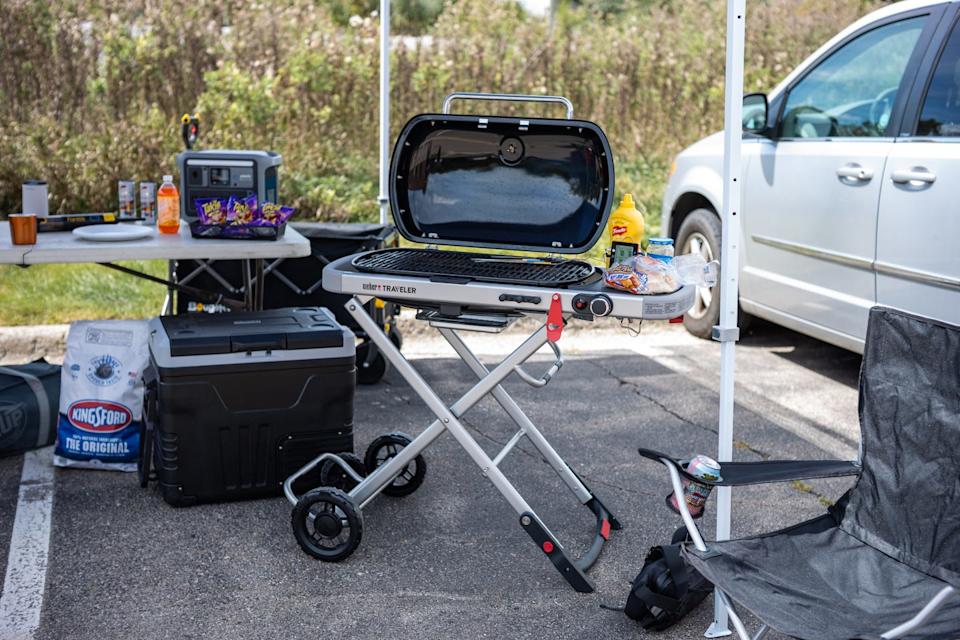
For this evaluation, we tested seven of the best portable electric coolers on the market, gathering measurable performance data and subjective impressions. (It’s worth noting that many of these coolers come in various sizes, so while we reference internal capacity, it’s more to provide a general sense of what to expect.)
Resisting the urge to crack open beers by the campfire, we focused on gathering objective data for this cooler test using thermometers, a Kia Sorento, and identical beverage cans. We evaluated the coolers based on these key criteria:
Cooling Efficiency/Time: How quickly they cooled to the lowest setting
Capacity: The number of cans each could hold
Design: Features that improved or hindered usability
Insulation: How well they maintained temperature
To test cooling performance, we used a Govee Home Thermometer. Starting each cooler at 71 degrees Fahrenheit, we measured how long it took to reach the cooler’s lowest setting, logging results via the Govee app to analyze cooling and insulation. Tests were conducted with empty coolers, per manufacturer recommendations, with priming and pre-cooling overnight using a 120-volt AC power cord.
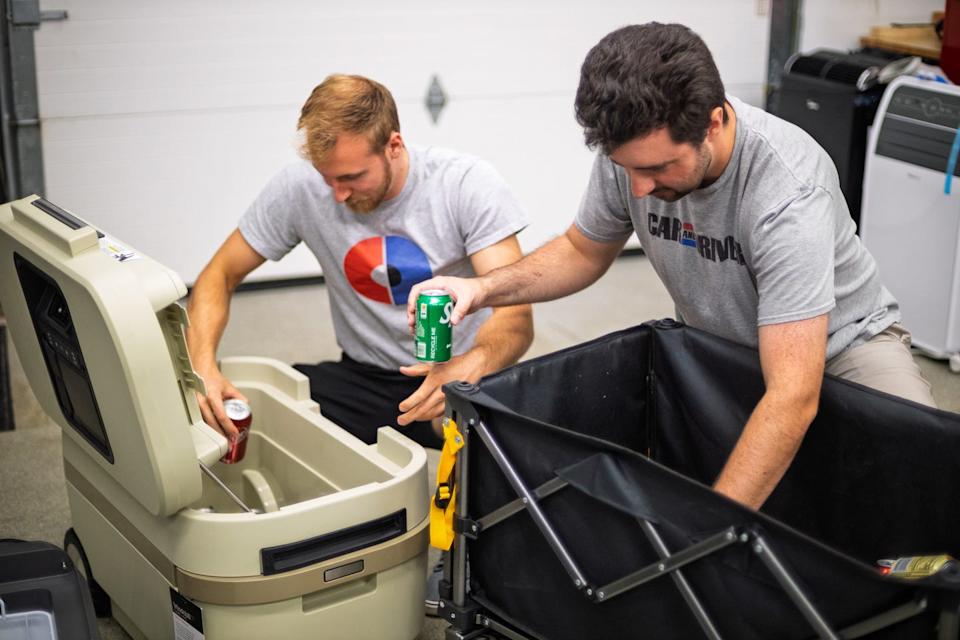
To confirm manufacturer capacity claims, we counted how many 12-ounce cans each cooler could hold.
Lastly, we evaluated design elements: portability, handles, wheels, interior baskets, and overall ease of use. Frequent repositioning during testing gave us a clear sense of how practical these coolers are in real-world scenarios.
Gannon Burgett – Car and Driver
Thermoelectric vs. Compressor
Portable electric coolers generally fall into two categories: thermoelectric and compressor. Thermoelectric coolers often double as warmers, but they can’t freeze your food. Compressor coolers, on the other hand, can reach freezing temperatures, though they tend to be bulkier and heavier.
Compressor coolers use the same technology as your home refrigerator, cooling through a series of compressed air and refrigerants. They are definitely more effective in cooling and are ideal for drivers who need to keep items at a consistent temperature.
Thermoelectric coolers use “solid-state cooling,” meaning there is no compressor or refrigerants. It uses the transfer of heat or cold through solid metal to run the device. Thermoelectric cooling is incredibly effective, but it does depend on the ambient temperature in which the cooler is operating. For example, if you are trying to run your cooler in the heat of the desert sun, the solid metal plate may have a hard time cooling since the original transfer begins at such a high temperature.
Which type suits your needs? Start by considering how you plan to use it. A thermoelectric cooler is a practical choice for keeping snacks and drinks cool during a road trip. However, a compressor cooler is the way to go if you’re transporting frozen meat from a hunting trip or ensuring frozen goods stay frozen solid during travel.
Gannon Burgett – Car and Driver
FAQsWhat is a portable electric car cooler?
A portable electric cooler is a smaller appliance that keeps food and drinks cold (and sometimes warm). They can be plugged into a 120-volt AC wall outlet, the 12-volt cigarette lighter outlet in your car, or a portable power source. Each model will have different power sources, so research your needs and pick up an adapter or power inverter if you need to.
How do I use a portable electric cooler?
To get the best out of your electric cooler, you should prime it the night before your trip. Plug it into your 120-volt wall outlet and begin the cooling process. Once it’s down to your desired temperature, transfer refrigerated items into the cooler. This way, your portable cooler is maintaining a cold temperature, which is far more efficient and uses less power than cooling down items.
Can electric coolers be used while driving?
Yes, most electric coolers plug directly into your car’s 12-volt power port, but they’ll need to be placed close enough so that the power cord reaches it. This may limit their use in pickup-truck beds and in SUV and van cargo areas. Many offer auxiliary battery packs and solar panels.
Can I use an electric cooler while the car is off?
For some models, it may be possible. But beware, if you run it for too long, the car’s battery might drain completely. Thankfully, many electric coolers produce a “low voltage” alert, which lets you know when the vehicle’s battery is getting dangerously low.
Can electric coolers freeze food and drinks?
Some electric coolers have a freeze function that can lower the temperature inside the cooler below the freezing point.
Gannon Burgett – Car and Driver
Why Trust Us
The Gear Team helps readers make informed purchasing choices about automotive gear, tools, and accessories through hands-on product evaluations and comprehensive testing. Car and Driver’s renowned testing standards mandate that we use all products we feature and that our findings and recommendations are based on personal experience and knowledge—not hype. We won’t claim to have tested something we haven’t, and we’ll never recommend a product we wouldn’t buy ourselves.
The Gear Team’s product selection and gear picks are editorially independent; Car and Driver has a strict policy against accepting payment for placement in articles.
We’ve evaluated dozens of product categories, like interior cleaners, dog seat covers, and shop vacs. Visit our Tested & Trusted page to see the very best in automotive gear. Read more about our testing process here.
Gannon Burgett – Car and Driver
You Might Also Like
Gift Guide: Best Ride-On Electric Cars for Kids
Future Cars Worth Waiting For: 2025–2029