
Gasgoo Munich-The large and mid-size SUV market is getting crowded with the “9” series.
It’s not just a single model; it’s a whole fleet. The Li Auto L9 Livis, AITO M9, NIO ES9, WEY V9X, Leapmotor D19, and from the joint-venture camp, the Volkswagen ID.ERA 9X…
These flagship SUVs, all tagged with the number “9,” are either hitting the market or debuting within the same tight window. Industry insiders describe it as a “war of the 9s” — a full-frontal clash between domestic and joint-venture brands over the large, high-end SUV segment, spanning technology, design, and intelligence.
The backdrop for this battle is grim. Data from the China Passenger Car Association (CPCA) shows retail sales of passenger vehicles in China totaled 4.22 million units in the first quarter of 2026, a 17.5% year-on-year drop. The pie is shrinking, and the meat is being redistributed. Luxury brands saw their cumulative retail sales slide 13.7% in the first quarter. Meanwhile, domestic brands’ market share climbed from 52% in 2023 to 60% in the first quarter of this year.
Li Yanwei, an expert committee member at the China Automobile Dealers Association (CADA), put it bluntly: Traditional luxury brands are losing market share to emerging domestic luxury new-energy players.
The sudden emergence of the “9” series is a calculated move — using higher-spec products to storm the price band where BBA has long felt most comfortable.
The “9” Squad Arrives
At this year’s Beijing Auto Show, the “9” designation is no longer the exclusive naming right of a single brand; it has become a collective trend.
A rough count shows nearly 10 “9” flagship SUVs either debuted or launched around the show. The brands and technological paths may differ, but the target is remarkably consistent: the large and full-size SUV market.
Start with price: this batch of models forms a clear hierarchy. Leapmotor’s D19 leads the charge at 219,800 to 269,800 yuan, pulling the entry threshold for large SUVs down into the 200,000-yuan range. Industry observers praise it for “delivering high value and pushing advanced driver-assistance features from the 300,000-yuan tier down to 200,000.” Moving up, the Volkswagen ID.ERA 9X carries a pre-sale price of 329,800 to 379,800 yuan, the BYD Tang is expected to range from 350,000 to 500,000 yuan, and the XPENG GX tops out at a pre-sale price of 399,800 yuan.
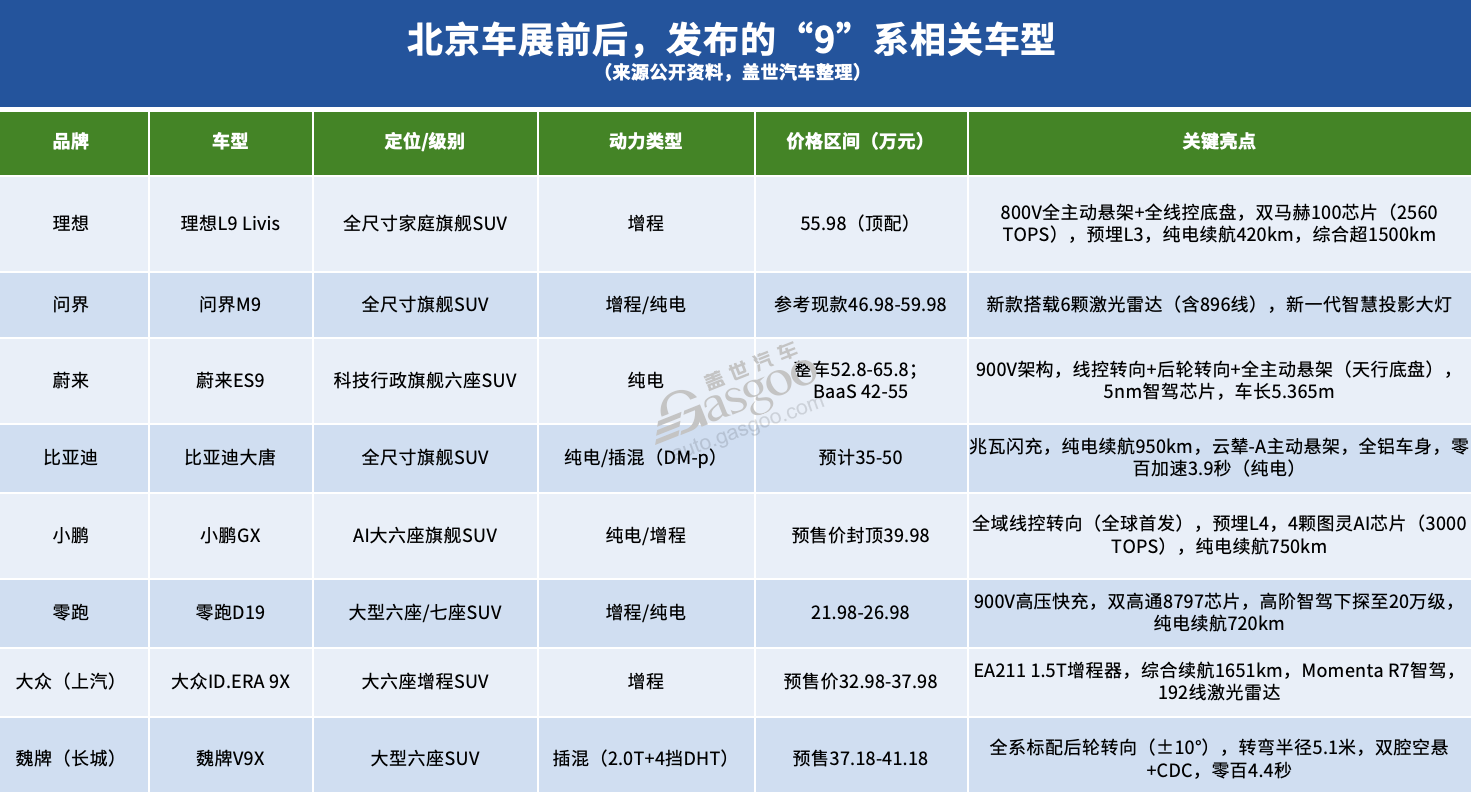
Go higher still, and the NIO ES9 is previewed at 528,000 to 658,000 yuan, with its Battery-as-a-Service (BaaS) option starting at 420,000 yuan. The Li Auto L9 Livis is priced at 559,800 yuan. AITO’s M9 hasn’t released official pricing yet, but based on the current model, it sits between 469,800 and 599,800 yuan.
As one insider summed it up, Leapmotor’s D19 anchors the 200,000 to 250,000 yuan range, while NIO’s ES9 pushes past 500,000 yuan — creating a layered offensive. This simultaneous deployment across multiple price points means the “9” series isn’t just a single breakthrough; it’s a continuous sweep across the 250,000 to 600,000 yuan zone, the traditional heartland of luxury brands.
The old rule of thumb — “look to joint ventures for anything over 300,000 yuan” — has effectively collapsed.
Then there’s the powertrain. The “9” series isn’t betting on a single technological path; it’s spreading its bets. The Li Auto L9 Livis sticks with range extension, offering 420 kilometers of pure electric range and over 1,500 kilometers of total range — a notable upgrade over the current version. NIO’s ES9 is all-in on pure electric power, featuring a 900-volt architecture, a maximum range of 620 kilometers, and relying on battery swapping to boost its charging competitiveness. The BYD Tang’s pure-electric version supports megawatt-level flash charging with a range of up to 950 kilometers, alongside a DM-p plug-in hybrid variant that sprints from zero to 100 in 4.3 seconds.
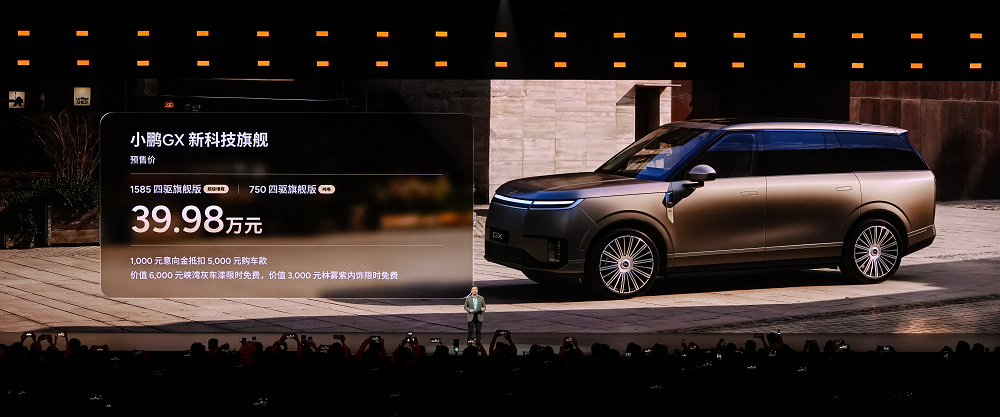
Image Credit: XPENG
Although XPENG’s GX doesn’t carry a “9,” it competes in the same class. It is hedging with both pure electric and range-extending versions — the former offering 750 kilometers of range, the latter 1,585 kilometers. On the joint-venture side, the Volkswagen ID.ERA 9X utilizes an EA211 1.5T range extender, achieving a total range of 1,651 kilometers.
Finally, consider size. These “9” series models are outdoing each other in bulk. The NIO ES9 stretches about 5.37 meters long with a 3.25-meter wheelbase, billed as “one of the largest pure-electric SUVs in China.” Some variants of the BYD Tang exceed 5.3 meters in length with a 3.13-meter wheelbase. The Li Auto L9 Livis is over 5.2 meters long, while the Leapmotor D19 measures 5.252 meters.
What does this mean? These “9” series vehicles have fully entered the territory traditionally occupied by flagship luxury SUVs.
Six-seat layouts are the norm, balancing family and business needs. Refrigerators, screens, and plush sofas are standard, but the real differentiators — the markers of hard power — are chassis dynamics and intelligent driving.
The Li Auto L9 Livis features an 800-volt fully active suspension and a full steer-by-wire chassis, with hardware pre-installed for Level 3 autonomous driving. XPENG’s GX debuted the world’s first mass-produced full steer-by-wire system, with hardware pre-wired for Level 4 capability. Industry insiders say it is “being developed entirely to Robotaxi standards.”
The new AITO M9 goes even further, equipped with six lidar units, including a new 896-line sensor. The NIO ES9 packs steer-by-wire, rear-wheel steering, fully active suspension, and its “Tianxing” smart chassis system.
The concentration of these technologies isn’t just about matching specs with BBA; it’s about redefining what a SUV costing over 400,000 yuan should offer.
The Art of Attack and Defense in the High-End Market
If the concentrated arrival of the “9” series represents a scale effect at the product level, the shift happening behind it is even more significant: the logic of competition itself is changing — from “value for money” to “quality for money.”
For a long time, Chinese brands focused their efforts below the 300,000-yuan mark. The strategy was simple: offer more configuration than joint ventures at a lower price. But in the 400,000 to 500,000 yuan bracket, value alone isn’t enough. Consumers are also looking at technology, experience, and brand prestige.
Li Yanwei uses the term “shrinking competition.” With overall consumption tightening and the market pie no longer expanding, every sale is a zero-sum game. Entering the high-end market now implies not just higher premium potential, but also far more brutal head-on collisions.
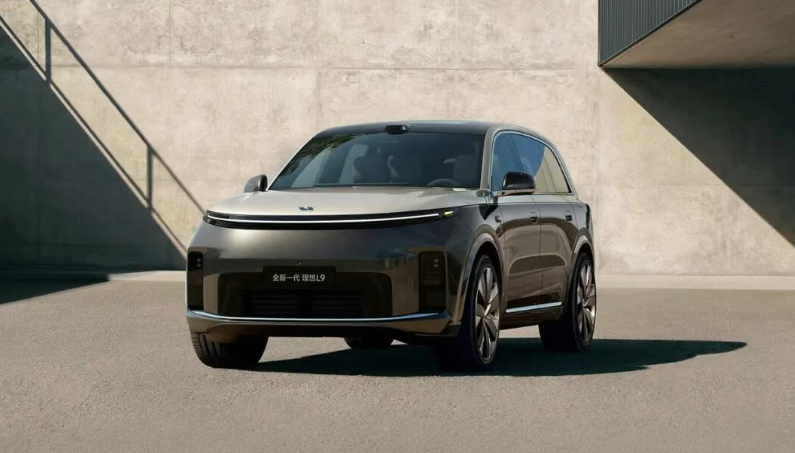
Image Credit: Li Auto
So, what lies at the core of “quality for money”?
First, technology. The 800-volt high-voltage platform is fast becoming standard equipment for vehicles priced over 300,000 yuan. Li Auto, NIO, XPENG, BYD, Volkswagen — almost every “9” series model features 800V architecture, with some pushing to 900V or even 1,000V. Reducing charging time from “an hour” to “the time it takes to drink a coffee” isn’t just marketing talk; it’s a tangible improvement in experience.
Chassis technology is trickling down just as fast. Steer-by-wire, fully active suspension, rear-wheel steering — features once found only on million-yuan luxury cars — are now appearing in vehicles costing just over 300,000 yuan.
Take the WEY V9X: it comes standard with rear-wheel steering. With a turning angle of plus or minus 10 degrees, this nearly 5.3-meter vehicle achieves a turning radius of just 5.1 meters — making it more agile than many compact cars. Additionally, Great Wall Motor’s insistence on a 2.0T plug-in hybrid powertrain could be a selling point for buyers who prioritize mechanical engineering.
Then there’s intelligent driving. High-computing chips combined with multi-sensor fusion are the entry tickets to the high-end market.
The Li Auto L9 Livis packs two self-developed 5-nanometer Mach 100 chips, delivering 2,560 TOPS of total computing power. XPENG’s GX goes even further with four self-developed Turing AI chips, totaling 3,000 TOPS. That computing power might not be fully utilized yet, but hardware pre-wiring ensures the car can continue evolving long after delivery. The product lifecycle is shifting from “fixed at delivery” to “continuous iteration.”
This implies the way vehicle value is assessed is changing — it’s no longer just about the specs at handover, but about the potential for future upgrades.
But the upward march of domestic brands doesn’t mean competition is getting any easier. On the contrary, the involution — or intense competition — in the high-end market is even more ruthless than at the low end.
Multiple companies are densely packed into the 300,000-yuan-and-above bracket. Li Auto, NIO, AITO, BYD, XPENG — everyone is fishing in the same pond. The competition has shifted from “can we enter the high-end?” to “how do we stand out once we’re there?”
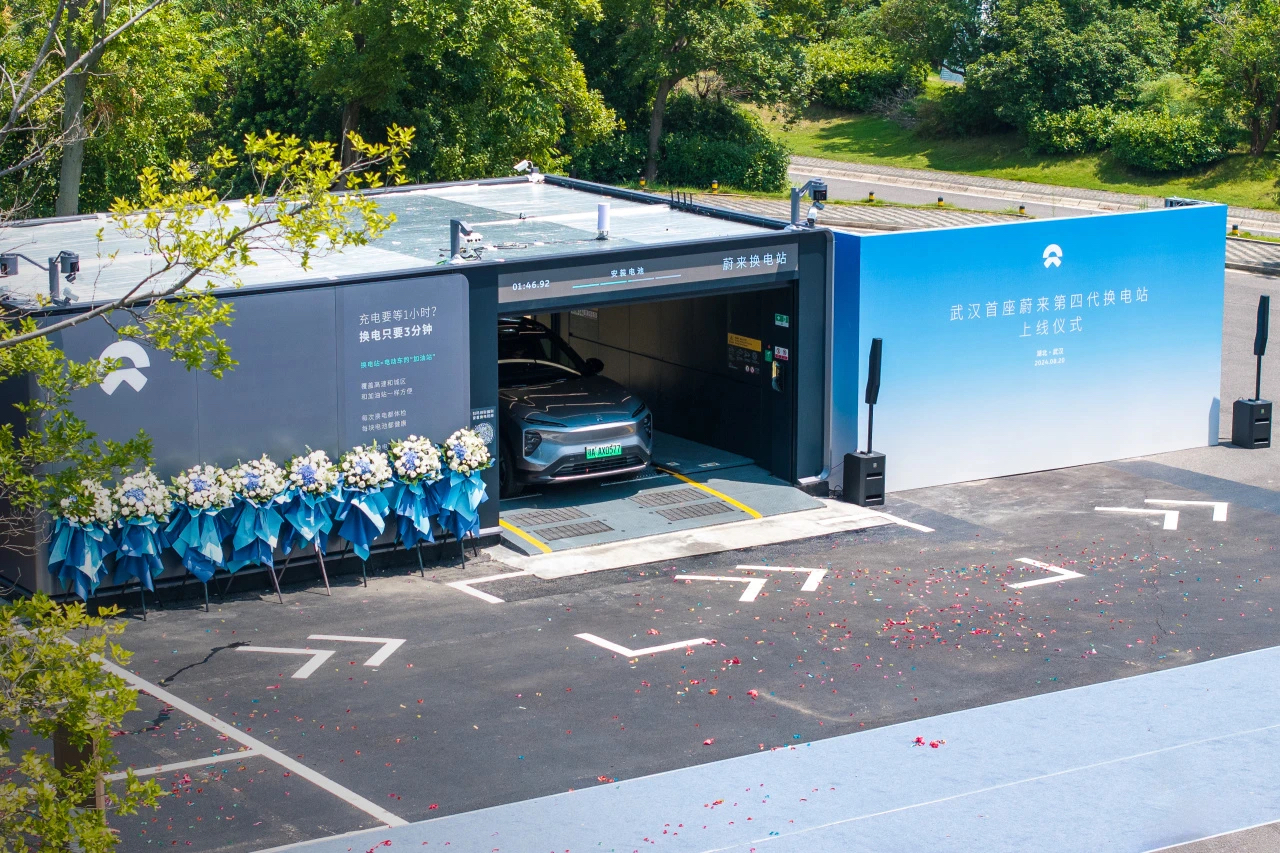
Image Credit: NIO
Some brands are betting on charging efficiency — NIO’s battery swapping, BYD’s megawatt charging. Others are pushing the limits of intelligent driving — XPENG’s Level 4 pre-wiring, AITO’s six lidars. Then there are those focusing on mechanical prowess — WEY’s rear-wheel steering and 2.0T plug-in hybrid system.
There is no “wrong” path, but neither is there a guaranteed winner.
As one view holds, “The livelier the auto show, the more brutal the shuffling. The ultimate winner won’t be the one that stacks the most specs, but the one that best understands the user’s motivation to buy.”
The shift from “value for money” to “quality for money” isn’t the finish line; it’s the starting line of a new round of competition. As technology becomes commoditized, differentiation will move to finer details — scenarios, experiences, and brand perception. The battle for the high-end market has only just begun.
Continuing the Assault on BBA’s Heartland
While the “9” series is capturing territory in the high-end market, the domestic offensive isn’t stopping there. What troubles BBA even more is the assault on their core heartland: the B-class sedan and mainstream SUV segments.
Look at the big picture first. CPCA data shows that in the first quarter of 2026, sedan sales hit 1.717 million units, accounting for 40.7% of the total market. SUVs sold 2.293 million units, taking a 54.3% share. But beneath these figures, the dynamics of attack and defense vary sharply by segment.
In the sedan market, traditional joint ventures and BBA still hold significant share, but it’s contracting. In the first quarter, mainstream joint-venture sedans sold 566,000 units, while luxury sedans moved 264,000 units — together holding a 20% share of the total market. Domestic sedans, meanwhile, sold 887,000 units, with their share rising to 21% of the total.
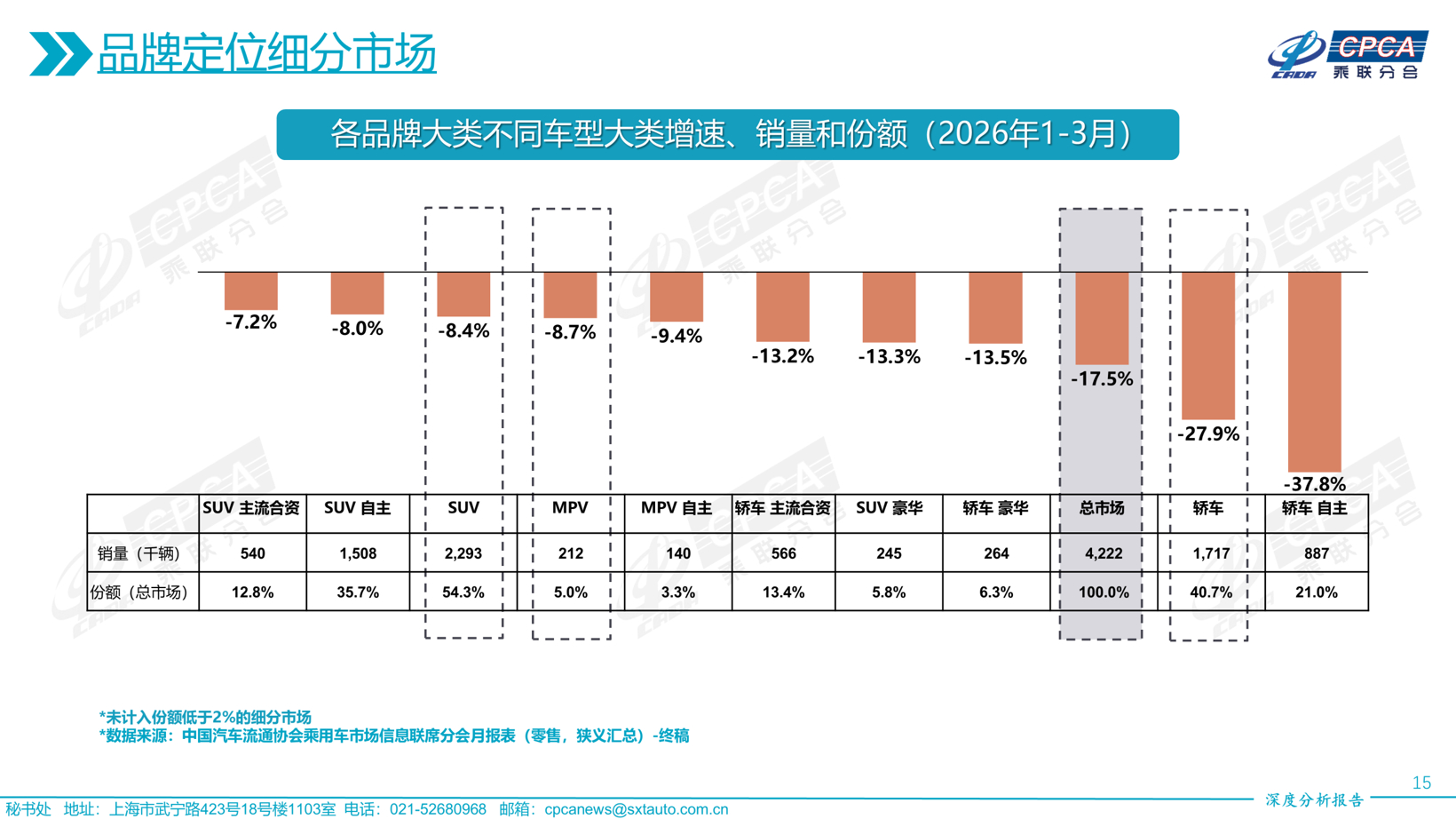
Image Credit: CPCA
Drill down to the brands, and BMW delivered 144,000 units in China in the first quarter, down 10% year-on-year. Audi delivered 127,100 units, down 12%, while Mercedes delivered 111,600 units — a steep 27% plunge. Combined, the three brands sold nearly 70,000 fewer units than last year, a daily drop of more than 700 vehicles.
Individual model performance is also telling. In March, the BMW 3 Series sold 11,000 units, the only BBA model to break the 10,000 monthly mark. The Mercedes E-Class moved 9,690 units, down 10.8%. The Audi A6L saw negative sequential growth as it undergoes a model changeover.
Meanwhile, joint-venture B-class sedans are slashing prices to prop up sales. The Hyundai Sonata has dropped below 110,000 yuan, the Audi A4L has dipped under 190,000, and the Lexus ES200 is going for just 190,000. Three years ago, terminal discounts like these would have had consumers lining up around the block. Now? The market heat is clearly shifting toward cars like the XPENG P7 and Xiaomi SU7.
In the SUV market, the shift is even more direct. In the first quarter, domestic SUVs sold 1.508 million units, capturing 60% of the SUV segment. Mainstream joint-venture SUVs sold 540,000 units, or 23.6%, while luxury SUVs moved 245,000 units, accounting for 10.7%. In March alone, domestic SUV sales surged to 594,000 units, grabbing a 66.2% market share.
The growth curve for domestic high-end new-energy brands is looking impressive. NIO delivered 83,500 units in the first quarter, a 98.3% surge; Li Auto delivered 95,100 units, up about 60%; and AITO sold 70,000 units, up 55.6%. This growth is concentrated in the large and above SUV segment — precisely BBA’s traditional stronghold.
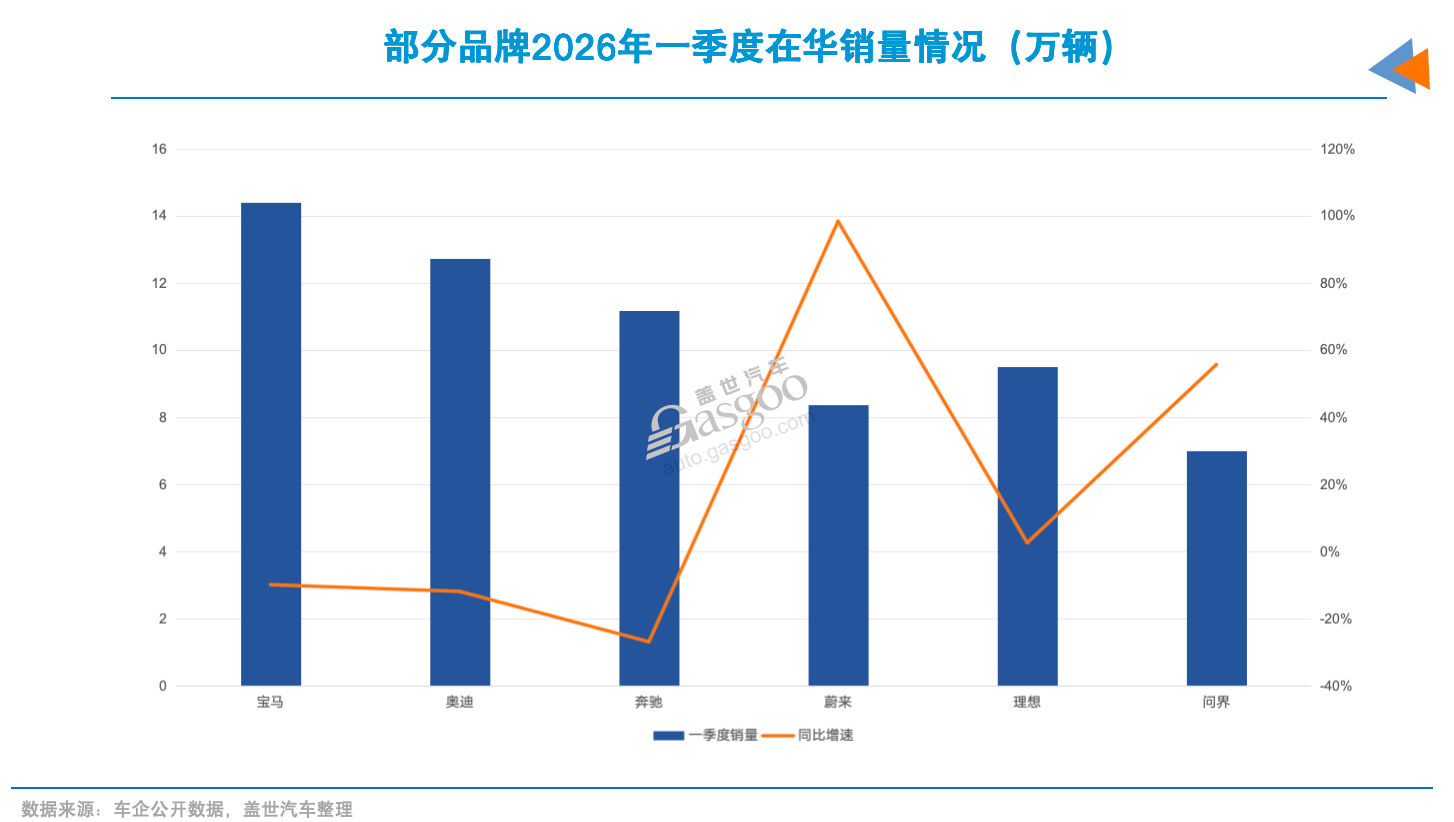
By comparison, the BMW X3 slumped 25.2% in March, feeling the impact of the new-energy surge. Why is the shift in the SUV market happening faster than in sedans?
It comes down to product form. SUVs naturally emphasize space, versatility, and adaptability across different scenarios — dimensions that align perfectly with the direction of new-energy technology. Large batteries need room, and SUVs have a structural advantage. For multi-passenger or long-distance travel, the value of charging efficiency and intelligent driver assistance is magnified.
The rapid proliferation of range extenders and plug-in hybrids in the SUV sector has also played a major role. By solving range anxiety, they’ve lowered the barrier to entry for new-energy vehicles. That’s a key reason why Li Auto and AITO have scaled up so quickly.
Facing these shifts, BBA unveiled countermeasures at the Beijing Auto Show. The core strategy comes down to two things: accelerating electrification and doubling down on localization.
BMW is moving fast. The new-generation iX3 and long-wheelbase i3 see their wheelbases uniformly extended by 108 millimeters to 3,005 millimeters, tailored specifically for China. The new cars feature the sixth generation eDrive system and an 800-volt architecture, with a CLTC range exceeding 900 kilometers and the ability to add over 400 kilometers of range in just 10 minutes.
On intelligence, BMW is partnering with Momenta to develop full-scenario navigation-assisted driving and teaming up with Alibaba to customize AI large models.
Mercedes brought the facelifted S-Class long-wheelbase version. Though officially an update, more than 50% of its parts are new. It features a luminous grille, the self-developed MB.OS architecture, and China-specific full-scene driver assistance — covering city streets, highways, and door-to-door navigation, adapted for local road conditions. Additionally, the all-new domestic GLC electric version made its global debut, built on the MB.EA platform with 800-volt architecture.
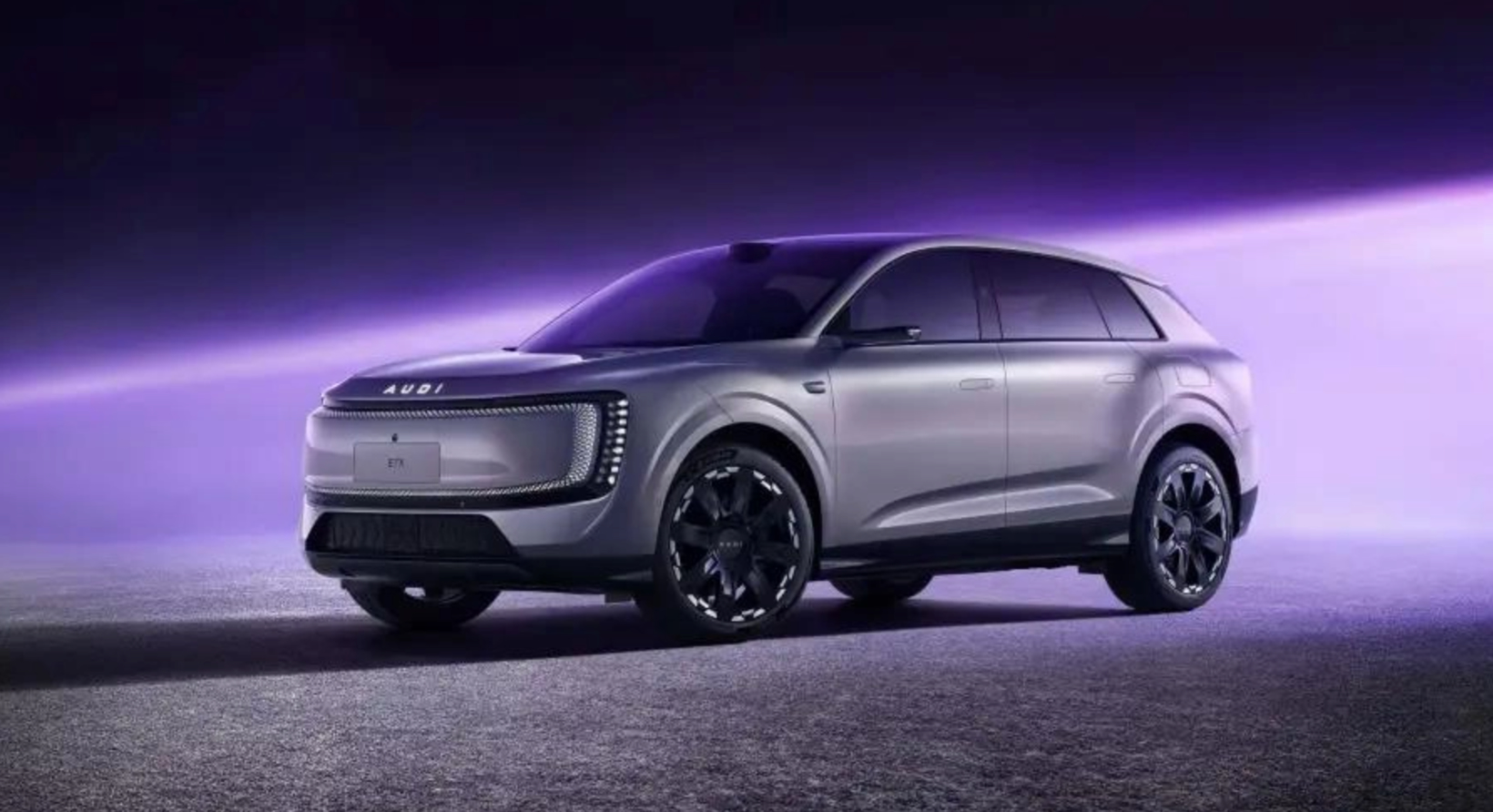
Image Credit: AUDI
Audi, meanwhile, unveiled the SAIC Audi E7X as a China-exclusive electric flagship. It comes standard with rear-wheel steering, air suspension, CDC dampers, and Momenta’s high-end intelligent driving system. Even more notable is that the new generation of A6L internal combustion models, along with the A5L, will also incorporate Huawei’s Qiankun intelligent driving system. Audi is the first traditional luxury brand to integrate a Chinese intelligent driving solution into a fuel-powered car.
Industry insiders note that German luxury brands are shifting from “introducing global models” to “developing for China.” This isn’t just talk; it’s tangible action.
Sales channels and pricing models are changing too. For their new electric vehicles, BBA is implementing a unified national pricing policy, eliminating terminal bargaining. Audi has launched “fusion direct sales,” where orders are placed via official platforms at a single price nationwide. Mercedes is already executing fixed pricing for its electric CLA, and BMW’s new-generation models are sold online with uniform pricing and no regional discrepancies.
German luxury brands are attempting to hold their ground during this transition window by strengthening product capabilities and collaborating with local supply chains. Because if the transition is too slow, the risk of market erosion is substantial.
For BBA, the Beijing Auto Show is not just a stage for showing off muscle; it is a platform for “rebuilding confidence” and declaring their transition.
The market shifts seen in the first quarter of 2026 are not short-term fluctuations. In the sedan market, traditional brands still hold ground, but room for growth is narrowing. In the SUV market, domestic brands have breached BBA’s defenses and are pressing deeper.
The balance between offense and defense is being redrawn. Can the domestic “9” series encircle and hunt traditional luxury brands like BBA? It’s too early to say for sure. But one thing is certain — the hunt has begun, and the Beijing Auto Show is the signal.