

In the world of technology analysis, we often look for the “tipping point”—that specific feature or capability that shifts a product from a niche luxury to a sustainable long-term asset. For years, the conversation around Electric Vehicles (EVs) centered almost exclusively on battery chemistry and raw range numbers. However, as the secondary market matures, a new hero has emerged in the data, and it isn’t the 0-60 mph time or the size of the infotainment screen.
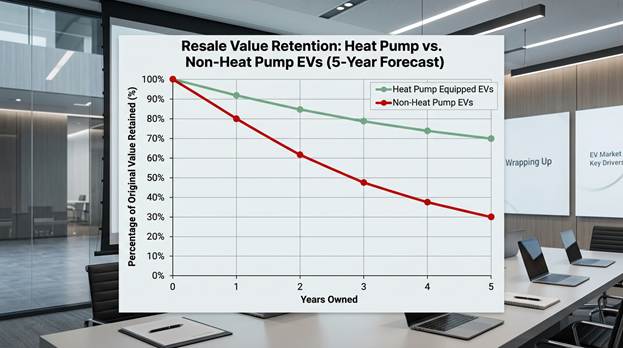
According to the latest EV Sales Statistics for 2026, there is a widening valuation gap between used EVs equipped with heat pumps and those relying on older resistive heating systems. The data suggests that vehicles with heat pumps are retaining significantly more of their original MSRP after three years compared to their “cold” counterparts. The market is beginning to treat the heat pump not as an optional luxury, but as a critical component of a vehicle’s “Recharged Score.”
Yet, if you walk onto a dealership lot today, the salesperson is likely to talk your ear off about “Ludicrous Mode” or vegan leather while failing to mention the thermal management system. This is a massive oversight. As we transition into a more pragmatically driven EV market, the heat pump is becoming the definitive “Intel Inside” moment for the automotive world – a badge of efficiency that guarantees the car remains useful and valuable regardless of the season.
What Exactly Does an EV Heat Pump Do?
To understand why the market is suddenly obsessed with this component, we need to look at the physics of cabin comfort. In a traditional internal combustion engine (ICE) vehicle, the engine is remarkably inefficient, losing about 60-70% of its energy as heat. In winter, we simply harvest that “waste” heat to keep the cabin warm.
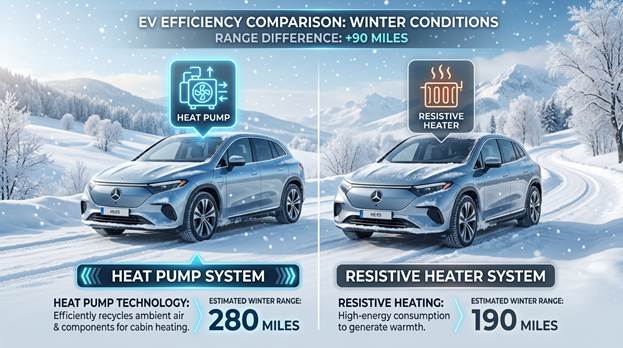
EVs, however, are victims of their own efficiency. Their motors generate very little waste heat. Early EVs solved this using Resistive Heating (PTC heaters), which essentially works like a giant toaster. You run electricity through a coil, it gets hot, and a fan blows that heat into the cabin. The problem? It is a massive drain on the battery, often reducing winter range by as much as 30-40%.
A heat pump operates on a completely different principle. Instead of generating heat, it moves it. Using a refrigerant cycle – much like your kitchen refrigerator or a home HVAC system – it captures ambient heat from the outside air (even in freezing temperatures) and compresses it to bring it into the cabin.
Think of it as a thermal multiplier. While a resistive heater has a COP (Coefficient of Performance) of 1.0, modern automotive heat pump systems can deliver significantly more heat energy than the electrical energy they consume. This “efficiency of movement” preserves the battery for its primary job: moving the wheels.
Advertising
The Economics of Thermal Efficiency
Why is this reflected so heavily in resale value? Because the used car buyer is often more risk-averse than the early adopter. A second-hand buyer in a cold climate doesn’t want a car that loses half its utility for four months of the year.
The Recharged 2026 report highlights that as the “early adopter” phase of EV ownership ends, the “utility phase” begins. In this phase, range consistency is king. A heat pump acts as an insurance policy against range anxiety. When a buyer looks at two used Tesla Model 3s—one from 2019 (without a heat pump) and one from 2021 (with one)—the newer model isn’t just better because it’s newer; it’s better because its “real-world” winter range is significantly closer to its advertised EPA range.
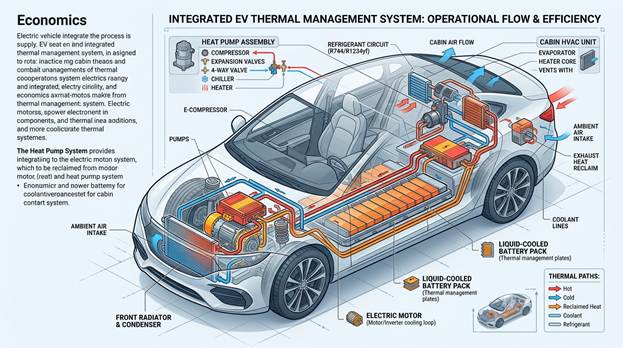
Furthermore, heat pumps do more than just warm the cabin; they are integral to advanced battery thermal management. A battery that is kept at its optimal operating temperature through an efficient heat pump system experiences less degradation and maintains faster charging speeds in cold weather. Smart buyers know that a car with a heat pump likely has a “healthier” battery history, further driving up the resale premium.
Advancing Technology and Leading Providers
We are currently in the “third generation” of automotive heat pump technology. Early systems struggled when temperatures dipped below zero. Today’s systems utilize “vapor injection” and complex scavenge cycles that can pull heat from the motor, the inverter, and even the battery itself to keep the cabin warm even in extreme sub-zero conditions.
The leaders in this space aren’t just the car companies themselves, but the Tier-1 suppliers who have mastered thermal fluid dynamics. Companies like Hanon Systems, Denso, and Mahle are the unsung giants of the EV revolution. Mahle’s integrated thermal suites are paving the way for systems that protect batteries and power electronics while ensuring cabin comfort.
Advertising
On the vehicle side, Tesla set a high bar with the introduction of the Octovalve. It was a masterclass in systems integration, allowing the car to move heat with surgical precision between components. However, the legacy automakers are catching up. Hyundai Motor Group has invested heavily in its Environmental Test Complex to tune heat pumps for extreme Northern European and Canadian climates. Their E-GMP platform cars (Ioniq 5/6, EV6/9) consistently outperform rivals in cold-weather range tests. BMW has also integrated highly sophisticated heat pumps into their i-series, treating thermal management as a core luxury performance metric.
The Market Disconnect: Selling the Wrong Specs
The tragedy of the heat pump is that it is a “hidden” feature. You cannot see it, and you don’t feel it—except for the fact that your range doesn’t plummet when the snow starts falling.
Automotive marketing departments are failing the consumer by not making the “Heat Pump Equipped” badge as prominent as “All-Wheel Drive.” In my years of analyzing tech trends, I’ve seen this before. In the early PC days, consumers bought based on clock speed, ignoring the fact that thermal throttling was what actually determined real-world performance.
We are seeing the same thing here. A 300-mile EV without a heat pump is actually a 180-mile EV in January. A 250-mile EV with a heat pump might still be a 220-mile EV in January. The latter is the better car, yet the former often sells for more when new because of the “top-line” number. The secondary market, however, is correcting for this marketing fluff by devaluing cars that can’t perform in the cold.
Wrapping Up
The EV industry is moving out of its infancy. We are no longer impressed just by the fact that a car can run on electricity; we now demand that it does so reliably and efficiently. The data from Recharged is a wake-up call for both manufacturers and buyers.
If you are a consumer looking to buy an EV today, the presence of a heat pump should be a non-negotiable item on your checklist—not just for the comfort of your winter commute, but for the protection of your investment. If you are a manufacturer, failing to include a heat pump as standard equipment is no longer just a cost-saving measure; it’s a recipe for creating a rapidly depreciating asset.
The heat pump revolution is here. It isn’t flashy, it isn’t loud, and you can’t see it from the driver’s seat. But when it comes time to trade in your vehicle, it might just be the most important part of the car.
Disclosure: Images rendered by Artlist.io
Rob Enderle is a technology analyst at Torque News who covers automotive technology and battery developments. You can learn more about Rob on Wikipedia and follow his articles on TechNewsWord, TGDaily, and TechSpective.
Follow us today…


