
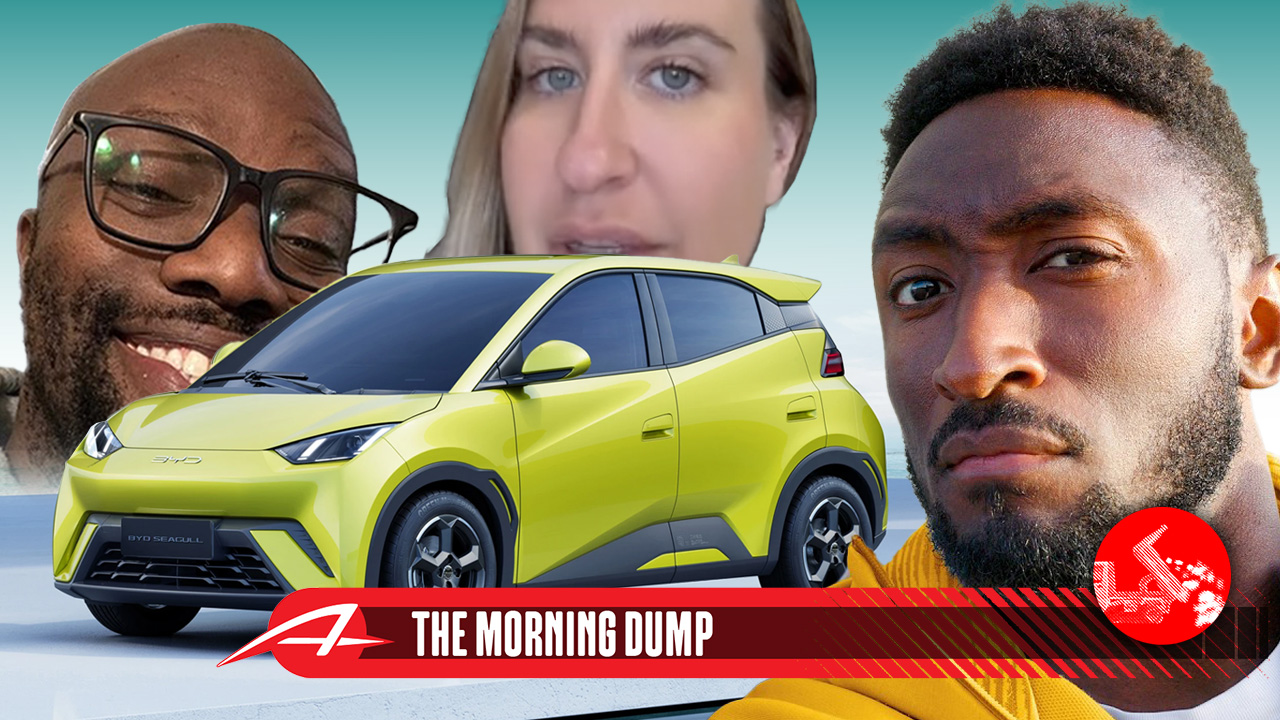
In The Manchurian Candidate, an American soldier is brainwashed by Chinese intelligence and becomes a sleeper agent for that country’s communist government. If only they’d have known then that the less lethal and more profitable path would be to start a social network and fly cars to influencers.
There’s a big feature out that talks about how American consumers are being persuaded to desire cheap Chinese cars by American influencers, and on a platform created by China no-less. Is that weird? I’ve been using The Morning Dump to influence you to believe that it’s the “Decade of the Hybrid.” You know who also agrees? Chinese automakers.


General Motors CEO Mary Barra is the highest paid automotive exec in Detroit, which makes sense when you look at the stock price and the company’s overall performance. She can’t have the job forever, and GM left a big hint as to who is going to replace her. Don’t worry, it’s not me.
Across town, Ford makes a lot of hybrids, but it can’t make trucks fast enough to keep up with demand. In fact, it can barely make trucks at all.
‘The Second I Mention A Chinese Car, The Videos Skyrocket’
Every automaker is trying to use influencers to convince people to buy their cars. This is nothing new. Six years ago, a typical launch for a car in the United States was 90% journalists and maybe 10% influencers. Many of the launches today have whole days just devoted to influencers, and the split is closer to 50/50.
It’s a good strategy. I find the traditional journalists at launches are the first to the bar, the last to the briefing, and produce nothing more than a mostly replaceable bit of copy published with manufacturer photos. The influencers grind. They produce reels! They post to Instagram stories! It’s far more interactive. I have way more respect for that kind of hustle than I do for sclerotic modern automotive journalism. I also think it often creates more value for the automaker that forked over the money to bring people on a trip.
In that context, this Bloomberg Businessweek feature titled “TikTok Makes Americans Want Chinese EVs They Can’t Have” shouldn’t be that surprising or controversial. Isn’t that what everyone does? Just by virtue of being younger and newer, these companies are embracing social media.
The Beijing Motor Show is going on right now, and there are a bunch of influencers (and journalists) there on various automaker trips. We were invited by a Chinese automaker to go, but couldn’t make it work because of timing [Ed Note: Yes, we were invited by a Chinese automaker to go to China to cover Chinese cars that we cannot buy in the U.S. -DT]. Also, they were suddenly more interested in bringing Canadians because Canada is getting Chinese EVs first.
There’s nothing outrageous in this piece, but it’s interesting to see it laid out this way:
Richard Benoit flew to Alaska a little more than a year ago to test-drive a slate of China’s newest electric vehicles, shipped onto US soil to dazzle online car influencers like him. Sitting in the driver’s seat of a sky-blue Chery iCar 03, Benoit marveled at the SUV’s roomy interior, widescreen digital display with built-in karaoke and jaw-dropping price tag: $24,000. “Now I understand why they don’t want these to come to America,” he said in a video he posted on YouTube. “This is insane.”
Titled “I drove the cheap Chinese cars that are illegal in the USA. Now I know why,” the video has since racked up nearly 2 million views. Benoit says his American subscribers can’t get enough of the sleek, affordable vehicles from Chinese brands including BYD, Xiaomi and Zeekr that flood their social media feeds—yet aren’t for sale in the US. “The second I mention a Chinese car, the videos skyrocket,” he says, when reached by phone from his home in Massachusetts. “Americans want these cars—they just do.”
Obviously, we recently drove a bunch of Chinese cars in America at a press event and the takeaway was that they’re familiar and pretty good. The market is young and Chinese consumers are very tech-forward, so there’s a lot of fun ideas in these cars that look interesting to Americans. Ford’s CEO famously didn’t want to give his borrowed Chinese car back.
Additionally, China has heavily subsidized battery development and has massive overcapacity issues and differing standards that makes Chinese cars appear cheaper than they really are, or ought to be (to say nothing of credible reports of problematic labor practices). A $10,000 Chinese car could easily be a $20,000 Chinese car here. Plus, these companies usually aren’t under the same pressure to be profitable as other automakers.
It feels strange, though. The fact that a lot of this is happening on TikTok, which is a platform created by Chinese company ByteDance, is strange. Even if influencers aren’t being paid directly by carmakers to talk about their products (which, if disclosed, is totally legal and fine), there’s a sort of secondary payment to these influencers as they get compensated by the platforms themselves for engagement. I haven’t seen any evidence that Chinese automakers are forking over cash to boost this content, but I wouldn’t be surprised, either. One of the companies doing this is DCar, which is itself a spinoff of ByteDance, the company that created TikTok.
The oddest bit is that, due to tariffs that go back to the Biden Administration, bringing Chinese-built cars here seems remote, no matter what the appeal might be. Americans don’t so much crave cheap cars as they crave nice cars that happen to be affordable. Some of the interest in Chinese cars is probably due to the fantasy of having their nian gao and eating it, too. It’s possible that Chinese automakers are planning for a future where those rules are relaxed following the planned meeting between President Trump and Chinese President Xi Jinping.
Either way, I do think that Forrest Jones, who often features Chinese cars, makes a good point in the kicker of that piece:
He knows showcasing them in America is controversial but thinks competition is healthy for the industry. “Even if we don’t get them here,” Jones says, “I would like consumers to know what’s out there and have that ammunition to demand more from the brands we do have access to.”
This is absolutely correct. American brands aren’t going to get better until they acknowledge what makes Chinese cars appealing that isn’t related just to cost.
China Is Excited About Hybrids, Too! Photo: Jaecoo
It’s the “Decade of the Hybrid” y’all! Even China, which builds all those fancy EVs all those influencers seem to love, has a strong yearning for hybrid cars. What’s happening here?
Nikkei Asia explains that hybrids got overlooked by Chinese automakers due to the lack of subsidies, which gave an advantage to Japanese carmakers with more hybrid experience:
“The cost of our HEV solution is nearly the same as our plug-in EV solution,” Wu Jian, an executive at GAC, said in a 2021 interview. “But when the price tags are similar, consumers are more willing to buy plug-in cars that are not only eligible for a green license plate but also exempt from purchase taxes,” he added, referring to the registration plate that offers perks such as exemptions from certain traffic restrictions.
All of a sudden, though, Chinese automakers are showing new hybrids. What’s going on?
The shift has been driven by reduced state tax incentives for EVs and plug-in hybrids starting 2026, as well as a regulatory change requiring automakers in China to reach an average fuel economy of 3.3 liters per 100 km in 2030, said Yale Zhang, managing director of Shanghai-based consultancy Automotive Foresight.
“If there are still fuel-powered cars in China in the future, they will largely be HEVs,” Zhang said. “I forecast that carmakers will stop launching traditional internal combustion engine models, starting next year.”
Electric cars for some, hybrids for others, and tiny Chinese flags for everyone else.
Sterling Anderson’s 40 Million Reasons To Stay At GM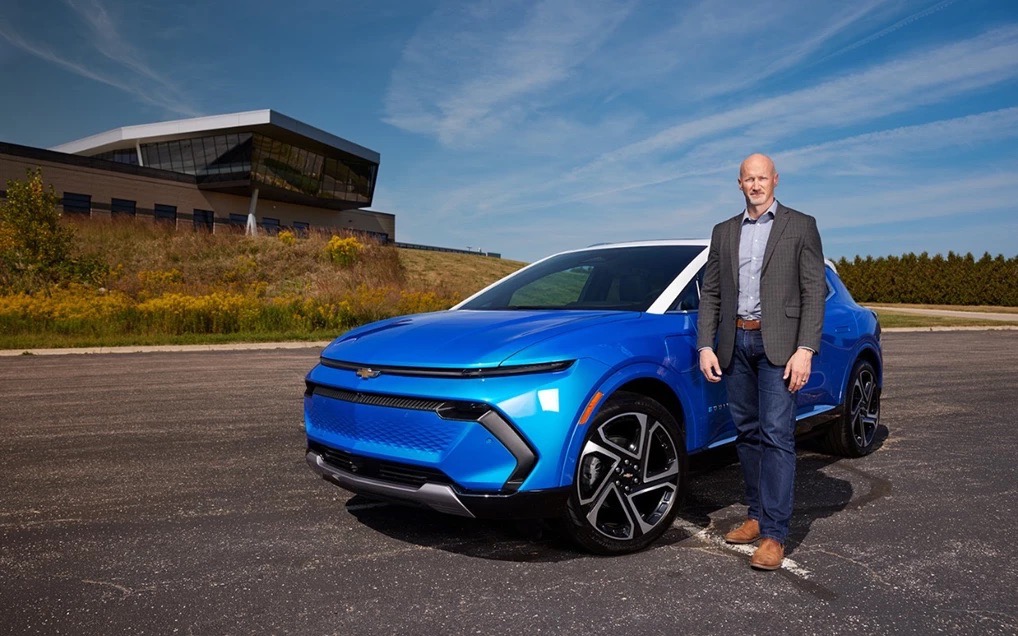 Photo: GM
It’s been a while since America had a big and tall automotive exec. Was the last one Lutz? It might have been Lutz. Or that one guy, Reid Landman. Either way, the next one might be Sterling Anderson. Why?
The Detroit Free Press noticed something interesting in the company’s executive compensation filings:
GM’s board also approved an elaborate, one-time-only new hire award package for an executive that media reports have said is on a short list to replace Barra ― Sterling Anderson.
Anderson’s hiring package totaled $40 million, a one-time deal that would be paid out through 2027. After the deal’s terms conclude on July 29, 2027, Anderson will receive a regular compensation more in line with other GM executives, according to GM.
Basically, Anderson has to meet certain goals and stick around at GM to keep the money. This could be meaningful or it could just be something normal. Maybe he’s just doing a great job. Or, maybe, they don’t want him to get poached. Last time I suggested this a GM spokesperson, unprompted, emailed to let me know this was all speculation. Let’s see if that happens again!
‘It’s A Heap Of A Mess’ Says Ford Dealer Source: Ford
As a Texan, the first two signs of spring were the arrival of fields of bluebonnets and Truck Month. I think this Truck Month might have been ruined, as a dealer points out to Automotive News:
Chuck Anderson Ford, less than 20 miles from Ford’s F-150 plant in Kansas City, Mo., usually starts Truck Month with about 70 of the pickups. This year, it had only nine.
“It’s a heap of a mess,” Nick Anderson, the dealership’s general manager, told Automotive News. “Outside of COVID, I’ve never seen an F-150 shortage like this.”
Ford dealers around the U.S. are grappling with an undersupply of a vehicle that’s a reliable profit pillar and the leader in an intensely competitive segment. The automaker is scrambling to boost production but has signaled that inventory levels may not stabilize until the second half of the year.
None of this is a secret. Ford has said in filings that the two fires at its aluminum provider in New York is going to slow down supply until later this year. Still, the extent of it seems to be profound.
What I’m Listening To While Writing TMD
Coachella sounds like it was a party this year, and there’s no one I’d have rather seen than the immeasurably great Kacey Musgraves. Watch her as she sings “Uncertain, TX” and sways along to a Tejano accordion. I love Tejano accordion.
The Big Question
Have you been exposed to influencers peddling Chinese cars? Has it worked? [Ed Note: I also want to ask: Are you convinced that Chinese cars are, as a whole, better than U.S. ones? -DT].
Top graphic images: TikTok; YouTube; BYD