

①The latest information shows that Ferrari’s first all-electric model, Luce, is preliminarily priced at 550,000 euros (approximately RMB 4.4 million), significantly higher than the starting price of around 450,000 euros for the internal combustion engine model Purosangue; ②The new car will be officially launched in Rome next month, and its market performance will test whether supercar users are willing to embrace high-end electrification, while also verifying the residual value potential of ultra-luxury electric vehicles.
Cailian Press, April 22 (Editor: Shi Zhengzhi) The latest information indicates that Ferrari’s first all-electric vehicle has been preliminarily set at a price of 550,000 euros (approximately RMB 4.4 million). The model will debut in Rome, Italy, next month. According to sources familiar with the matter, the final price may still fluctuate by about 10% up or down.
The latest developments also indicate that, as a four-door, four-seat supercar, Ferrari Luce (previously codenamed Elettrica) is positioned significantly higher than the company’s internal combustion engine model Purosangue, which starts at approximately 450,000 euros.
 In Italian, “luce” means light, and the company stated that it “symbolizes the brand’s unwavering focus on the future.”
As Ferrari’s first SUV model, Purosangue has become one of the most important models for the brand since deliveries began in 2023. It expanded the company’s customer base from traditional two-seater sports car enthusiasts to a broader audience and contributed to an increase in the average selling price. Ferrari limits the production of this model to approximately 20% of its total annual output to maintain its exclusivity.
For the capital markets, Ferrari’s proprietary electric platform will validate a critical proposition: whether high-end sports car users, who traditionally emphasize the “roar of internal combustion engines,” will purchase electric vehicles bearing the same brand. Given that many affluent buyers are highly concerned about the potential for supercars to retain or even appreciate in value, the residual value of ultra-high-end electric vehicles will also face market scrutiny.
Ferrari has stated that, provided it can maintain the driving performance that defines the brand, the company aims to offer customers the freedom to choose between internal combustion engines, hybrid powertrains, and fully electric drivetrains.
In terms of performance, Ferrari Luce features a four-motor configuration with a combined power output exceeding 1,000 horsepower. The battery capacity is approximately 122 kWh, providing a range of 530 kilometers. Thanks to the 800V architecture, fast charging can bring the battery up to 80% in just 15 minutes. The battery pack is independently designed and assembled by Ferrari (with cells supplied by SK On), and Ferrari claims it has the highest energy density among mass-produced electric vehicles globally—195 Wh/kg.
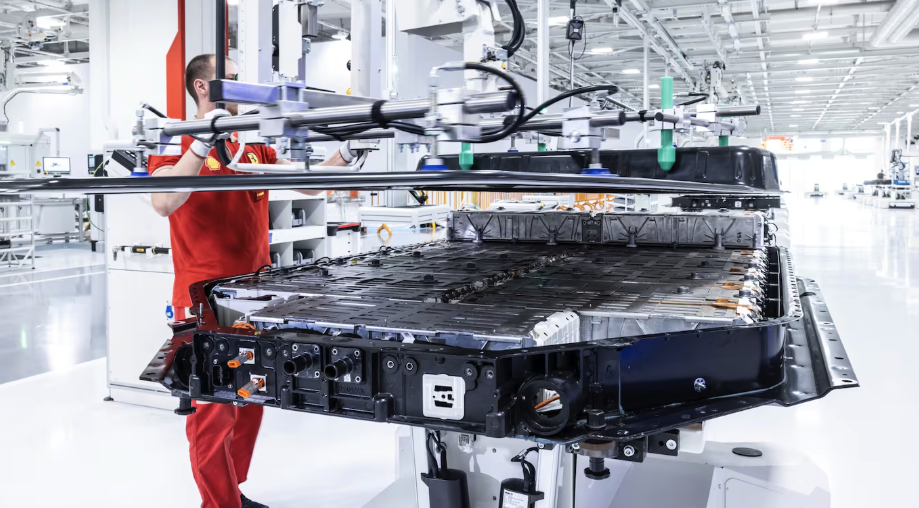
Despite the additional weight from the battery, Luce’s acceleration from 0 to 100 km/h remains at 2.5 seconds.
Ferrari’s electric vehicles are unlikely to be associated with the term “quiet.” The company filed a patent for an acoustic device in 2021, aiming to amplify the hum of the electric motor and transform it into a sound closer to a low growl. Another patent subsequently obtained describes a “virtual gearbox,” replicating the sensation of gear-shifting without mechanical linkage.
Gianmaria Fulgenzi, Ferrari’s Chief Product Development Officer, once stated: ‘We will amplify the sound at the right moment, such as when accelerating in a certain way, when our senses anticipate the presence of sound and expect it to increase in volume.’
By the way, this new model may have additional appeal to some loyal Apple users.
Jony Ive, the legendary designer and long-time friend of Ferrari Chairman John Elkann, designed the interior of this new car. Ive, who worked with Jobs to usher in the era of mobile touchscreens, has presented his understanding and interpretation of the ‘automotive touchscreen era’ in the design drawings that have been made public.
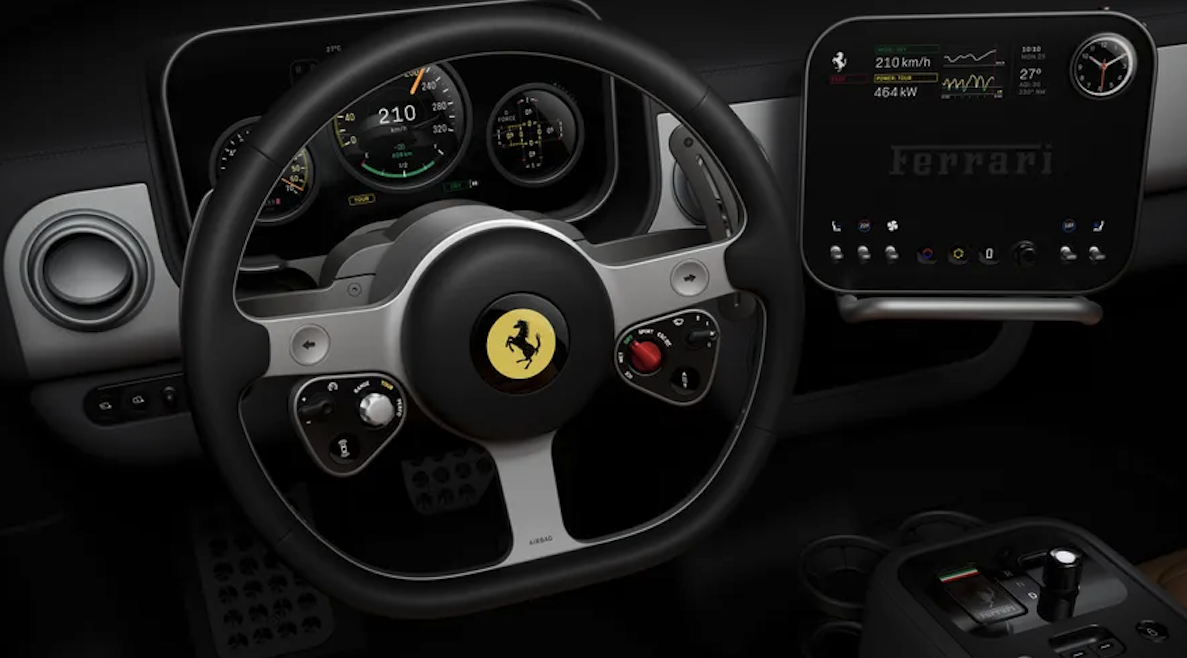
(Luce interior design drawing)
Regarding the design concept, Ive stated in February: ‘Achieving simplicity and intuitiveness is actually very difficult. Everything is built on functionality. It is not decoration, not embellishment, because that would be distracting and cannot stand the test of time. The instrument panel and steering wheel are closely connected, which is about driving. Everything else complements this experience.’
Ive also criticized that, from the perspective of practical use and functionality, large touchscreens are unsuitable for cars – a fact that is ‘undeniable.’ He commented that this approach is both simplistic and somewhat lazy. In this field, it is easy to become obsessed with form and fashion itself.