
 Fuel Cell Electric Vehicle (FCEV) Market Overview
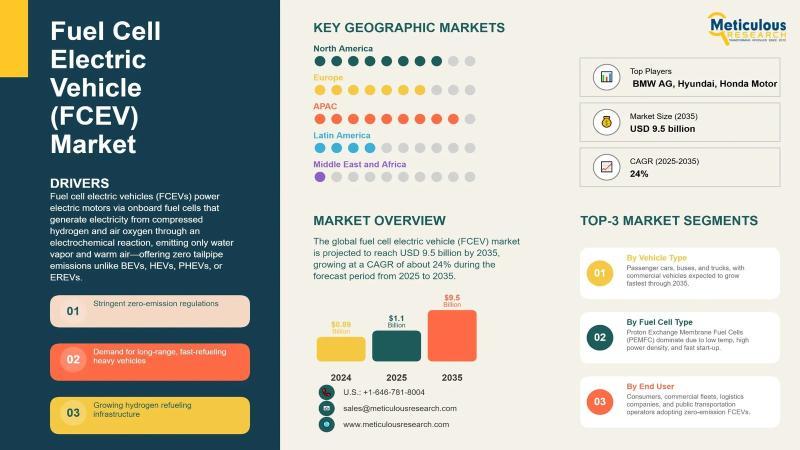
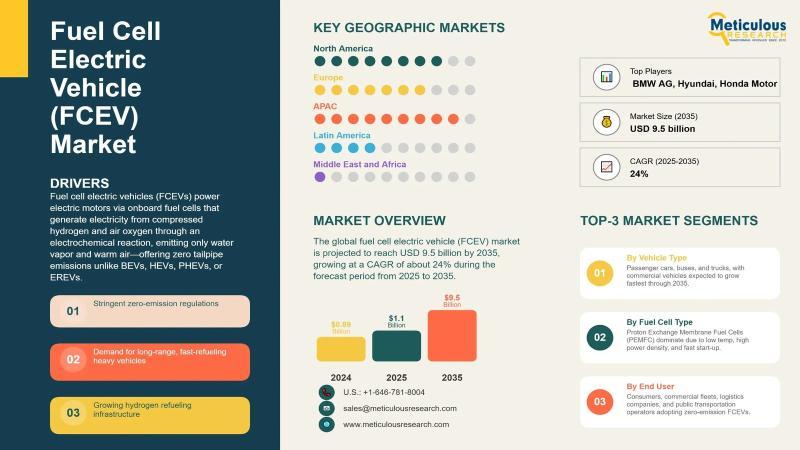
The global fuel cell electric vehicle (FCEV) market is emerging as a key segment within the zero-emission mobility landscape. The market is projected to grow from USD 1.1 billion in 2025 to USD 9.5 billion by 2035, registering a strong CAGR of around 24%. This rapid expansion reflects the increasing focus on clean energy solutions and the need for alternatives that overcome the limitations of battery-based electric vehicles.
FCEVs operate using hydrogen fuel cells that generate electricity through an electrochemical reaction between hydrogen and oxygen. This process powers an electric motor while producing only water vapor and heat as byproducts, making FCEVs completely free of tailpipe emissions. Their ability to deliver long driving ranges and fast refueling times positions them as a practical solution for both personal and commercial transportation needs.
Download Sample Report Here: https://www.meticulousresearch.com/download-sample-report/cp_id=6324
Technology and Working Principle
Fuel cell electric vehicles differ significantly from other types of electric vehicles. Instead of relying on large battery packs like battery electric vehicles, FCEVs use hydrogen stored in high-pressure tanks. When hydrogen flows into the fuel cell stack, it reacts with oxygen from the air to produce electricity. This electricity powers the motor and charges a small battery that supports acceleration and energy recovery.
One of the biggest advantages of this technology is refueling speed. FCEVs can be refueled in just three to five minutes, similar to conventional fuel vehicles. At the same time, they offer driving ranges of 300 to 500 miles on a single tank, making them suitable for long-distance travel. Continuous improvements in fuel cell efficiency, durability, and material usage have also reduced costs and enhanced performance over the years.
Market Trends and Industry Evolution
The FCEV market is undergoing a significant transformation, particularly with the growing shift toward commercial vehicle applications. While early adoption focused on passenger cars, attention is now moving toward buses, trucks, and logistics fleets. These segments benefit greatly from hydrogen technology due to the limitations of battery weight and charging time in heavy-duty operations.
Another important trend is the development of next-generation fuel cell systems. Automakers are investing in advanced fuel cell technologies that offer better efficiency, longer lifespan, and lower reliance on expensive materials such as platinum. These improvements are expected to make FCEVs more cost-competitive in the coming years.
The growth of green hydrogen production is also shaping the market. Although most hydrogen is currently produced from fossil fuels, there is increasing investment in renewable energy-based hydrogen generation. As production costs decline, green hydrogen is expected to become a more viable and sustainable fuel option for transportation.
Additionally, the expansion of hydrogen refueling infrastructure is gaining momentum. Governments and private companies are investing in building refueling networks to support the adoption of FCEVs. New technologies, such as liquid hydrogen storage, are also being explored to improve energy density and efficiency.
Browse in Depth: https://www.meticulousresearch.com/product/fuel-cell-electric-vehicle-market-6324
What Makes FCEVs a Strong Alternative to Other EVs?
FCEVs are gaining traction because they address some of the major challenges associated with battery electric vehicles. For long-distance and heavy-duty applications, batteries can become heavy and require long charging times. In contrast, hydrogen-powered vehicles offer quick refueling and consistent performance over extended distances.
This makes FCEVs particularly suitable for commercial fleets, including trucks and buses, where downtime must be minimized. Their ability to operate efficiently over long routes without frequent stops provides a clear advantage in logistics and transportation sectors.
Market Drivers and Opportunities
The growth of the FCEV market is strongly influenced by government policies and environmental regulations. Many countries are implementing zero-emission vehicle mandates and offering incentives to encourage the adoption of clean transportation technologies. Financial support for hydrogen production and infrastructure development is also playing a crucial role in accelerating market growth.
Another key driver is the need to decarbonize heavy-duty transportation. Trucks and buses contribute significantly to global emissions, and hydrogen fuel cells provide a viable solution for reducing their environmental impact. With better range and faster refueling compared to battery-powered alternatives, FCEVs are well-positioned to support this transition.
Opportunities are also emerging in commercial fleet electrification. Fleet operators are increasingly looking for solutions that combine efficiency, reliability, and compliance with environmental standards. Hydrogen-powered vehicles are particularly well-suited for fixed-route operations, where refueling infrastructure can be strategically deployed.
The continued expansion of hydrogen infrastructure presents another major opportunity. As more refueling stations are built, the adoption of FCEVs is expected to accelerate. Investments in hydrogen hubs and supply chains are helping address one of the key barriers to market growth.
Segment Insights
Passenger vehicles currently account for a significant share of the FCEV market, driven by early commercialization and government incentives. However, the commercial vehicle segment is expected to grow at the fastest rate in the coming years. Buses and trucks are increasingly adopting fuel cell technology to meet emission standards and improve operational efficiency.
In terms of fuel cell technology, proton exchange membrane fuel cells dominate the market due to their suitability for automotive applications. These systems operate at relatively low temperatures, offer quick start-up times, and deliver high power output, making them ideal for transportation.
When it comes to driving range, vehicles offering 300 to 500 miles per tank are the most common. This range provides a balance between performance and infrastructure availability, supporting both urban and long-distance travel needs.
Buy the Complete Report with an Impressive Discount: https://www.meticulousresearch.com/view-pricing/1641
Regional Market Insights
Asia-Pacific leads the global FCEV market, supported by strong government initiatives and significant investments in hydrogen infrastructure. Countries such as China, Japan, and South Korea are at the forefront of hydrogen mobility, with extensive refueling networks and supportive policies.
Europe is also making steady progress, with increasing focus on hydrogen as part of its clean energy strategy. The region is expanding its refueling infrastructure and encouraging the adoption of fuel cell technology across various sectors.
North America is gradually developing its hydrogen ecosystem, with efforts concentrated in specific regions. Government funding and private investments are expected to drive further growth in the coming years.
Competitive Landscape
The FCEV market is characterized by the presence of both established automotive manufacturers and specialized technology providers. Companies are investing heavily in research and development to improve fuel cell performance, reduce costs, and expand product offerings. Strategic collaborations and partnerships are common, as industry players work together to accelerate the development of hydrogen mobility solutions.
Related Reports:
Electric Commercial Vehicle Market: https://www.meticulousresearch.com/product/electric-commercial-vehicle-market-5766
Electric Vehicle Market: https://www.meticulousresearch.com/product/electric-vehicle-market-5179
About Us:
We are a trusted research partner for leading businesses worldwide, empowering Fortune 500 organizations and emerging enterprises with actionable market intelligence tailored to drive revenue transformation and strategic growth. Our insights reveal forward-looking revenue opportunities, providing our clients with a competitive edge through a diverse suite of research solutions-syndicated reports, custom research, and direct analyst engagement.
Each year, we conduct over 300 syndicated studies and manage 60+ consulting engagements across eight key industry sectors and 20+ geographic markets. With a focus on solving the complex challenges facing global business leaders, our research enables informed decision-making that propels sustainable growth and operational excellence. We are dedicated to delivering high-impact solutions that transform business performance and fuel innovation in the competitive global marketplace.
Contact Us:
Meticulous Market Research Pvt. Ltd.
1267 Willis St, Ste 200 Redding,
California, 96001, U.S.
Email- sales@meticulousresearch.com
USA: +1-646-781-8004
Europe: +44-203-868-8738
APAC: +91 744-7780008
Visit Our Website: https://www.meticulousresearch.com/
For Latest Update Follow Us:
LinkedIn- https://www.linkedin.com/company/meticulous-research
This release was published on openPR.