
Dear Alex,
I have owned my Mini Clubman for six years. I now want something with a more elevated driving position (but don’t want anything huge), and I’m also considering the transition to an electric vehicle (EV). I’ve always bought new Minis or BMWs, but now, in retirement, I only want to spend about £25,000. I’m aware this will exclude BMWs so I’m not sure where to start. Key factors are battery range, length of warranty and low running costs. What do you suggest?
– MS
Dear MS,
For a well-engineered EV with a long warranty, look to Korea. Hyundai and Kia make some of the best EVs, with batteries that seem to resist degradation pretty well, while they have warranties of five and seven years (respectively) from new.
That makes a Kia Niro EV the logical first port of call. It’s comfortable, roomy and is only 20cm longer than your Mini. The official range is a respectable 285 miles – expect somewhere between 200 and 250 in the real world, depending on the weather conditions. Its crash test scores of 91 and 84 per cent for adult and child occupant protection are very good.
For your budget, you should be able to find an example at a main dealer under the Approved Used Car scheme, in which Kia automatically tops up the original warranty to the original seven years. (Note, this is different from a Kia Assured car, to which this does not apply). I found a 2025 Niro EV 3 with said warranty top-up and only 8,000 miles for £24,995.
How can Hyundai beat that? Its Kona Electric is more compact than the Niro EV, so its dimensions are more akin to your Mini. It has a comfy ride, roomy interior and a dashboard that’s sensibly laid out with large, tactile buttons instead of touch-sensitive pads. And it’ll do, officially, 319 miles on a full charge – which means 230 to 280 in the real world.
Its crash test scores aren’t quite as good as the Kia’s (80 and 84 per cent for adult and child occupant protection), but they’re still pretty respectable.
Hyundai’s warranty is five years compared with Kia’s seven, so you’d think a two-year-old example would have only four years left. But Hyundai also has a used car scheme, called Promise, under which you can top up the warranty to the full five years if the car is less than three years old. This costs extra, but the price is pretty reasonable; indeed, your budget buys you a 2025 N Line with 7,000 miles and the warranty extension.
Not much else offers a better combination of range, safety and warranty length than these two, so try both and see which you prefer.
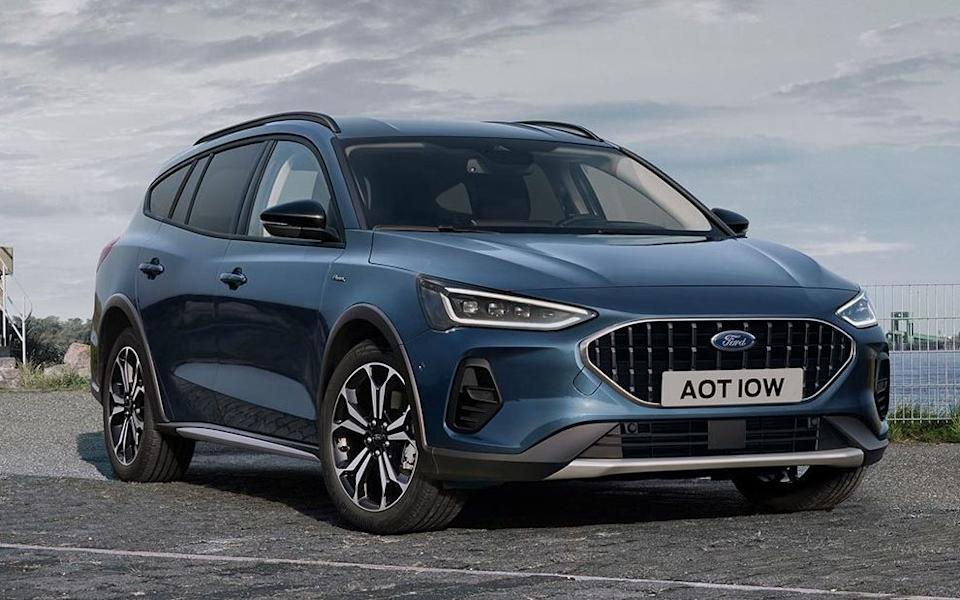
The Ford Focus Estate has three drive modes – Normal, Sport and Eco
When should I use my car’s Eco mode?Dear Alex,
I bought a new Ford Focus Estate last year. The salesman advised that Eco mode should be used on motorways, however Google’s AI advises that it should not be used on motorways but for urban driving. The car’s handbook isn’t helpful, so which advice is correct?
– AG
Dear AG,
Who do you trust more: AI or a car salesman? The answer is both. And, also, neither. Let me explain.
Eco mode refers to one of the drive modes, which in your Focus are Normal, Sport and Eco. (Active models also have Slippery and Trail modes, but those aren’t relevant here).
In some cars, the various modes have a noticeable effect on the way they drive – adjusting the suspension damping, exhaust note, even the way the differential reacts – but in the Focus they do little more than tweak the steering and accelerator response. The Sport setting sharpens them to make the car feel more lively, while Eco softens their response to help smooth your driving and thus reduce fuel usage.
If your car has an automatic gearbox, these modes will also adjust the gearbox behaviour, shifting up later in Sport and sooner in Eco.
So why did the salesman advise you to use Eco on motorways? It could be down to personal preference. In urban driving, with lots of acceleration and braking, many people find Eco mode can make a car feel less responsive. Some will only switch a car into Eco when they maintain a constant speed.
The trouble is, of course, that if you can’t feel the difference, it probably isn’t doing much. To put it another way, when you aren’t accelerating, slowing and changing direction, there isn’t much throttle or steering action for the system to alter.
That could be why the AI tells you only to use it in town, when you are likely to use the accelerator pedal more aggressively. In this manner, the potential fuel savings in Eco mode will be greater.
However, perhaps the AI is getting confused: some plug-in hybrids (PHEVs) in Eco mode will prioritise using electric power rather than petrol – which is what you want in town. Perhaps the AI is applying that principle despite your car not being a plug-in hybrid.
Either way, use Eco mode when you like – using it (or not) isn’t critical to the car’s wellbeing and won’t make a vast difference to its fuel economy. Experiment with this mode in a variety of situations. If it works for you, great. If not, you need never touch the Drive Mode switch again.