
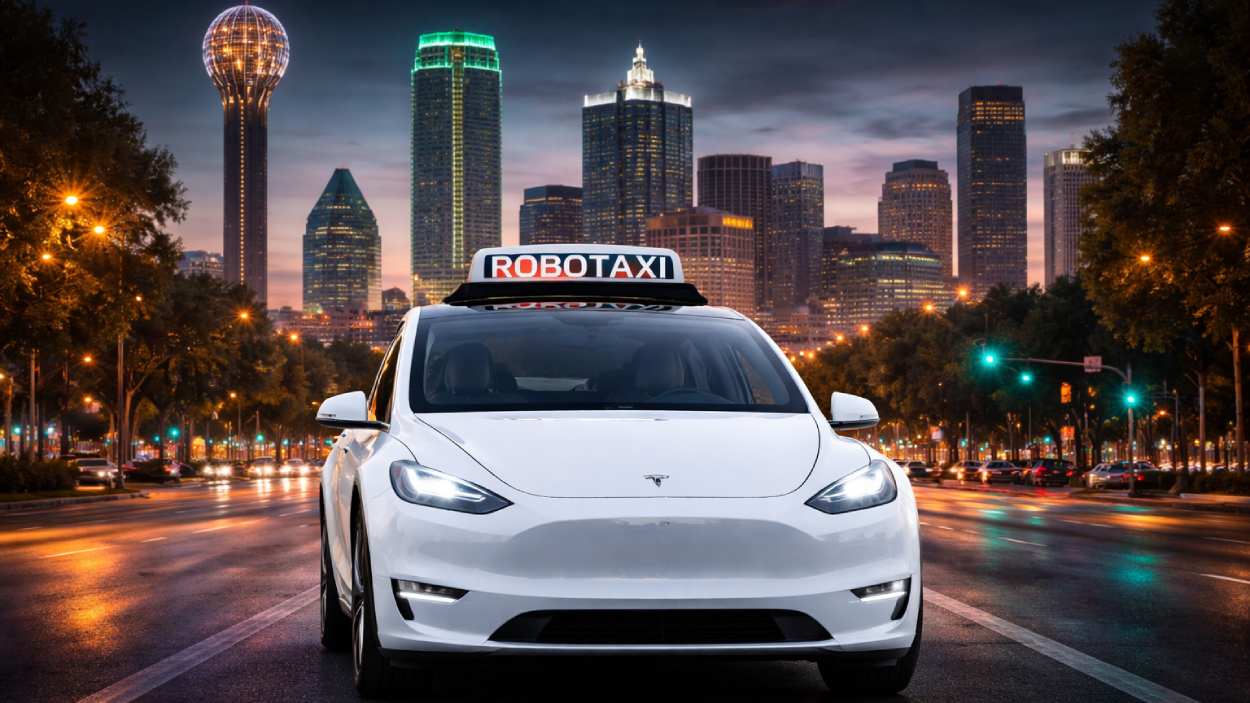
Tesla has expanded its robotaxi service to Dallas and Houston, marking a new phase in its push toward fully autonomous ride hailing.
Quick Summary – TLDR:
Tesla launches robotaxi service in Dallas and Houston, adding to its existing Austin operations.
Vehicles operate without drivers or front seat monitors, signaling confidence in Full Self Driving tech.
Initial fleet appears limited, with early data showing very few active vehicles.
Safety remains under scrutiny, with 14 crashes reported earlier in Austin operations.
What Happened?
Tesla announced the rollout of its robotaxi service in Dallas and Houston through a social media post, accompanied by short videos showing driverless vehicles on public roads. The move expands the company’s autonomous ride service to three major cities in Texas, following its earlier launch in Austin.
Robotaxi now rolling out in Dallas & Houston 🤠 pic.twitter.com/G3KFQwqGxB
— Tesla Robotaxi (@robotaxi) April 18, 2026
Expansion Across Texas Gains Momentum
Tesla is steadily building what looks like a Texas-based robotaxi network, starting with Austin and now extending to Dallas and Houston. The company first introduced the service in Austin last year and removed safety drivers completely in January 2026.
With this latest expansion, Tesla is focusing on scaling its autonomous ride hailing ambitions in a state that has been relatively open to self driving technology. Texas regulations currently allow companies to operate autonomous vehicles without requiring a human safety driver, which has made it a key testing ground.
The announcement itself was simple, but effective. Tesla shared a short video showing cars moving through city streets with empty front seats, reinforcing the idea that these vehicles are fully autonomous.
Fleet Size Starts Small in New Cities
Despite the big announcement, early signs suggest that Tesla is taking a measured and cautious approach in Dallas and Houston.
Crowdsourced tracking data shows only one active robotaxi in each city at launch.
In comparison, Austin has around 46 active vehicles already operating.
Tesla has not shared official numbers on fleet size or ride pricing.
This limited rollout indicates that Tesla is likely testing real world conditions before scaling up. Each city presents different challenges, from dense downtown traffic to sprawling suburban layouts.

Subscribe To Our Newsletter!
Be the first to get exclusive offers and the latest news.
Safety Record Remains a Key Focus
Tesla’s expansion comes at a time when autonomous vehicle safety is under close watch.
In a February 2026 filing, the company revealed that its robotaxis in Austin had been involved in 14 crashes since launch. While details about these incidents were not disclosed, such reporting is now part of regulatory requirements for autonomous vehicle operators.
This puts Tesla in a similar position to other players in the space, where real world testing often exposes edge cases and unexpected risks.
Competing Approaches in Autonomous Driving
Tesla’s robotaxi strategy stands out because of its camera-based system, which relies heavily on vision and artificial intelligence instead of combining multiple sensors like lidar and radar.
This approach is designed to:
Reduce costs and improve scalability.
Use existing Tesla vehicles like Model Y, Model 3, Model S, and Model X.
Integrate seamlessly with Tesla’s broader ecosystem.
At the same time, competitors are using more hardware heavy systems, which some experts argue may offer greater redundancy and safety in complex environments.
Real World Challenges in Dallas and Houston
Launching in Dallas and Houston introduces a new set of challenges for Tesla’s system.
Complex highway systems with fast moving traffic.
Sudden weather changes, including storms and extreme heat.
Wide urban sprawl, requiring efficient long distance navigation.
These cities will act as a stress test for Tesla’s Full Self Driving capabilities, especially as the company aims to prove that its system can handle diverse and unpredictable environments.
Public Trust and Adoption Will Decide the Future
Even with the technology in place, the biggest hurdle may be consumer trust.
Tesla is betting that using familiar vehicle designs, rather than futuristic pods, will make people more comfortable trying driverless rides. The visuals of empty driver seats are meant to normalize the idea, but real adoption will depend on:
Safety perception
Ride comfort and reliability
Pricing and availability
Elon Musk also amplified the launch by encouraging users to try the service, adding visibility and excitement around the rollout.
SQ Magazine Takeaway
I think this is one of Tesla’s boldest moves yet, but also one of its riskiest. Expanding into two major cities at once shows confidence, but the tiny fleet size tells a different story. It feels like Tesla is still in testing mode, just doing it in public.
If Tesla can prove that its system works reliably in places like Dallas and Houston, it could change how people think about transportation. But if safety concerns continue to surface, it could slow everything down. For now, this looks like a high stakes experiment happening in real time.