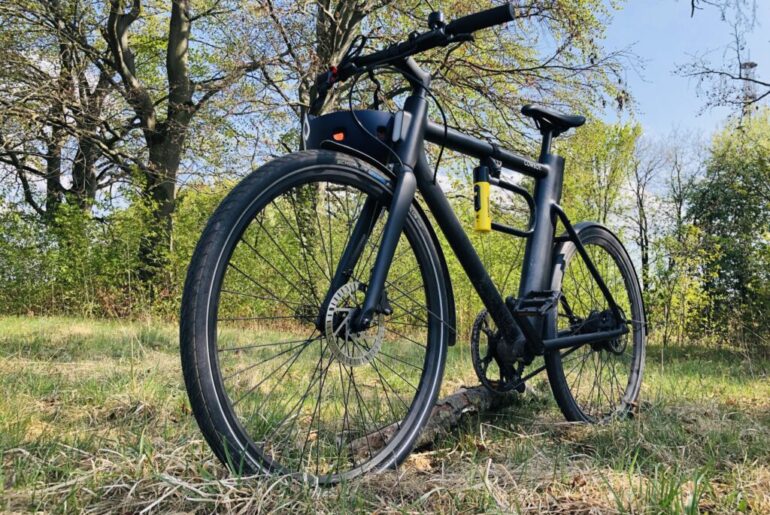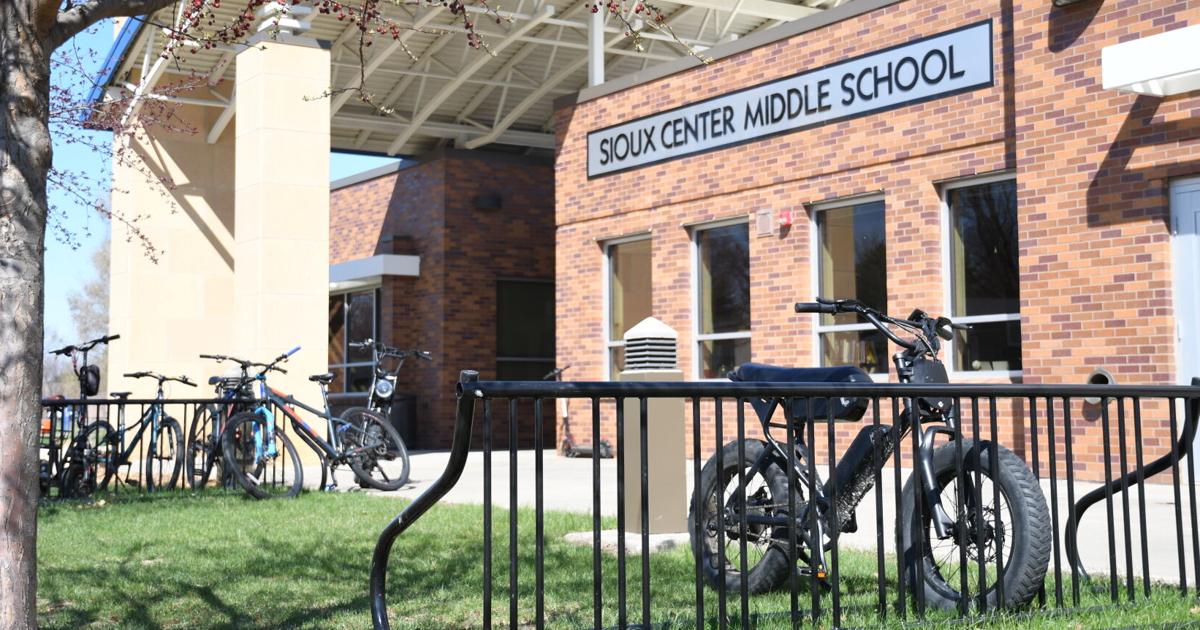
SIOUX CENTER—As the weather warms up, the sidewalks and recreation trail are getting busier, with the notable return of increasingly popular battery-operated scooters and bicycles.
For the young, these devices are a fun way to get around town, to be social and get to activities. Sioux Center Police Department is encouraging young riders to be safe and motorists to be aware of their surroundings, especially at street crossings and along the recreation trail.
According to Sioux Center Police Department school resource officer Kyle Munneke, he mainly sees students at the intermediate and middle school level adopting these e-scooters and e-bikes, as that’s the age when they’re more independent and capable of operating something with more power and speed but don’t yet have access to a car. But it also requires a level of maturity and responsibility to use properly, and for that, he’s taken time during the school year to talk with students about safely using these devices.
“During the school year last year, we had a conversation at the intermediate and middle school with students about safety and doing those types of things: watching for traffic, using the crosswalks, using the flashing lights, wearing a helmet, that mistakes on roads don’t always give you second chances. Just being very cautious,” Munneke said. “We’re looking at doing that again here before school is out to prepare our kids for summertime again.”
Police chief Josh Koedam added that the police department is aiding the city to create a document that will provide a comprehensive overview of the rules and regulations at the local and state levels regarding e-bikes, e-scooters and e-dirt bikes. The latter is a bit of a newcomer and adds another level of challenges in oversight when it comes to this selection of poorly understood battery-powered devices.
With an ever-increasing number of options available on the market, Koedam has taken to using the term e-everything.
“There’s just so much out there. It’s a challenge for us as law enforcement to keep up with the times as far as the newest and greatest things coming out with this e-stuff,” Koedam said. “We saw a lot of e-scooters, and now it’s transitioning into the e-bikes and now we’re seeing a transition from the e-bikes to the e-dirt bikes. We’re trying to navigate that, too, with what is allowed and what is not allowed in city limits.”
Regulations do vary depending on the device in question. A person using an e-scooter is still considered a pedestrian in most cases, but there are different classes of e-bikes with different definitions. A Class I e-bike has pedal assist and can travel up to 20 mph, a Class II e-bike has throttle assist and also can travel up to 20 mph but a Class III e-bike has pedal assist and can travel up to 28 mph.
“The thing with Class III is you have to be 16 years old or older to operate that. We are seeing people under that age operating those when they’re not allowed to,” Koedam said.
Relatedly, any bike with a battery above 750 watts is no longer considered an e-bike but a motor vehicle, which comes with similar restrictions.
When it comes to e-dirt bikes, those can be identified when the bike no longer has pedals but instead has pegs.
“It’s not a bike at that point but a motorcycle. So, you get above the 750 watts plus no pedals, it’s an e-dirt bike,” Koedam said.
E-dirt bikes can’t be used on a street like a motorcycle, though, since motorcycles are required to have mirrors, turn signals and be registered. Those are metrics that most e-dirt bikes fail to meet and mean that e-dirt bikes are quite restricted on where they can legally be operated. Mainly, an e-dirt bike will only be able to be used on private property or at off-road vehicle parks, which are regulated by the Iowa Department of Natural Resources. The latter option has its own set of requirements, however, such as 12-17-year-olds needing to obtain safety certificates.
All of this can put law enforcement in a tough spot where they have to inform families that their new e-dirt bike might not be usable in the city.
“I would remind parents to be mindful of what they’re allowing their child to operate. Take a look at what is regulated by the state, what is my child allowed to have on the streets and on the sidewalks,” Koedam said. “It’s important to be mindful of that before you go and purchase something for them and gift it to them and say, ‘Here you go, you can ride this.’ Just have an understanding and be educated about what is allowed and what is not allowed.”
Koedam said there is more legal clarity on handling e-bikes and e-scooters than there used to be, thanks to continuing conversations among different entities and municipalities.
“The Iowa League of Cities and law enforcement officers are having conversations with other agencies about what they’re doing in their jurisdictions, just trying to come together and determine how we’re going to address these issues. It’s not just Sioux Center, it’s all over the state,” Koedam said.
Beyond the legal aspects, the police department and the Sioux Center Parks Department ask that anyone operating these battery-powered devices remember to be courteous and cautious when using them on sidewalks or on the recreation trail. A little common sense and neighborliness goes a long way.
“The trails are used by everybody from little kids to older people, people with dogs and pets. Just being courteous of not flying by people, slowing down and saying, ‘Passing on your left,’ or, ‘Coming up behind you.’ Let people know you are there,” Munneke said, adding, “We have beautiful trails and want kids to use them and everybody to use them. So, if we can educate people on how to use them appropriately and responsibly, then everybody can enjoy our trails without having to have a harsh ordinance come out that bans things. We don’t want that. We want our trails used. We want people to enjoy them.”