
Living
MG now has a more complete HS line-up with mild hybrid and plug-in hybrid entries. Jack Yan tests the HS Essence Super Hybrid, and finds a far better balanced package—not to mention the appeal of electric power
Photographed by the author
The second-generation MG HS upped the style quotient but our chief complaint in early 2025 was that it was too soft. As it’s not a model offered in China, but an adaptation of the Roewe RX5, we concluded that the softness came from MG’s sister marque on the home market. Roewe was parent company’s SAIC’s back-up marque in case they weren’t able to secure the rights to the Rover trade mark when the British operation went bust two decades ago, and at that time it was the softer of the two. SAIC continued the distinction.
Our other complaint was that the HS only came as a petrol model for the New Zealand market, and we felt that MG should look to bring in both the mild hybrid and plug-in hybrid variants.
Either MG read our road test or it has read the writing on the wall, and done just that.
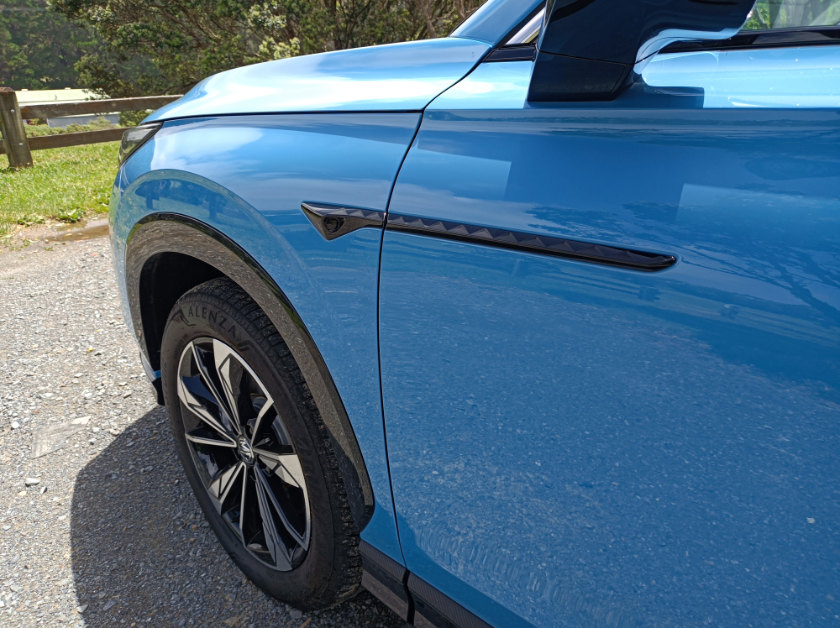
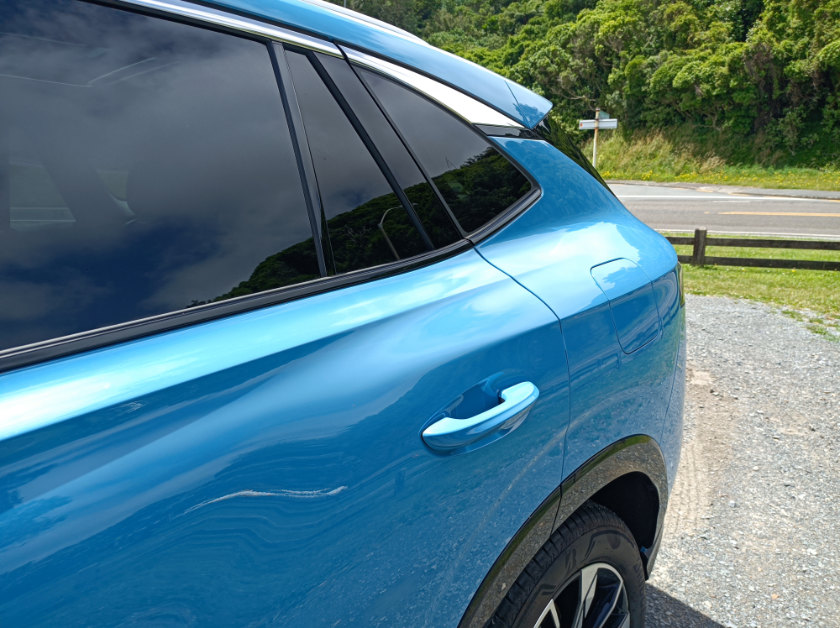
MG now has, complementing the petrol models, both the regular hybrid (Hybrid+ in MG parlance) with a 1·83 kWh battery, and the plug-in hybrid, or what it calls the Super Hybrid, with the 24·7 kWh battery and up to 120 km (WLTP) of electric-only driving. The latter is identifiable by two flaps on the rear wings, one on each side: one for fuel and one for power.
While price-wise, they begin where the regular petrol range ends (the Excite Hybrid+ starts at NZ$44,990, while our top-of-the-range Essence Super Hybrid starts at NZ$56,990), they still present strong value, especially with their size.
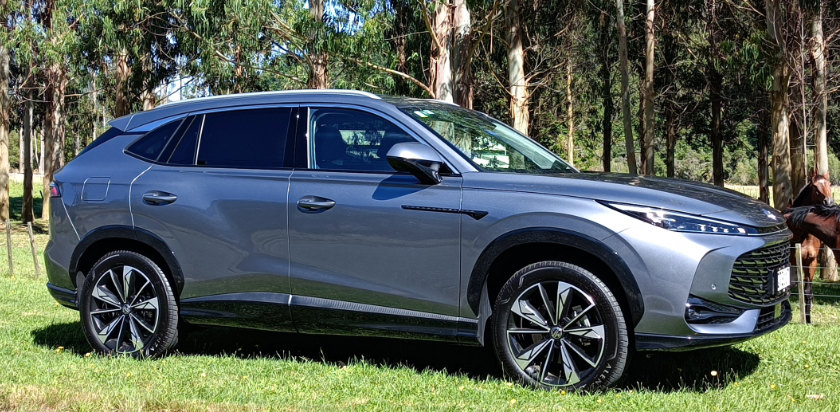
It’s the same body as the HS tested earlier, which means a comfortable size up on the first-generation HS, and it’s far more cohesive to our eyes than a comparable Toyota RAV4, not to mention better priced. The jewelled grille—definitely part of the Chinese æsthetic—adds a premium look. The high waistline gives it confidence and presence, not to mention an impression of solidity. We can’t believe the floating roof is still with us in SUV design—this seems to be one trend that won’t go away, despite a decade with us on various models. Having said that, it’s nicely integrated into the lines. The blue finish on our test car works well, as if to convey its environmental credentials, though we think a more sapphire-like shade would be in keeping with the HS’s confident looks. Longer, lower and wider than the previous HS, you notice how well it sits on the road compared to its predecessor, with a more planted appearance. The contours and lines along the sides give the HS a boost compared to so many of its rivals. This is a stylish proposition, one that looks good in the driveway to impress the neighbours.
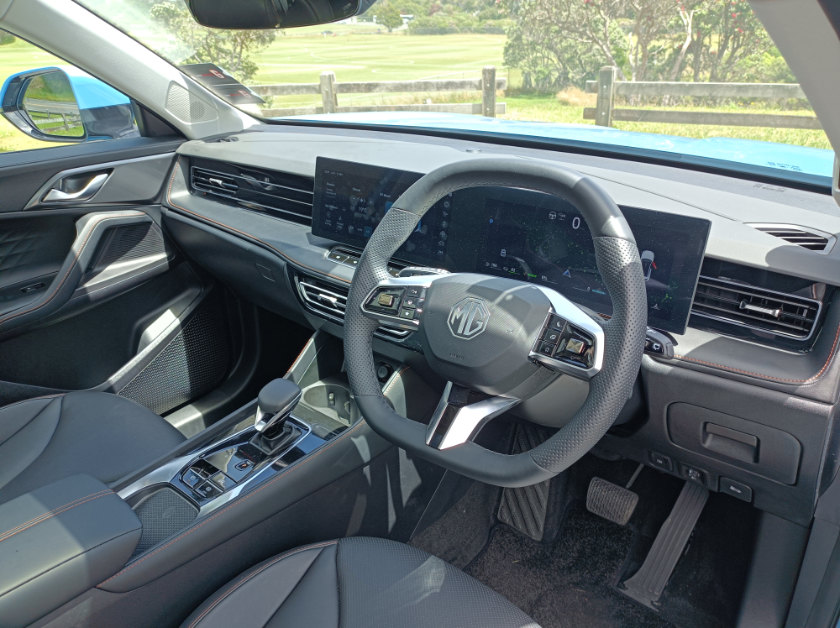
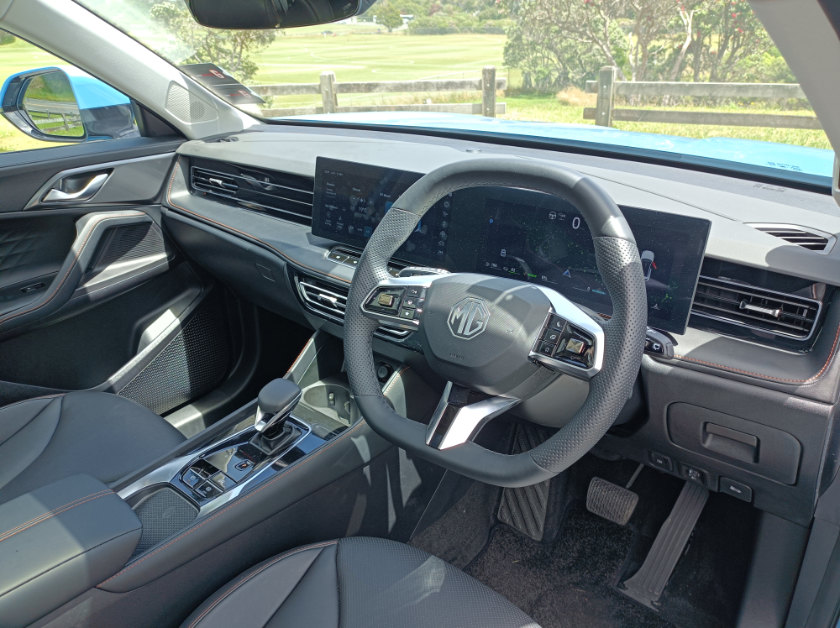
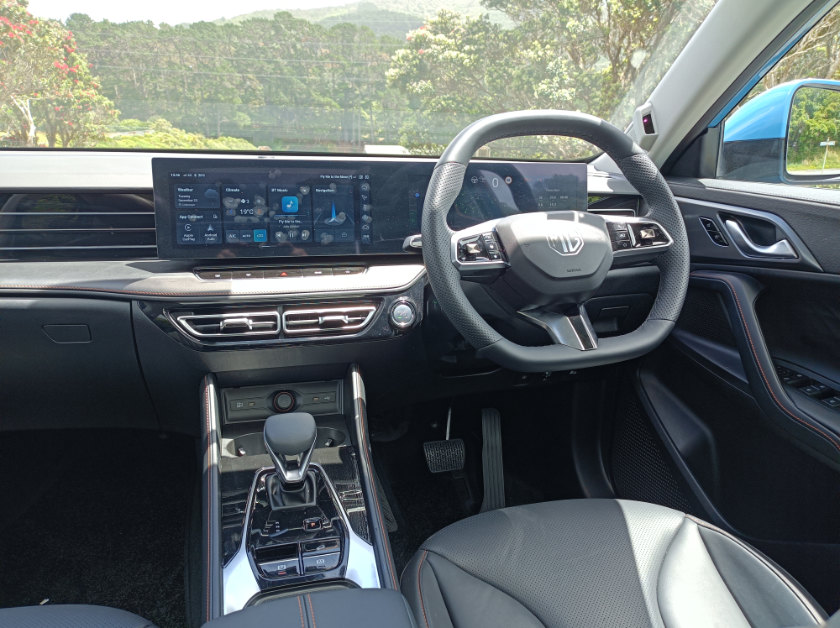
Inside, the good news continues: a six-way electric adjustable seat for the driver, four way for the passenger, both with lumbar support. There are two 12·3 in screens, one for the central unit and another for the dashboard, which both display sharply even under sunlight. As with the regular HS, there’s red stitching that lifts the ambience and conveys some sporting cred. The one disappointment has to be the typography, with MG making no effort on the speedometer to go beyond defaults. It seems a silly thing to skimp on, given that other models get this right, and Arial smacks of those early days of the MG 6, when the company was still finding its feet after the operation found itself out east.
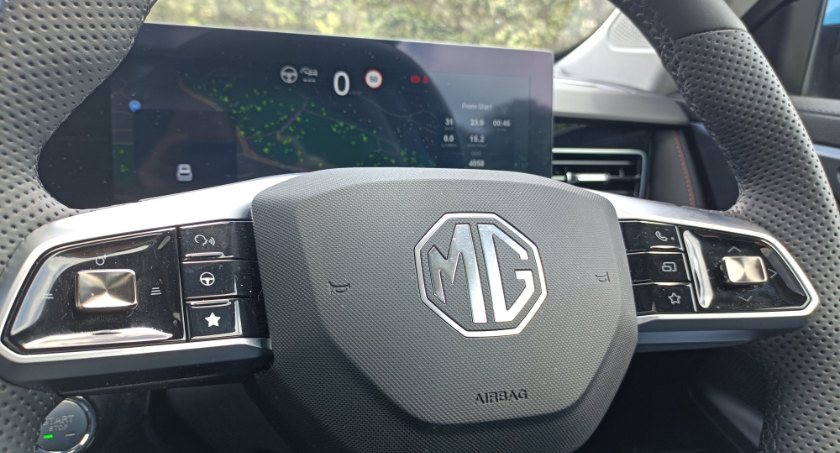
Similarly, the central infotainment unit is familiar territory. We’re used to it by now and it offers few surprises. For the most part, we can find out way around, but we hope MG ups the ante soon and borrows some of the flasher graphics and tech from its Zhiji brand, a.k.a. the IM sub-range, which we’ll come to shortly in Lucire. The steering wheel controls are also familiar and take little time to get used to.
continued below
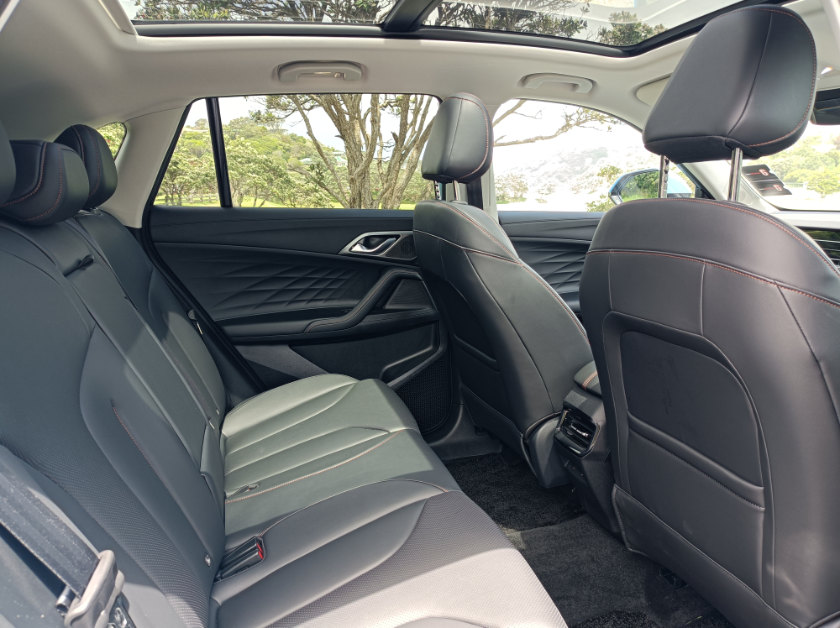
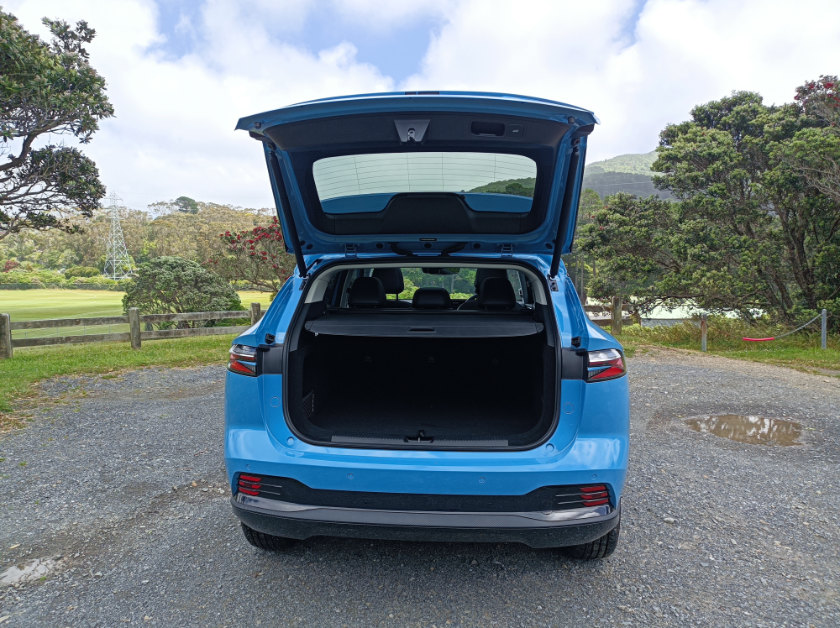
There is decent accommodation front and rear, and MG quotes a boot volume of 507 ℓ with the seats up, and 1,484 ℓ with the rear seats down, more than enough for the mostly urban use that the HS is likely to see.
The shallower window area from that higher waistline, doesn’t make for a darker cabin, since the panoramic sunroof lets in plenty of light. The usual mod-cons are there with the MG Pilot safety suite: 360-degree camera, parking sensors front and rear, warnings about speed limits and lane-keeping, as well as a driver fatigue monitor. The warnings can be turned down—we learned this from the previous HS—as the driver fatigue monitor, in particular, may be overly sensitive.
The cabin feels like a premium place to be, and while the leather-feeling material on the seats is PVC, everything fits well and you can find an ideal seating position.
It’s on the road that the HS Super Hybrid shines. We feared that we would be confronted with another soft HS, but we needn’t have feared. Maybe it’s the extra 265 kg of the hybrid system, but the suspension feels tauter and the car is better planted. And so it should: MacPherson struts at front and multi-link at rear, there’s little excuse. We wouldn’t say this was the best handling crossover ever, but it is competent and comfortable, and the steering response, body roll and road behaviour are where the HS should have been to begin with.
You also don’t lose anything in ride comfort: the Super Hybrid can be a cruiser, capable of taking on the long journeys without any range anxiety.
All the HSs on this market are equipped with a 1·5 turbo, but with the Super Hybrid, you actually lose 20 kW on power, possibly as a fuel-saving measure. This brings the petrol power down to 105 kW. It’s more than made up by the electric motor with 154 kW on tap; when combined, the HS Super Hybrid offers 220 kW. Torque is similarly down when comparing just the petrol units (275 Nm v. 230 Nm), but once you add the electric motor with 340 Nm, you are more than compensated for—MG quotes a total of 350 Nm.
In practice, it works well: you don’t notice the hybrid system working at all—it’s seamless—and the vehicle propels itself with much the same urgency, except you know your fuel consumption has gone from 6·9 ℓ/100 km for the petrol model to 0·7 ℓ/100 km, and you’ve emitted only 17 g/km of carbon dioxide.
It’s that feeling of having 120 km of electric-only range that makes so much sense in the mid-2020s when the daily news is about the Hormuz Strait, and the world faces down another 1970s-style fuel crisis. Except this time it’s not small Datsuns and Toyotas that people will shift to. They’ll be looking for electrified options, where MG—unlike many other manufacturers—hasn’t been caught with its pants down. It has hybrid and EV models at the ready, all with sensible pricing, and this is one of the smartest. •
Jack Yan is founder and publisher of Lucire.
Related articles hand-picked by our editors
Softly softly task force
MG’s new-generation HS has imposing looks and more bulk, aiming at the heart of the C-segment crossover market. Jack Yan examines if it hits the target
Photographed by the author
Relax, it’s the MG QS
MG’s SUV flagship is the seven-seat QS, née Roewe RX9, which makes a strong argument given both its interior appointments and its price, writes Jack Yan
Best of both worlds
Not ready to go full EV? MG’s plug-in hybrid, the HS Plus EV, is a very convincing C-segment crossover that blends the best of both worlds, writes Jack Yan
Photographed by the author