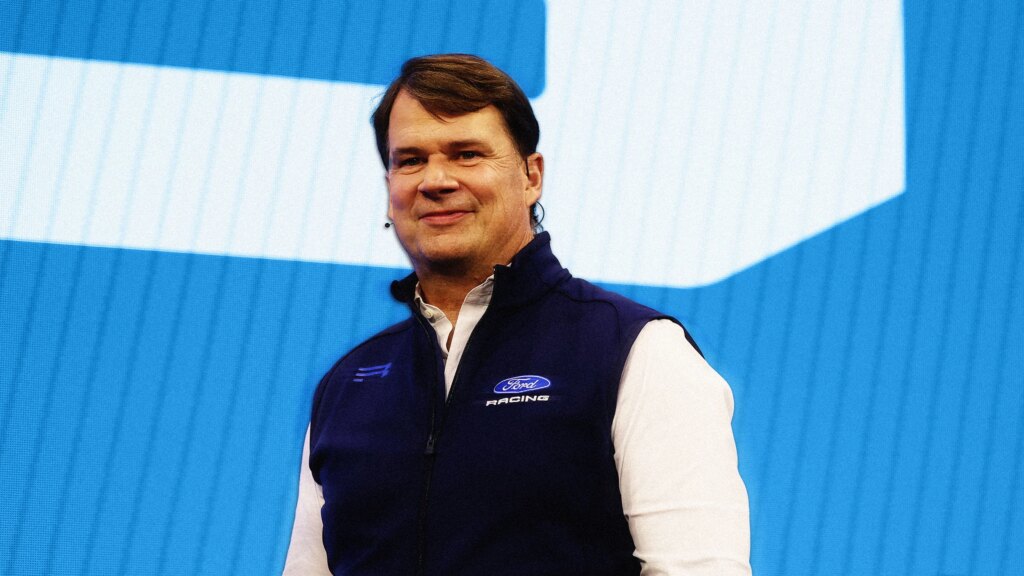
With the Strait of Hormuz in crisis and gas prices surging, few executives are feeling the pressure more acutely than Ford Motor Co. CEO Jim Farley. He gives a candid account of what the turmoil means for the auto industry, and for an iconic American brand navigating one of the most turbulent moments in its history. Plus, Farley gets frank about the China threat reshaping the global auto business, and his frustration with Ford’s own ingenuity.
This is an abridged transcript of an interview from Rapid Response, hosted by former Fast Company editor-in-chief Robert Safian. From the team behind the Masters of Scale podcast, Rapid Response features candid conversations with today’s top business leaders navigating real-time challenges. Subscribe to Rapid Response wherever you get your podcasts to ensure you never miss an episode.
The big question mark looming over everything right now is the activity around Iran and the Middle East, what happens with the Strait of Hormuz, and oil prices. You’re on the front lines of all that impact in your business. What are you seeing? What are you feeling? Are there any strategic adjustments you’re making?
It’s been an interesting couple of weeks. It’s very asymmetric around the world. Ford is still a global company. A lot of our North American competitors have left Europe. We’re the biggest pickup truck maker in the world, in Thailand and Australia—these are huge pickup markets—even China now. And we face off with Chinese companies in all these markets. Two things are happening while this war is going on. In the first quarter, the Chinese market, which is a third of all new vehicles sold on the planet, was down almost 30%. And they’re already the largest exporter in the world, far beyond the Japanese and South Koreans. Their exports are up 43% this year, and they are already No. 1. So the war is happening, and the electrification in the first quarter is happening. Of course, fuel price is way up. In places like Australia, where they get a lot of the oil through the straits, they’re out of fuel.
Most companies are asking people to stay at home. Many provinces are giving away free transportation because you just can’t get fuel. In places like the Middle East, the business has completely stopped. And that’s very important for logistics. Commodity costs have gone up—not just oil, but all commodity costs have gone up. So we have to adjust to the higher cost level. But I would say what we’ve really learned is that electric cars are very vibrant. Prices have gone up almost $10,000 in the U.S. for electric cars, and electric cars are now up to 7% of the U.S. industry. That’s not a small amount, with no government support. But what’s selling in EVs is more important, which is that the truly affordable EVs are more popular. Used EVs are super popular right now. So the market has changed. I like to look at the used market even more than the new market to understand what consumers’ mindset is, and they’re more interested in hybrids.
Late last year, you announced some scaling back on some of your electric vehicle production. Do these changes and the surge in pump prices make you rethink any of that, or is what you’re seeing the same in the marketplace that you were reacting to?
Thank you for asking this question. Everything that we’ve seen with escalating fuel prices in the U.S. is reinforcing our choices. Not because I’m the CEO of Ford and we’re always right. It’s because we moved first among all the competitors—before Toyota, before GM, before all the traditional OEMs [original equipment manufacturers]. We were No. 2 to Tesla for three or four years in EVs. We moved really fast, but these were designed the wrong way, let’s put it that way. So they lost a lot of money. But we got to see how customers choose. And we also came out with the hybrid F-150, America’s best-selling truck. We hybridized it before Ram, and they still don’t even have a hybrid. So we got to learn, Bob, before any of our competitors, where the EV market was already going. And with the escalated fuel price, it’s only reinforced it.