
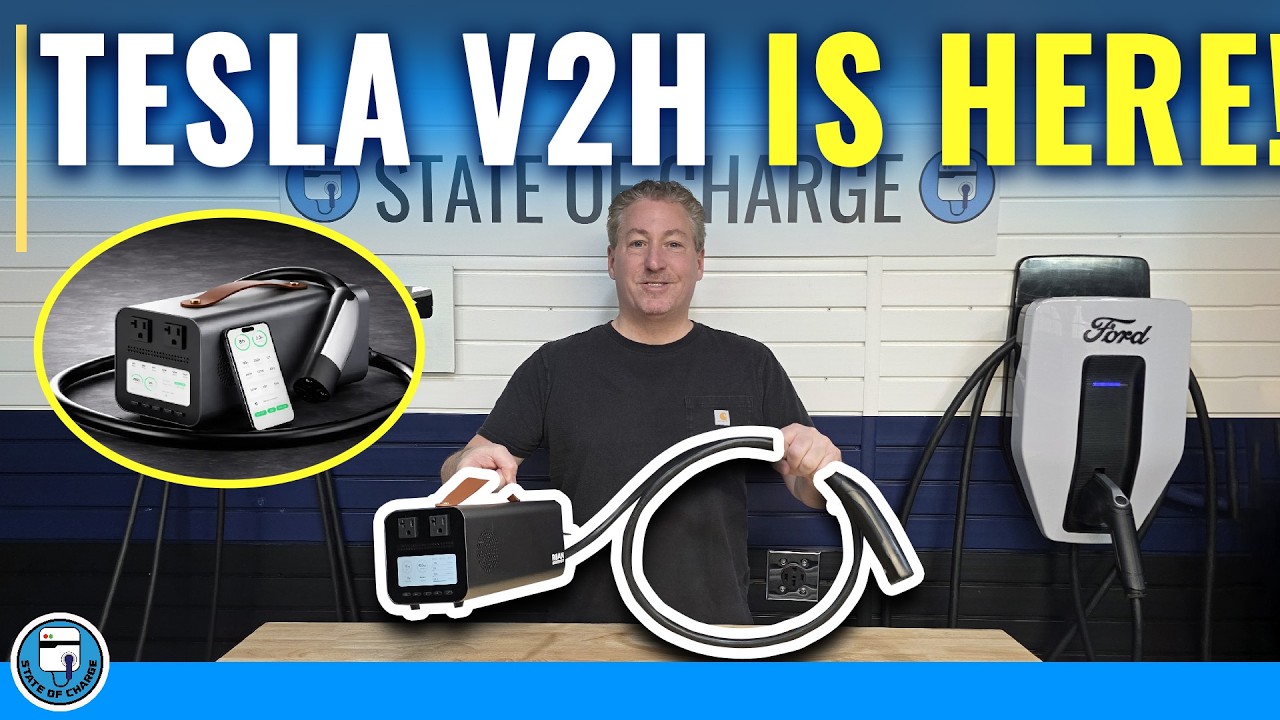
RoamEnergy introduced the PowerBridge Pro, the second generation of its power export device for Tesla EVs, which can deliver up to 7.5 kW of power. It’s now on Kickstarter, with a market launch coming soon (the first batch ships in August 2026).
State Of Charge had an opportunity to demonstrate the first generation in 2025 (currently renamed from Discharger to PowerBridge Standard). However, the initial Vehicle-to-Load (V2L) device was limited to 3.5 kW (from two 120-volt NEMA 5-15 outlets).
The new PowerBridge Pro is highly improved, as it can handle higher voltage (240 volts) and doubles the power. Additionally, it features a larger display and an easier way to recharge the internal battery. Let’s take a look.
RoamEnergy PowerBridge Pro
What It Is
The RoamEnergy PowerBridge Pro is essentially an inverter that converts DC electricity into AC electricity. It has been designed to export power from Tesla EVs (the vehicle’s main traction battery), through the charging port, to ordinary electric outlets. We can call it a Vehicle-to-Load (V2L) device with a potential for Vehicle-to-Home (V2H) application.
Just like the first generation, the new PowerBridge Pro works solely with Tesla EVs that support the CCS charging protocol — usually, 2021 or newer Tesla EVs (older ones might require a retrofit). One can check compatibility by entering Vehicle settings / Software, then selecting “Additional Vehicle Information,” to see whether “CCS and 3rd-party NACS DC charging Enabled” is enabled, as Tom shows at 29:00. Other EVs are not compatible.
The North American version of the RoamEnergy PowerBridge features a charging cable with a NACS connector on the input side. On the output side, there are two 120-volt AC outlets (NEMA 5-20), which can supply a total of 3,500 watts (3.5 kW) with a current limit of approximately 29 amps (up to 20 amps or about 2.4 kW from a single outlet).
Additionally, there is a NEMA 14-50 outlet that can deliver up to 7.5 kW (32 amps at 240 volts). That’s a huge upgrade compared to the first generation.

RoamEnergy PowerBridge Pro: Key Features (Image credit: State Of Charge)
The RoamEnergy PowerBridge Pro has its own battery. If it runs out, it must be recharged via the rear USB port. That’s an upgrade compared to the PowerBridge Standard, which required a 12-volt cigarette lighter plug for that.
In case of any troubles, the device is equipped with a microSD card reader and a card. If the device encounters a charging issue, it records the error information on the microSD card. As far as we know, the file can then be sent to the manufacturer.
There is also an Ethernet port in the back for software updates. It may be needed in the future if Tesla’s software updates affect the power export.
The device is not safety-certified yet, but the manufacturer promises it will be safety-certified once it hits the market. Its operating temperature is 14-104°F (-10°C to 40°C). It’s important to note that it’s not water-resistant.
The PowerBridge Pro also has a mobile app (currently only for iOS, with an Android version coming) that enables output monitoring and settings via Bluetooth.
Different Regional Versions
Depending on the exact market, there will be slightly different versions with different electric outlets:
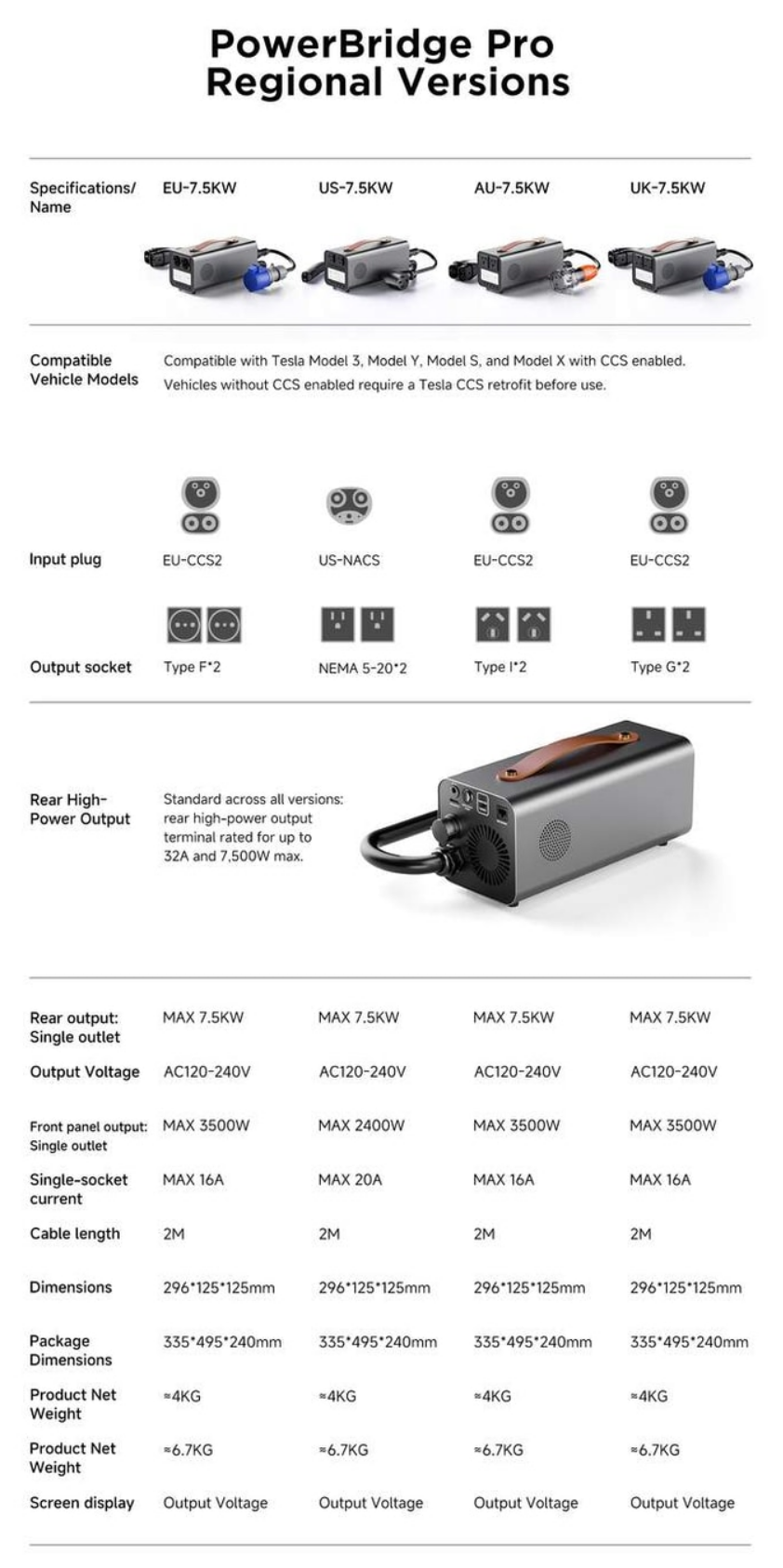
RoamEnergy PowerBridge Pro: Regional Versions (Image credit: RoamEnergy)
How It Works
Most of the Tesla EVs do not offer Vehicle-to-Load (V2L). The primary exceptions are the Tesla Cybertruck and the new Tesla Model Y Performance version (at least in some markets), which have a factory V2L option.
To add the power export feature to Tesla EVs, RoamEnergy developed a special solution. As far as we understand, when connected to the charging port, the device communicates with the car using the CCS charging protocol. It tricks the vehicle into thinking it will DC fast charge to access the battery pack.
There is a side-effect. The car thinks it will get a DC fast charge, triggering its battery thermal management system (TMS). It makes some noise and probably wastes some energy on preparing the battery’s optimal temperature for fast charging. At that point, the device is ready to draw power from the battery. The user can connect loads to the outlets.
RoamEnergy prepared settings of a minimum state of charge (SOC), which can be changed with a 5 percent point granularity. This prevents the car’s battery from discharging below the desired level and leaving the car stranded.
Tests
NEMA 5-20: 120 V
The first tests by State Of Charge focused on the two 120-volt outlets at the front. Our very own Tom Moloughney initially tested the RoamEnergy PowerBridge Pro with a heater, which, according to the device’s display, was getting 1.5 kW (12-13 amps).
Additionally, Tom connected an oven, increasing the total output to 3.4-3.6 kW (29-30 amps) from the two outlets. The test was successful.
NEMA 14-50: 240 V
The second, more important test was with the rear 240-volt NEMA 14-50 outlet. To use it, Tom first had to switch the settings to 240 volts. It’s a tricky moment, because the same voltage is also in the 120-volt outlets (it would be great if these outlets were somehow disabled in this mode).
* The tested demo device had several voltage options (230-340 volts) for various markets. The final production version is expected to be slightly different.
Once everything was set, Tom used the PowerBridge Pro to supply power to a portable EVSE and charge a Ford F-150 Lightning. According to the display, the device was running at 6.5 kW (28 amps), although the vehicle reported getting 5.7 kW.
Regardless of the exact value (net or total), this test was also successful over roughly 40 minutes and demonstrated a power export of roughly 6 kW, which is a substantial level. One could use it for various devices, charge a stranded EV, or even try to survive a household power outage for a day or two.
Tom decided to run an additional test with a 40-amp plug-in charging station (a load of up to 9.6 kW, exceeding the 7.5 kW spec). It was not supposed to work, and it didn’t. In this case, the device barely started, and the power output quickly stopped, with the red light on the charging station blinking. At least we know that nothing bad happened.
Price and Availability
The RoamEnergy PowerBridge Pro is now on Kickstarter. It’s expected to enter production in June 2026 (mass production in July), and the first batch will be ready for shipping in August 2026.
The regular price is $2,499, but the device can be pre-ordered with a $900 incentive for $1,599.
Once the Kickstarter campaign ends, there will still be a way to purchase the PowerBridge Pro at a discount. According to the video, applying the TOMPRO coupon code gets $700 off, bringing the cost to $1,799.
Meanwhile, a separate TOM999 coupon code can lower the price of the PowerBridge Standard to $999 (by $200-$300, depending on the current price).
Video timestamps:
03:03 Unboxing
08:53 Comparing The PowerBridge Pro to the PowerBridge Standard
11:05 The RoamEnergy PowerBridge Pro key features
12:59 120 volt test
19:48 240 volt test and setting the correct voltage
25:04 Overdrawing the PowerBridge’s power output
27:07 Setting the vehicle’s state of charge shutoff point
29:00 What Tesla vehicles are compatible with the PowerBridge?
30:55 The PowerBridge Pro app
33:26 Safety certification
36:45 How to order the PowerBridge
38:17 Save $700 with the “TOMPRO” discount code