
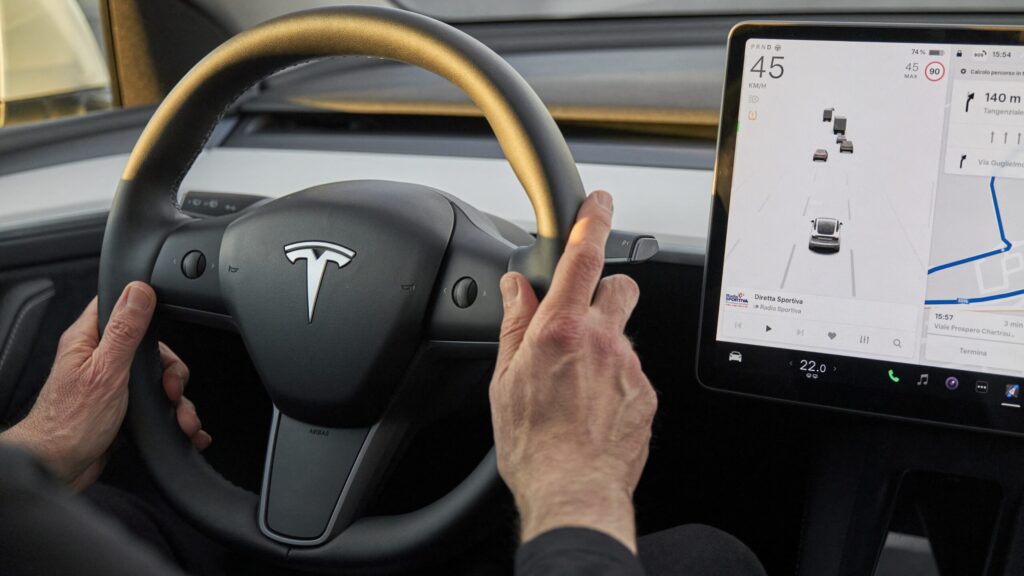
Dutch regulators have approved the use of Tesla’s self-driving software with required human supervision on highways and city streets, marking a European first for the electric car maker and potentially paving the way for wider adoption across the European Union.
The technology, known as Full Self-Driving Supervised (FSD), can steer, brake and accelerate a vehicle, but still requires an attentive driver behind the wheel. The approval follows more than 18 months of testing and analysis by the Dutch vehicle authority, the RDW.
‘Proper use of this driver assistance system makes a positive contribution to road safety,’ the regulator said in a statement, adding that it would now submit an application for the system to be authorized across the EU.
The decision represents a significant step for Tesla, whose long-term strategy relies heavily on the widespread adoption of autonomous driving technology. Much of the company’s valuation is tied to CEO Elon Musk’s vision that artificial intelligence-powered self-driving systems and robotaxis will become a major source of revenue.
Tesla is also hoping the rollout of FSD will help boost vehicle sales in Europe, where demand has slowed amid an ageing model lineup and controversy surrounding Musk’s political statements. The company recorded its first monthly sales increase in over a year in February, raising expectations that new technology offerings could further support growth.
Tesla said it plans to begin rolling out the technology in the Netherlands shortly, with further European expansion expected in the near future.
The software is already available to drivers in the United States through a subscription model, although it remains under scrutiny there. US regulators have launched investigations and lawsuits have been filed following accidents and reports of traffic violations involving the system.
According to the RDW, the European Union applies stricter safety standards for vehicle approvals than the United States, meaning the EU version of FSD differs from its American counterpart, though specific technical differences were not disclosed.
Tesla is currently the most popular electric vehicle brand in the Netherlands, with around 100,000 Model 3 and Model Y cars eligible to receive the software update.
While several automakers are developing self-driving technologies, most rely on a combination of sensors, including radar and lidar, to monitor the driving environment. Tesla, by contrast, primarily uses camera-based systems supported by artificial intelligence.
Other manufacturers such as Mercedes-Benz, Ford, and BMW have introduced limited ‘hands-free’ driving features on select highways, mainly in Germany. Tesla’s system is the first in Europe to be approved for use across a broader range of driving conditions.
The Dutch authority will now forward its approval to the European Commission, where member states will vote on whether to extend authorization across the bloc. A majority decision is required for EU-wide implementation, although individual countries may still choose to permit the system independently if consensus is not reached.
Tesla has previously indicated that it expects a broader European approval decision as early as this summer.
Related articles: