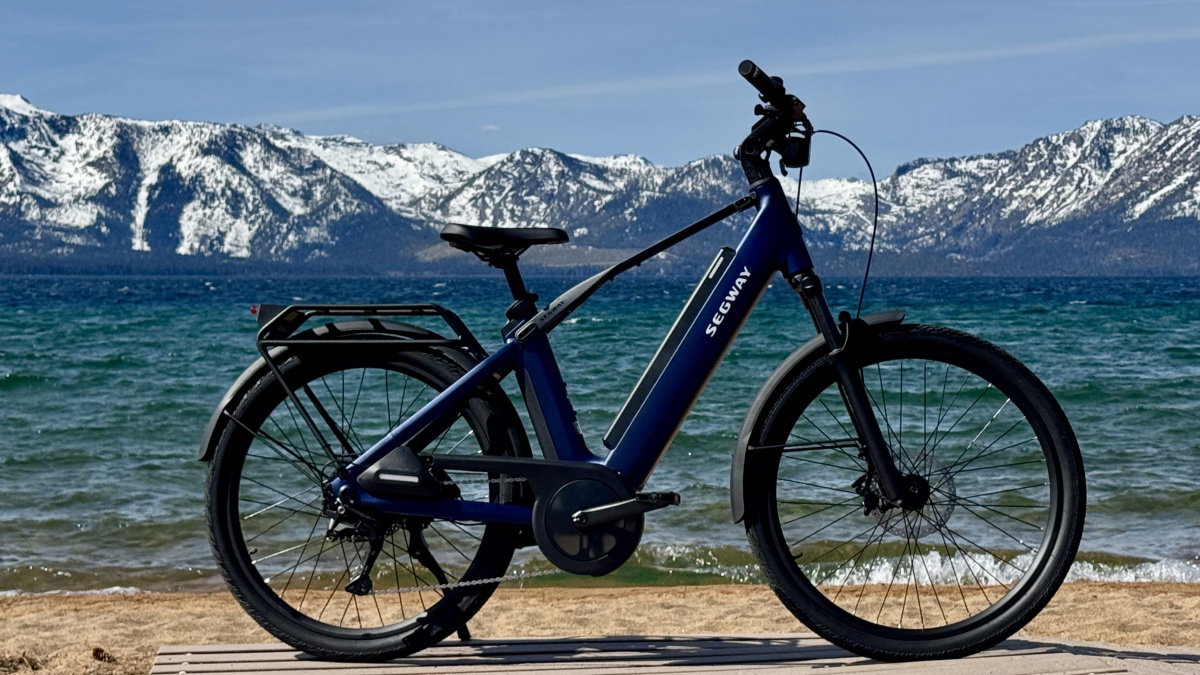
Segway has had a couple of tremendous successes in the e-bike market since debuting last year with the Xafari and Xyber. They are no strangers to micro-mobility, and the fresh perspective they bring to the ebike market has spurred innovation that drives competition. The Myon is a more conventional-looking electric bike, but it’s anything but conventional.

High-tech and highly customizable, the bike is shown here with the optional top tube installed. Credit: Joshua Hutchens
The experience of purchasing the Segway Myon serves as a clear case study of the trade-offs inherent in a dealer-exclusive distribution model for a brand still establishing its footprint. While Segway is a dominant force in tech, its bicycle-specific dealer network remains relatively sparse compared to industry veterans. This creates a disconnect where the initial convenience of a seamless online ordering process is quickly overshadowed by the logistical hurdle of reaching a physical storefront, which for many riders requires a significant time investment and a long-distance commute.
The Myon’s rack supports the paniers below the top deck, leaving the top open for other accessories.
The true value and the primary frustration of this model became evident during the delivery of our bike. Despite the promise of a professional hand-off, the bike arrived with active error codes and critical malfunctions in both the throttle and rear braking system that weren’t discovered until we were geared up and ready for the first ride. This scenario highlights the dealer’s unique role as an essential advocate: because the bike was purchased through an authorized shop, the staff took on the burden of navigating Segway’s support channels and performing the technical repairs themselves.

One of our first rides on the Myon was in the rain; we appreciated having fenders already installed, and the tires did a great job of evacuating water with their inverted tread. Credit: Joshua Hutchens
However, this professional safety net comes with a hidden “time tax” that can sour the initial ownership experience. While the dealer successfully resolved the faulty components, the process caused a 10-day delay and several hours of additional driving before the Myon was actually road-ready. Ultimately, this purchase illustrates that while a shop-supported brand offers a level of accountability that direct-to-consumer models often lack, that security is only as convenient as the proximity of your nearest authorized mechanic.

Conjuring images of simple Dutch bikes, the Myon blends old-school looks with fancy new technology. Credit: Joshua Hutchens
Once out on the road, we found the Myon fun to ride and more capable than its specs would suggest. The handlebar controls are unique; they’re high-tech and cool looking, but intuitive, they are not. We struggled to find the right buttons and ended up using the turn signals when we wanted more power and inadvertently shifting gears a few times.
The reinvented handlebar controls created a bit of a learning curve for our veteran bike testers.
The Myon offers a neutral, stable ride quality that won’t catch anyone off guard. With a headtube angle of 68.5 degrees, the bike is well-suited for urban commutes or leisurely rides on the bike path. Bumps in the road are dampened by the 80mm suspension fork, but the 1.95″ wide tires don’t provide as much comfort as wider tires that are more common on similar bikes. The narrow tires are a trade-off that improves the bike’s range but also limits its versatility; they are less than ideal on dirt or gravel.

The inverted tread on these 1.95″ tires is great for smooth pavement and riding in wet conditions. Credit: Joshua Hutchens
The bike’s geometry gives you a fairly upright riding position with good visibility and not too much weight on your hands. An adjustable-angle stem lets you trade some of the cockpit length for a bit more rise.

There is a fair amount of adjustability in the stem, allowing you to trade reach for height. Credit: Joshua Hutchens
The handlebars have a familiar shape but unique grips, with turn signals on the ends. This is excellent for visibility, but it feels strange that you’re not holding onto the handlebars at the ends while riding.

The Myon’s cockpit offers a lot of functionality while retaining a fairly neat, clean look. Credit: Joshua Hutchens
Whether using the pedal assist or the throttle, the power assist the Myon provides is remarkably smooth; the power never feels choppy or abrupt, and the bike is anything but underpowered. When we encountered steep hills, the bike seemed to tap into a secret reserve of power. That “secret reserve” is the bike’s numerous sensors, which detect a steep grade and provide the rider with significant additional power. If Segway had made the power available full-time, the bike might feel overpowered and have less range, so this is a fascinating application of technology.

Most of the drivetrain is hidden behind the chainguard here, ensuring that you won’t have greasy, ripped pant legs when you arrive. There are also some fancy sensors stashed within the bike that give it impressive performance. Credit: Joshua Hutchens
The Myon is available in exactly one size, but Segway has done something odd with the frame design. Instead of making a step-through or step-over design, they made it both. A unique “bolt-on” top tube lets you achieve the dual-triangle aesthetic some riders prefer. We purchased the top-tube separately and rode the bike with and without the attachment.

Three bolts up front and four in the rear give the bike a top tube, but it has no functional purpose. Credit: Joshua Hutchens
Our testers overwhelmingly preferred the convenience of the step-through design, and none of us noticed any performance difference or increased rigidity. This modular part is a big win for manufacturing and reduced inventory, but it has minimal functional appeal. On some traditional bikes, the top tube gives you a convenient spot to lift the bike, but this top tube specifically warns you against using it to lift the bike. We generally recommend that people buy step-through bikes when they’re available, as they’re far easier to mount and dismount, but the step-over aesthetic may win some people over. The removable top tube has mounts for an additional water bottle or accessory, so if you’re planning to load the bike down with gear, the accessory might be helpful.

“Do not lift the bike by the top tube.” If it isn’t useful, why bother having one? Credit: Joshua Hutchens
The Myon has a step-over height of 19″, and with the added top tube, it is 31″. Segway makes no claims about which riders will fit the bike, but it lists a 300-pound weight limit. Our testers ranged from 5’2″ with short legs to 6’2″ with long legs. Our smallest tester was able to ride the bike without the top tube, and the seat and handlebars were at their lowest positions. Our tallest tester didn’t get full leg extension when the seatpost was at its maximum height, but had no complaints about the fit of the bike. The seatpost can be adjusted by 14cm, which isn’t much considering the bike is only available in one size.

Just under 6″ of adjustability in the seat mast doesn’t give the Myon the broadest fit range. Credit: Joshua Hutchens
We rode the bike rain or shine, and plenty of times headed out after dark. We found the dual front lights adequate for riding at night, with the larger lamp outputting 600 lumens, which was sufficient on the darkest paths.

The dual headlight provides visibility to be seen, but more crucially, the illumination to see the road ahead. Credit: Joshua Hutchens
Lightweight polycarbonate fenders kept our testers dry and, importantly, didn’t make much noise when the tires kicked up sand or pebbles.
The rear light sits at the rear of the rack and provides wide visibility. We purchased the optional Rearview Radar with our Myon, which uses millimeter-wave radar to scan the area behind you and warn of approaching vehicles. When we first used radar on the Rad Power RadRunner MAX, we were dubious about its benefits; it seemed like a bizarre, maybe useless, addition to a bike, but we were quickly sold on the feature.

The device under the tail light is the bike’s optional radar. Credit: Joshua Hutchens
We found the radar on the Myon less impressive for a few reasons. It’s not nearly as sensitive as Rad Power radar and occasionally misses approaching vehicles, which leads to mistrust and a lingering need to look over our shoulder. The bike notifies you by illuminating tiny lights inside the handlebar controls. It’s a slick integration of technology, but we often didn’t notice the lights or couldn’t see them in bright light.

Do you see it? Just to the right of the bell on the right side of the handlebars is an illuminated yellow light. That indicates a vehicle is approaching from the rear on the right. Credit: Joshua Hutchens
Real-World Range Test Results, How far does the Segway Myon actually go?
The Myon uses a 722Wh UL-Certified battery that stows in the top side of the bike’s downtube. While that’s a smaller pack than the one in the Xafari, the Myon also weighs less and uses a lower-power motor. We set out to test the Myon using its throttle at full power setting. The result was impressive: the Myon covered 36.1 miles while conquering over 1,300 feet of elevation gain.
Segway claims the Myon has an 80-mile range, and we won’t dispute that, but in order to get that kind of mileage from a single charge, you’ll likely need to be adding quite a bit of leg power and riding on flat ground.
The Myon provided a unique test case for us. When we put the bike on the dynamometer, it put out a modest 584 watts, far less than you would expect from Segway’s 500-watt motor. The torque figures of just under 25 Nm were also significantly lower than we expected. We tested the bike a second time and got identical results, yet it delivers far more power and torque than these numbers suggest. In addition to torque and cadence sensors, the bike also has gyro sensors and an inertial measurement unit. So, even when using the throttle, it knows how fast you’re going (not just from wheel speed), whether you’re going uphill or downhill, and what kind of resistance the bike is facing. It analyzes all input data in real time for a smooth, natural feel, providing more power when you need it and less when you don’t. In simple terms, the bike rides with a normal power band on level terrain but can almost triple its output to 1500 watts when needed for hill climbing.
The power data we gleaned from the dyno only tells half the story.
Segway’s lofty power and torque claims were confirmed in our hill-climbing tests. We were able to climb our 9% test grade at an average speed of 18.8 mph on throttle power, which is faster than any other bike in our test (except the moto-inspired Segway Xyber). The bike accelerated normally with a smooth delivery of power at the bottom of the hill, and as the incline increased, the power ramped up, and the bike slowed to 17.6 mph at the steepest section of the hill, a truly impressive performance.
The Myon is a “Class Configurable e-bike” that lets you select between Class 1, 2, and 3, but since the bike is GPS-enabled, it will default to what it senses the local laws to be. When we tested the Segway Xafari, we noticed it would change classes within about 2 miles of crossing the California/Nevada border. While this is a neat technological implementation, it sometimes felt invasive. Riding a fire road in the middle of the woods at 24mph, and all of a sudden, the power drops off because we came too close to a border. The Myon takes this tech a level further, and we spent quite a bit of time trying to adjust the bike’s class level. We picked the bike up at a shop in California, so it was set to Class 2 mode. We then drove it home to Nevada, where there are no restrictive laws, but the bike wouldn’t switch out of Class 2. Multiple resets, app refreshes, chats with tech support, and even a return trip to the dealer didn’t solve the issue.

Using a dynamometer gives us exact data that allows for direct comparisons between electrical systems. Credit: Joshua Hutchens
We were eventually able to switch out of Class 2 by using an IoT reset that involved holding both brake levers and pushing the toggle switch to the right until the bike restarted. The tech undoubtedly protects Segway from legal issues, but it can feel disempowering for consumers, especially when it misidentifies your location. We’re not fast drivers, but we wouldn’t want a car that was software-locked from exceeding the speed limit, and we feel the same about bikes.
We have mixed feelings about the interface on the Myon. It’s a tech-forward presentation that reinvents some of the normal bicycle controls. Our testers have ridden thousands of bikes and suddenly found themselves confused with the Myon’s controls. The Segway Xafari used a Tesla-style scroll wheel that required a bit of getting used to, but it also had a conventional shifter and clearly labeled buttons for the horn and lights. The Myon drops some of those user-friendly cues and leans into new ways to control the bike and its peripheries. A color display at the center of the stem is directly in your line of sight and automatically adjusts its brightness for the ambient lighting. There is a wealth of information on the screen, including details such as your current gear, Bluetooth status, time, and essentials like state of charge and assist level.

To use Myon’s navigation feature, enter your destination in the Segway app. Unfortunately, the app didn’t recognize most dedicated bicycle routes, such as the scenic bike path along the American River. Credit: Joshua Hutchens
We got used to Myon’s controls, and while the electronic shifter felt a bit cramped by the other controls, all of our testers eventually adapted. We appreciate how they’ve brought a fresh UI perspective to the controls and packed so many features into such small spaces, but having three Segway bikes with wildly different controls makes it feel like they’re struggling to find a design language that is better than what traditional ebikes offer. The left controller uses a joystick-style control, but it doesn’t have nearly the functionality it’s capable of. It is used to scroll through screens and provides some usefulness in each screen. Despite being able to move up, down, left, right, and be pushed inward, many of the screens don’t have any functions associated with those motions. For instance, you can play music from your phone into a Bluetooth speaker or earbud (which we don’t recommend), and the current song title pops up on the screen. It would be great if the joystick could turn the volume up or down or select a track, but its only function in that screen is to pause or play.

The screen shows the current song playing on our Bluetooth speaker, and the bike’s controls allow you to pause or play the selection. Credit: Joshua Hutchens
Myon uses a 48V, 722 Wh battery that is UL-certified with multiple built-in safety layers. The pack features individual cell temperature and voltage monitoring to help maximize battery performance over time. The certification and features should help you rest easily while the bike charges in your garage. The battery can be charged on or off the bike with the 3.9-amp charger. A completely depleted battery can be recharged in 5.5 hours, and it carries an IP-X7 waterproof rating, so if your commute resembles a car wash, fret not.

Unlocking the battery cover gives you access to the removable 722Wh battery. Credit: Joshua Hutchens
The bike has some impressive anti-theft features, but they probably won’t negate the need for a bike lock. Our favorite feature is the Air-Lock used on other Segway bikes. This is essentially a phone-based proximity lock, like the one in a modern car. The bike automatically locks when you walk away and unlocks when you approach. If that feels too techy or you don’t carry a phone, the bike lets you lock and unlock using a passcode. A motion-alert feature sounds an alarm if the bike is moved without unlocking, and that alarm triggers a notification on your phone. If you were inside the store and someone moved your bicycle, you’d get an alert, while the mover would be startled by a sudden alarm.

The physical part of the bike’s anti-theft system is here; this notched collar on the rear axle accepts an electronically driven bolt. Much like a deadbolt in a door, it prevents the rear wheel from moving, which makes the bike far more difficult to steal. Credit: Joshua Hutchens
In the event the bike went missing, it can be tracked using Apple Find My or the bike’s GPS through the Segway app. While there is little you can do to stop some high-tech bicycle thieves in high-risk areas, the Myon’s features make it less attractive than the bikes around it. Have you ever found yourself wishing your bike had a bell and a horn? Neither have we, but there may be a time when the bell just doesn’t reach through the automotive glass or over the sound of traffic.

While we got the hang of the user interface, this doesn’t have the intuitive, “skip the manual” type of user-friendliness. Credit: Joshua Hutchens
Since Segway uses a classic bicycle dealer sales model, there is no need (or option) for self-assembly. This can be a real benefit for some users who might not feel comfortable assembling their own bike or who want to test-ride a bike before buying it. It’s remarkable that Segway can offer pricing that is competitive with direct-to-consumer brands while still giving you the bicycle shop experience. As we said above, that may be less of a benefit for users in some locations.
Servicability / Dealer Network
This is the third Segway bike we’ve purchased, and the second to require fairly significant repairs that took more than a week at the dealer. While our test team is made up of several professional bicycle mechanics who wouldn’t have shied away from doing these repairs ourselves, the support of a shop with a direct line to Segway is a nice thing to have. There is a clear trade-off here for the average buyer that shouldn’t be ignored. If you live within a reasonable distance of a Segway dealer, the peace of mind their specialized support offers is a massive win, especially when dealing with this bike’s complex electronics. But if you’re in a region where authorized shops are scarce, you’re essentially buying into a logistical headache whenever a proprietary sensor or component fails. It highlights a critical gap: Segway offers impressive tech, but that tech is only as good as your local mechanic’s ability to access it. If you aren’t lucky enough to live near a service hub, you might find yourself wishing for a more “universally repairable” bike that any neighborhood shop can handle without needing a special manufacturer login.

While the bike uses a number of standard, readily available bicycle parts, it also has a few that might raise eyebrows at your local bicycle shop. The Shimano Cues derailleur is a modern staple, but the servo-activated electronic shifting isn’t a common feature. Credit: Joshua Hutchens
Should You Buy the Segway Myon?
The Myon is much more bike than it appears, and its abundance of features is a double-edged sword. If you’re a tech-savvy person and embrace the latest gadgets, the Myon will delight you with its fresh approach to assisted riding. If you’re less tech-savvy, the features might just get in your way or even frustrate you.
What Other E-Bikes Should You Consider?
While the Myon has some of the most impressive technology we’ve come across, that tech may be off-putting for some. If you want a simpler feeling bike with similar utility, take a look at the Aventon Level 3. The Level is our favorite commuter bike and has ride quality and specs similar to the Myon. While the Level also has some high-tech features, you’re not obligated to use them. With slightly wider tires and a suspension seatpost, the bike is also a bit more comfortable than the Myon. If Segway’s tech-forward approach appeals to you but you want a bit more capability, have a peek at the Segway Xafari. While it’s too heavy for most people to lift, it offers a phenomenal ride with enough power to skip pedaling altogether. The Xafari uses wide, off-road-capable tires and an enormous battery to seriously expand your domain.