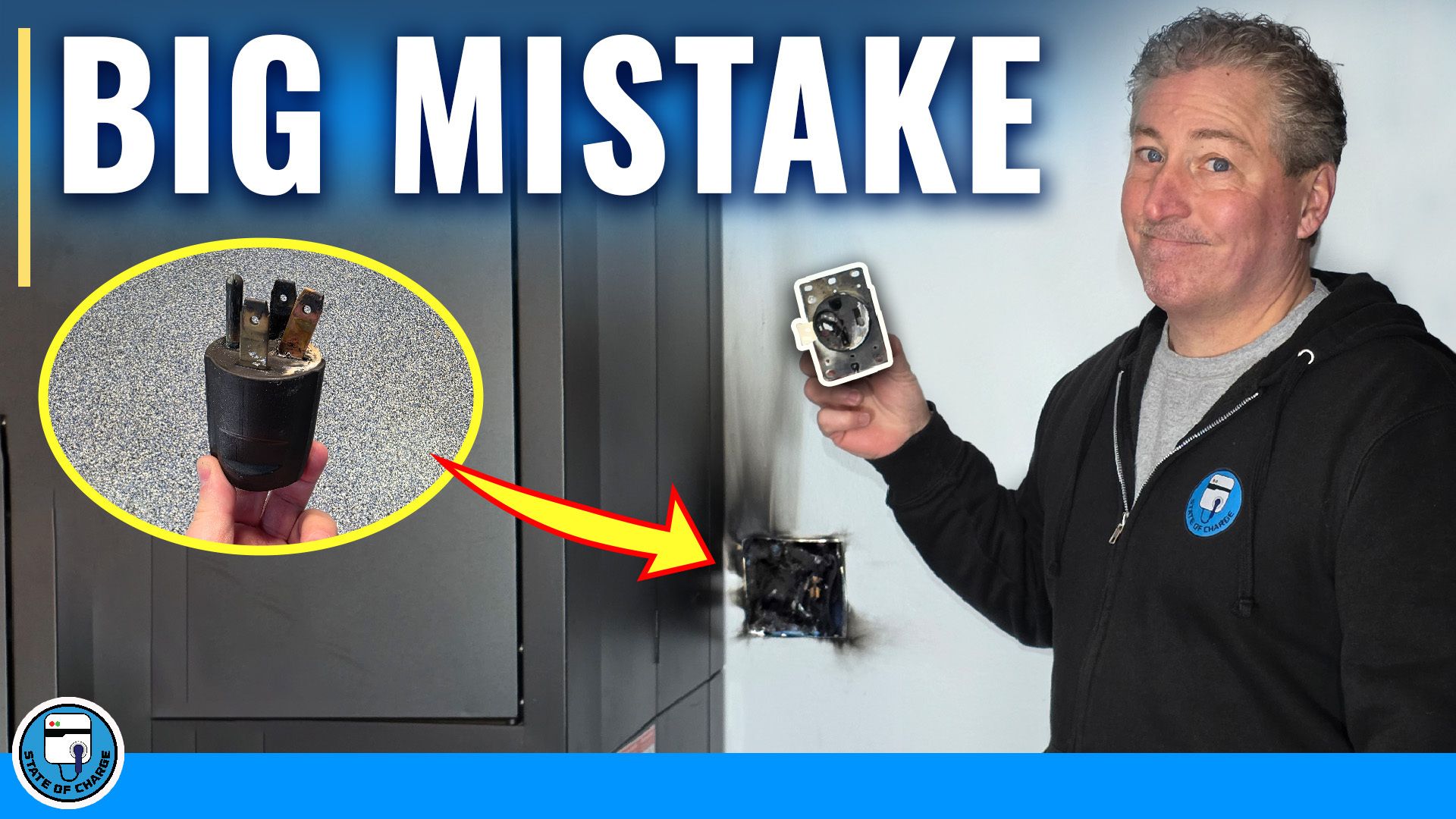
State Of Charge‘s Tom Moloughney recently visited Silver Spring, Maryland, for a new Recharge Rescue project, during which a bunch of dangerous mistakes were discovered. One of them nearly caused a house fire.
The story concerns Brian’s house, where he used two NEMA 14-50 outlets for EV charging in the garage. The issue emerged after years of operation without problems (since 2013, with a check a few years ago).
The Issue
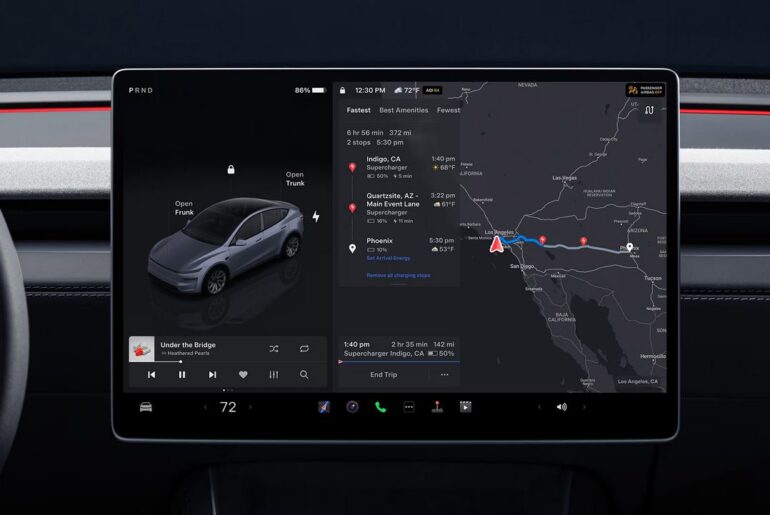
One day, Brian got a Tesla mobile app alert on his phone about a possible electrical fault. Charging a Tesla Model 3 using a portable Tesla Mobile Charger from one of the NEMA 14-50 outlets was reduced due to a high plug temperature.
Brian checked the garage and immediately saw smoke coming from the charging outlet, although no flames. The entire outlet was melted. It seems there was a fire inside the box.

Recharge Rescue Maryland: An alert from the Tesla app. (Image credit: State Of Charge)
Luckily, the alert came during the day when Brian could react. Normally, his EV charges during the night.
Here, we can appreciate Tesla’s temperature sensing and alerts. However, the question is whether charging should stop, or just the power, once a problem occurs? We assume that a complete stop would be a safer default, while power reduction should be an option in the settings.
Usually, when outlets are melting, the reasons are cheap outlets, insufficient to handle the EV charging duty cycle, loose or undersized wires, or a combination of multiple factors.
At Brian’s house, the installation was reportedly done by a master electrician, although it was in the early days of EV adoption, more than 10 years ago, when the specifics of EV charging were not necessarily treated seriously.
There were regular NEMA 14-50 outlets, which are not designed for a long, high-power duty cycle (potentially 10+ hours at 9.6 kW — assuming 40 amps at 240 volts, daily). It’s better to use heavy-duty versions, although they cost 4-5 more. For all those who use plug-in charging solutions, State Of Charge has an example NEMA 14-50 recommendation here (by using the affiliate link, you support the site and channel).
As it turned out, there were other issues too. The 50-amp circuit had an undersized wire (#6 Romex, good for a 40-amp circuit). Additionally, the circuit wasn’t connected directly to the panel but ran from the dryer circuit.
The Solution
State Of Charge, in partnership with Qmerit and its contractor, Salone Solutions, decided to complete an overhaul of the EV charging system, which would not only make charging safer but also increase charging speed.
Emporia supplied Recharge Rescue with two of its outstanding Emporia Pro charging stations (shortlisted among State Of Charge’s top in 2025). The hardwired versions can deliver up to 11.5 kW (48 amps at 240 volts), but they also require a 60-amp circuit. One of the charging stations features a NACS connector, and the other an SAE J1772 connector, which provides flexibility since there are four EVs in the household.
There are no EV charging outlets anymore, as the installation is hardwired. The next step is to replace the undersized wire with a new one. The previous one wasn’t even suitable for supporting a 40-amp charging station. Now, the higher-power charging station requires a 60-amp circuit. The team decided to install a 75-amp #6 MC (Metal Clad) wire directly from the panel. That’s more than enough for EV charging (it can supply 60 amps — 80% of the rating).
Technically speaking, one could stick with a plug-in setup — although the charging would be limited to 9.6 kW (up to 40 amps at 240 volts), a better outlet would be recommended, and a new 50-amp circuit should be installed anyway. The chosen solution is more of an upgrade.
Brian is an experienced EV owner (he also runs the EV OG channel), but he had luck. Looking at the melted outlet, a garage or house fire was near.
Please ensure you have a professionally installed charging circuit, whether it’s plug-in (with high-power duty-cycle NEMA 14-50) or hardwired. As always in life, nothing is guaranteed, and even a master electrician’s work should be inspected.
“Folks, don’t be my next episode — or worse!” — Tom Moloughney