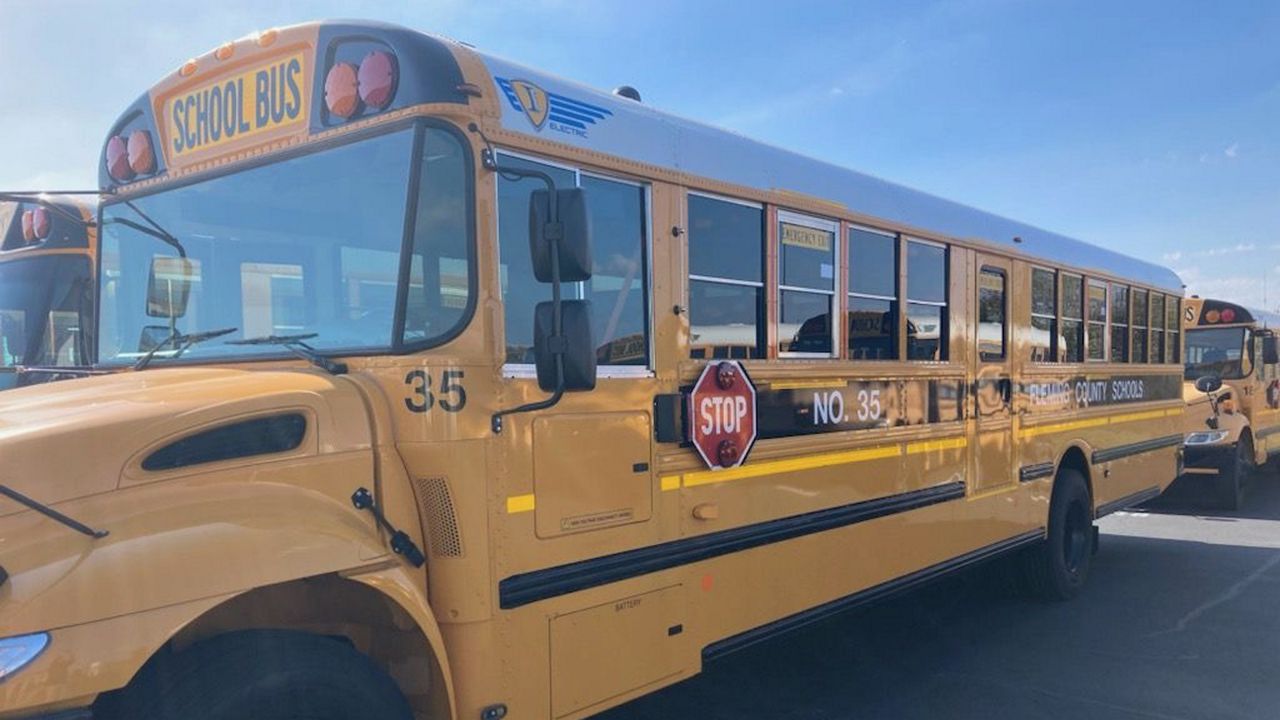
LOUISVILLE, Ky. — Fewer than a dozen of Kentucky’s 171 school districts operate electric school buses.
What You Need To Know
Fleming County Schools operates 24 electric buses, along with three propane and seven diesel buses
Transportation leaders say electric buses cost about 13 cents per mile to run, compared with about 55 cents per mile for diesel
District leaders say the fleet could save about $200,000 a year in transportation costs
The district received about $9.5 million in federal grant funding for the electric buses
Fleming County Schools Transportation Director Kerri Marshall said the electric buses are very quiet.
“Because when diesel buses are running, you can’t hear anything when you’re walking in between the buses. I couldn’t hear anything,” Marshall said.
Marshall said the district’s fleet consists of 24 electric, three propane and seven diesel buses.
“It costs about 13 cents a mile for an electric bus to run. A diesel bus costs about 55 cents a mile,” Marshall said.
The school district applied for the federal Clean School Bus Program in 2021 under the Biden administration and received its first electric bus in April 2024.
“In the 2021-22 school year, we spent roughly $240,000 for diesel and propane together. The next year, when diesel and gas prices increased, we were at $280,000. Then, over 15 months — from August 2024 to November 2025 — we spent $67,000 to operate 17 buses,” Marshall said.
Superintendent Brian Creasman said the investment had school board support, passing on a 5-0 vote.
“It was a 10- to 15-year cost savings for Fleming County Schools to add this number of buses. So that really equates into money we can put right back into the classroom, like we try to do,” Creasman said.
In February, the current administration rolled back the Clean School Bus Program under President Donald Trump’s executive order, ‘Unleashing American Energy.’ The EPA canceled roughly $30 billion in what the administration described as wasteful grants and contracts.
Still, for Fleming County Schools, Marshall said the buses represent an investment in drivers and students.
“We look at it as about a $200,000 savings a year,” Marshall said.
Creasman said the district received about $9.5 million in grant funding for the electric buses.